Text to imageLandscapeStyle guide
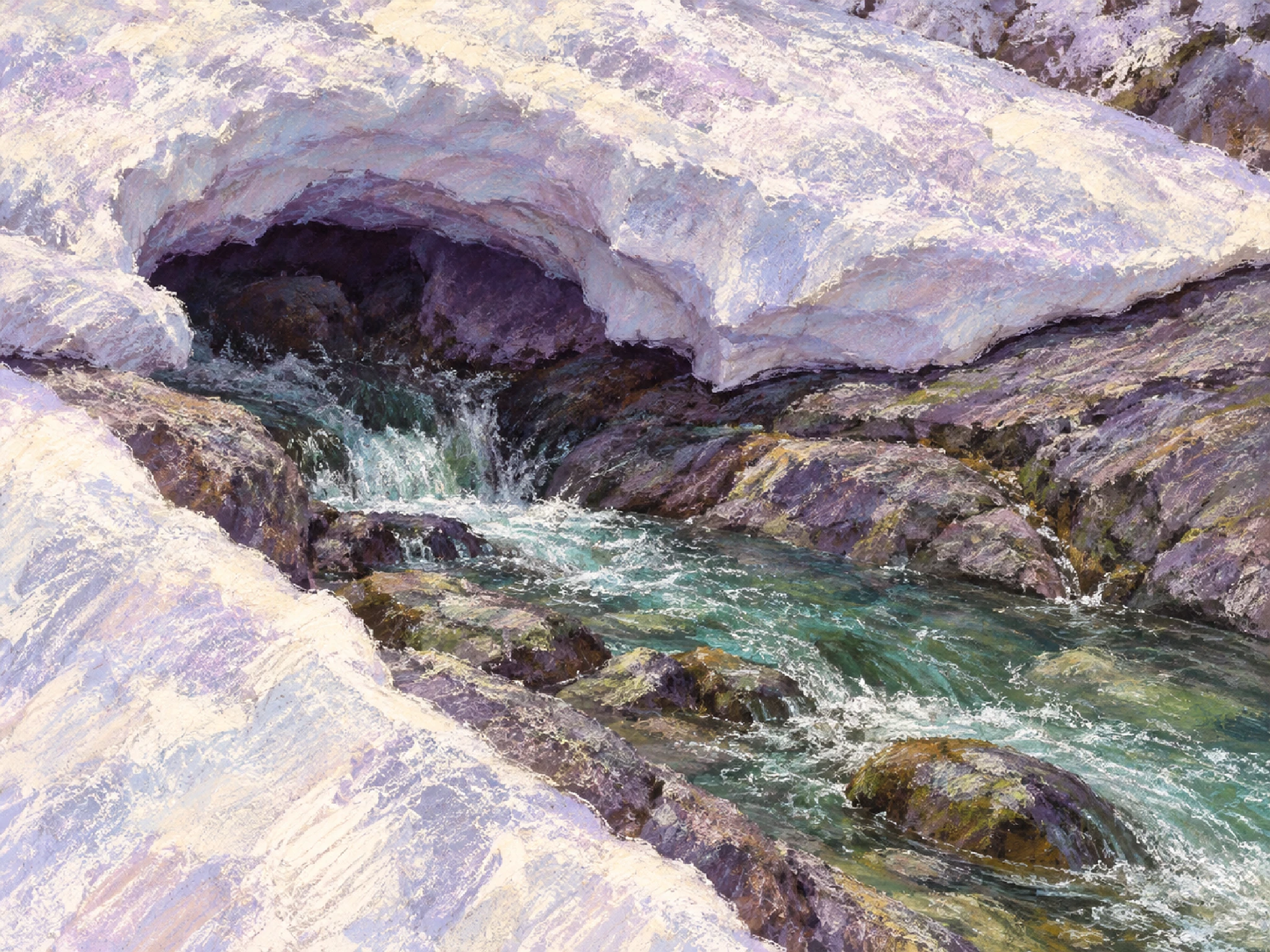
Meltwater Beneath the Snow Shelf
An intimate landscape of meltwater emerging beneath an undercut snow shelf, with rubbed and scratched oil pastel joining the weight of snow to the depth of water.
Remix this referenceMeltwater Beneath the Snow Shelf
- Form language
- Simplify forms into swollen masses and scooped hollows; let small irregularities vary within the same rounded vocabulary.
- Contour
- Let rubbed edges dissolve, interrupted by a few blunt pastel rims; avoid enclosing every form with an outline.
- Mark-making
- Drag oil pastel sideways in broad strokes, rub passages together, and scratch occasional wandering lines through the wax.
- Surface rendering
- Build dreamy tonal transitions from cloudy rubbed layers against dense waxy deposits, allowing earlier marks to show through.
Priority
Make rubbed and scratched oil pastel visibly define the finished image.
What to avoid & what to check
Exact prompt for this example
MODULE OWNERSHIP
subject: Subject count, type, stable proportions and landmarks, resting face geometry, hair shape, physical materials, garment construction and permanent marks. No emotion, movement, color assignment or rendering recipe.
expression: Facial soft-tissue displacement and pupil direction, muscle coordination, regional intensity, asymmetry and onset/peak/release. No head/body pose, stable appearance, skin color or rendering.
gesture: Head/neck/body/limb orientation, joint movement, support, contact and pose-caused occlusion using existing anatomy. No eye/pupil movement, emotion, identity, props inventory or camera.
props: Prop count, type, construction, physical material and scale relative to the subject. Holding/contact belongs to gesture, position to composition, color to palette.
scene: Environment elements, terrain, backdrop/floor presence and structural detail. No canvas positions, camera, lighting, assigned colors or render texture.
camera: Projection, focal-length impression, camera elevation/yaw/roll, viewing distance and crop. No actor pose, world placement, lighting or canvas aspect ratio.
composition: Normalized 0-100% canvas positions, scale in frame, depth/overlap, focal hierarchy and margins. No joint pose, camera projection, rendering, subject/prop inventory or emotion.
palette: Color anchors, hue/saturation/value ranges, colors assigned to parts and approximate color coverage. No illumination direction, shading algorithm, physical material or layout.
lighting: Light-source direction/softness/intensity, ambient illumination, physical shadow direction/length and highlight position. Absence of directional illumination is allowed. No shading technique, palette or material changes.
style: Reusable form abstraction, contour weight/taper/edge quality, medium and mark scale/density/direction, surface rendering and tonal transition technique. No fixed subject proportions, anatomy, identity, expression, pose, palette, light-source direction, camera or layout.
output: Image count, aspect ratio, size, file/alpha requirements and global lettering/logo/watermark restrictions. No background scenery, crop, style, identity or pose.

SUBJECT
inventory: No characters are present.
geometry: No independent subject geometry applies.
resting-face: No faces are present.
appearance: No separate subject appearance applies.

PRIORITY


AVOID


CHECK


PROPS
inventory: No separate props.
construction: No prop construction applies.

PRIORITY


AVOID


CHECK


SCENE
inventory: An undercut snowbank, an exposed meltwater channel, and water-worn bedrock form a mountain ravine detail.
structure: A thick snow lip roofs a hollow; water emerges through its opening and follows a bedrock groove past embedded stones.

PRIORITY


AVOID


CHECK


CAMERA
projection: Natural perspective with a short-telephoto impression and restrained depth expansion.
viewpoint: Look steeply downward from beside the channel, with a slight upstream yaw and level roll.
crop: Use a close landscape detail; cut through the snowbank and rock boundaries, with no horizon visible.

PRIORITY


AVOID


CHECK


COMPOSITION
placement: The snow shelf fills roughly the upper 60%; its opening sits left of center and the channel opens toward the lower right.
depth: The overhang overlaps the recessed opening; the channel connects that recess to the broad foreground.
spacing: Make the hollow the first read, then the water; preserve a broad quiet snow mass against the compressed rock edge.

PRIORITY


AVOID


CHECK


PALETTE
colors: Use pearl, smoked violet, deep plum, and mineral green, with restrained saturation.
assignment: Give snow pearl and violet, the hollow deep plum, water mineral green, and rock muted violet.
balance: Pale values dominate; reserve the deepest values for the hollow and the clearest chroma for exposed water.

PRIORITY


AVOID


CHECK


LIGHTING
sources: Broad, soft daylight arrives from the upper left, with gentle ambient fill inside the ravine.
shadows: The snow lip shelters a deep shadow; exposed stones cast short, soft shadows toward the lower right.
highlights: Keep highlights broad on the snow rim and intermittent on the water facing the light.

PRIORITY


AVOID


CHECK


STYLE GUIDE
form-language: Simplify forms into swollen masses and scooped hollows; let small irregularities vary within the same rounded vocabulary.
contour: Let rubbed edges dissolve, interrupted by a few blunt pastel rims; avoid enclosing every form with an outline.
mark-making: Drag oil pastel sideways in broad strokes, rub passages together, and scratch occasional wandering lines through the wax.
surface-rendering: Build dreamy tonal transitions from cloudy rubbed layers against dense waxy deposits, allowing earlier marks to show through.

PRIORITY
Make rubbed and scratched oil pastel visibly define the finished image.

AVOID


CHECK


OUTPUT
format: One finished image, 4:3 aspect ratio, 2048 × 1536 pixels, opaque PNG.
restrictions: No lettering, logos, signatures, or watermarks.

PRIORITY


AVOID


CHECK


FINAL INTEGRATION
composition + lighting + style: Let the pastel transitions carry the lighting while preserving the composition's distinction between recess and open surface.
Model information comes from image provenance. The same prompt may produce a different result.