Text to imagePortraitStyle guide
Bob-Haired Adult · Selective Rim Lighting
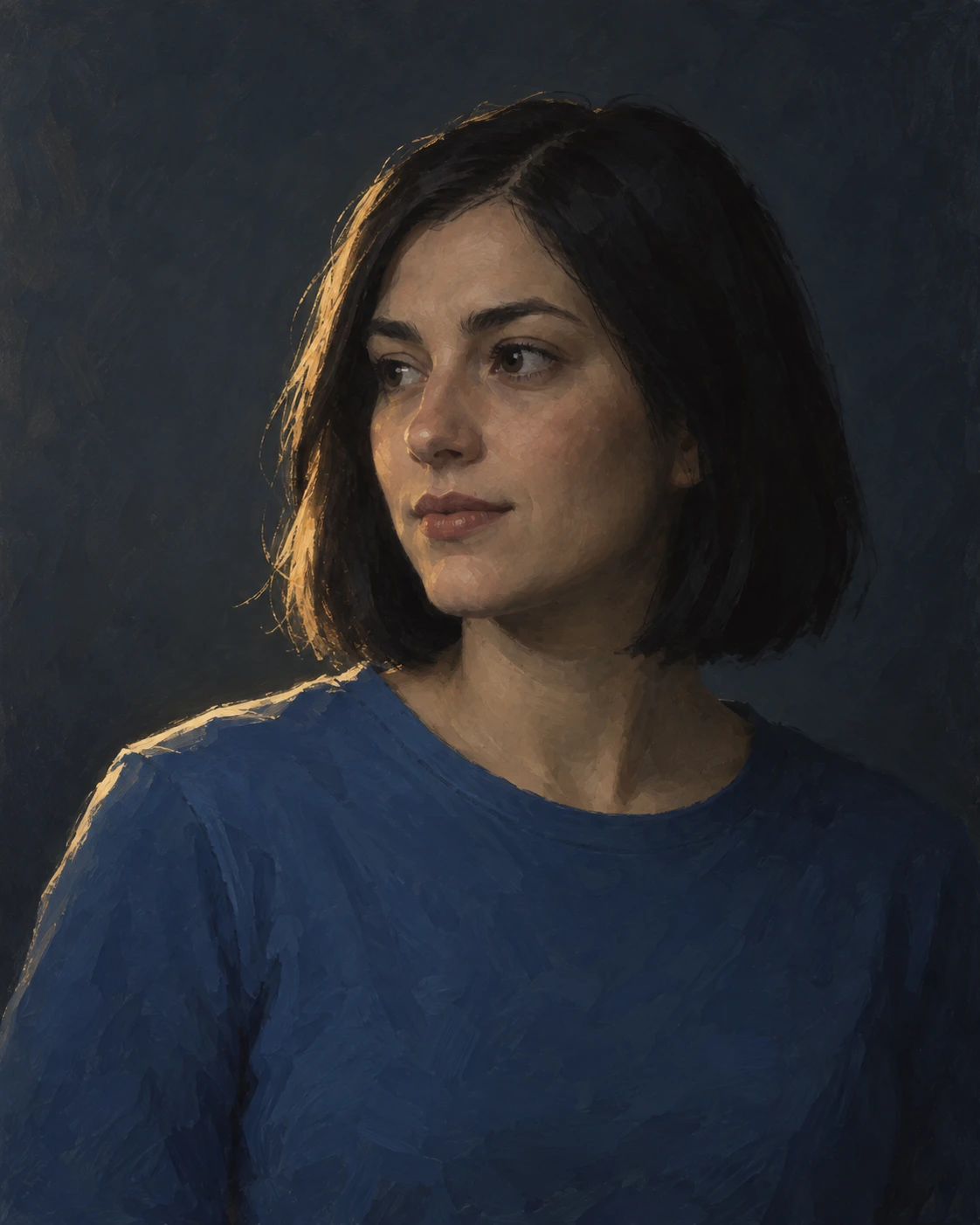
A bob-haired adult against a dark background demonstrates selective rim lighting along the hair and shoulder edges facing a rear light.
Bob-Haired Adult · Selective Rim Lighting
- Shape & line
- Build the head, bob, and shoulders as clear connected masses with natural proportions. Keep the bob's outer contour simple, adding only a few projecting strands on image-left so the illuminated edge follows a readable hair silhouette.
- Color & light
- Place a warm light behind the adult on image-left, outside the frame. Let it skim the image-left outer hair edge and the upper edge of the image-left shoulder, breaking where the hair blocks it. Keep the image-right contour unlit; use weak frontal fill to reveal the face at a lower brightness than the rim.
- Texture & material
- Use opaque gouache with broad matte strokes across skin and shirt. Paint the hair as a dark solid mass with a few grouped strokes; reserve small warm strokes for the lit edge, keeping skin highlights soft and the shirt's shoulder rim broader and duller than the hair rim.
- Composition
- Keep the background a quiet deep blue-gray, especially behind the image-left lit contour. Separate the face through restrained value changes, leaving the eyes readable without sharp white accents; guide attention from the bright hair edge inward to the expression.
Priority
Make the broken image-left rim and the softly readable face the clearest relationship.
What to avoid & what to check
Avoid a continuous glowing outline, a bright frontal face, or evenly highlighted hair strands.
Check that the rear-left light visibly catches only exposed left edges while the right contour stays dark.
Exact prompt for this example
SUBJECT
One adult with a straight dark bob and a plain blue shirt, wearing a calm expression. The head turns slightly toward image-left; the hair falls beside the cheeks and rests just above the shoulders.

COMPOSITION
An eye-level, chest-up portrait in a vertical 4:5 frame. Place the adult slightly right of center with breathing room above the hair and a plain dark background visible around both shoulders.

STYLE GUIDE
1. Shape & line
Build the head, bob, and shoulders as clear connected masses with natural proportions. Keep the bob's outer contour simple, adding only a few projecting strands on image-left so the illuminated edge follows a readable hair silhouette.

2. Color & light
Place a warm light behind the adult on image-left, outside the frame. Let it skim the image-left outer hair edge and the upper edge of the image-left shoulder, breaking where the hair blocks it. Keep the image-right contour unlit; use weak frontal fill to reveal the face at a lower brightness than the rim.

3. Texture & material
Use opaque gouache with broad matte strokes across skin and shirt. Paint the hair as a dark solid mass with a few grouped strokes; reserve small warm strokes for the lit edge, keeping skin highlights soft and the shirt's shoulder rim broader and duller than the hair rim.

4. Composition
Keep the background a quiet deep blue-gray, especially behind the image-left lit contour. Separate the face through restrained value changes, leaving the eyes readable without sharp white accents; guide attention from the bright hair edge inward to the expression.

PRIORITY
Preserve the requested identity, count, action, composition and output settings. Apply the style rules within those constraints; a style reference must not replace the subject or layout. Within the style: Make the broken image-left rim and the softly readable face the clearest relationship.

AVOID
Avoid a continuous glowing outline, a bright frontal face, or evenly highlighted hair strands.

OUTPUT
One painted portrait image, vertical 4:5 aspect ratio, with no lettering, captions, logos, or watermark.

SELF-CHECK
Check that the rear-left light visibly catches only exposed left edges while the right contour stays dark.
Model information comes from image provenance. The same prompt may produce a different result.