Text to imageCafe & brandStyle guide
Bending the Chair Back
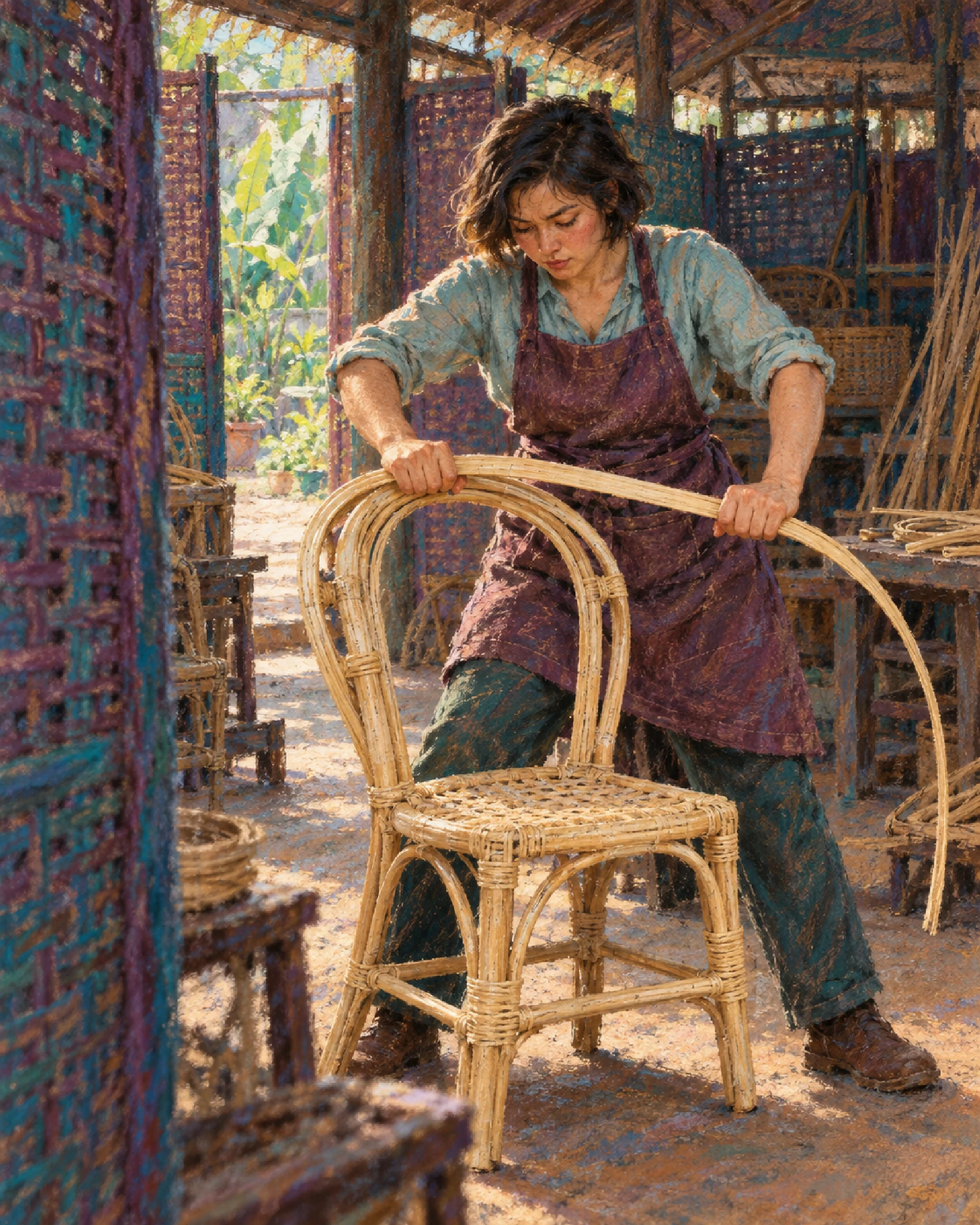
Among layered woven screens, an artisan bends a rattan strip to fit a chair back. Rubbed and scratched oil pastel surrounds a tactile moment of furniture making.
Remix this referenceBending the Chair Back
- Form language
- Simplify forms into gently swelling masses and elastic arcs; permit handmade variations without dissolving recognizable construction.
- Contour
- Let edges alternate between rubbed disappearance and thick waxy ridges; reserve thin scratched contours for selective clarification.
- Mark-making
- Drag broad pastel strokes, rub them with uneven pressure and scratch through selected passages so earlier layers reappear.
- Surface rendering
- Fuse rubbed tonal pools with broken opaque deposits, allowing hazy transitions to meet occasional crisp wax-built edges.
Priority
Keep the dreamlike oil pastel visibly rubbed, layered and scratched rather than uniformly blended.
What to avoid & what to check
Exact prompt for this example
MODULE OWNERSHIP
subject: Subject count, type, stable proportions and landmarks, resting face geometry, hair shape, physical materials, garment construction and permanent marks. No emotion, movement, color assignment or rendering recipe.
expression: Facial soft-tissue displacement and pupil direction, muscle coordination, regional intensity, asymmetry and onset/peak/release. No head/body pose, stable appearance, skin color or rendering.
gesture: Head/neck/body/limb orientation, joint movement, support, contact and pose-caused occlusion using existing anatomy. No eye/pupil movement, emotion, identity, props inventory or camera.
props: Prop count, type, construction, physical material and scale relative to the subject. Holding/contact belongs to gesture, position to composition, color to palette.
scene: Environment elements, terrain, backdrop/floor presence and structural detail. No canvas positions, camera, lighting, assigned colors or render texture.
camera: Projection, focal-length impression, camera elevation/yaw/roll, viewing distance and crop. No actor pose, world placement, lighting or canvas aspect ratio.
composition: Normalized 0-100% canvas positions, scale in frame, depth/overlap, focal hierarchy and margins. No joint pose, camera projection, rendering, subject/prop inventory or emotion.
palette: Color anchors, hue/saturation/value ranges, colors assigned to parts and approximate color coverage. No illumination direction, shading algorithm, physical material or layout.
lighting: Light-source direction/softness/intensity, ambient illumination, physical shadow direction/length and highlight position. Absence of directional illumination is allowed. No shading technique, palette or material changes.
style: Reusable form abstraction, contour weight/taper/edge quality, medium and mark scale/density/direction, surface rendering and tonal transition technique. No fixed subject proportions, anatomy, identity, expression, pose, palette, light-source direction, camera or layout.
output: Image count, aspect ratio, size, file/alpha requirements and global lettering/logo/watermark restrictions. No background scenery, crop, style, identity or pose.

SUBJECT
inventory: A is one original adult woman working as a furniture artisan.
geometry: She has a sturdy ordinary build, broad cheekbones, a rounded nose and a softly indented chin.
resting-face: Her resting face has straight brows, slightly hooded eyes and a broad mouth with level corners.
appearance: A short uneven bob accompanies a collarless linen shirt with rolled sleeves and a heavy canvas apron.

PRIORITY


AVOID


CHECK


EXPRESSION — ACTOR A
brows: Inner brows draw slightly inward and down, with a small uneven crease.
lids: Upper lids narrow slightly; lower lids remain firm without a hard squint.
cheeks: Cheeks stay mostly relaxed, with faint tension beside the mouth.
nose: Nostrils remain at rest, without flaring or wrinkling.
mouth: Lips press gently together, with one corner tucked slightly inward.
jaw: The jaw stays closed with mild muscular firmness.
gaze: Both pupils aim downward toward the bending strip.
coordination: Brow tension leads; mouth tension stays quieter and slightly asymmetric.
timing: Hold the apex of quiet concentration without a developing grimace.

PRIORITY


AVOID


CHECK


GESTURE
head: A lowers her chin slightly and inclines her neck toward the work.
torso: She hinges forward at the hips with a grounded stance and a gentle twist through the shoulders.
limbs: Her elbows spread as both forearms draw inward, making the bending effort broad and readable.
contact: Both hands grip opposite ends of the strip; one thigh steadies the chair while both feet support her weight.

PRIORITY


AVOID


CHECK


PROPS
inventory: One unfinished rattan chair and one separate flexible cane strip long enough to span its back.
construction: The chair has an open oval back and a woven seat; the strip is broad, flat and naturally fibrous.

PRIORITY


AVOID


CHECK


SCENE
inventory: A reed-roofed furniture workshop with fixed woven partitions, an earthen floor and a planted courtyard beyond a doorway.
structure: Staggered partitions create connected work bays beneath exposed rafters; the doorway opens between two screens.

PRIORITY


AVOID


CHECK


CAMERA
projection: Use a natural normal-lens perspective with gentle spatial recession.
viewpoint: View from slightly above seated eye height at a three-quarter angle, with no camera roll.
crop: Use an environmental full-figure view that includes the complete chair while allowing peripheral screens to be cropped.

PRIORITY


AVOID


CHECK


COMPOSITION
placement: Place A just right of center, with the chair below her and the hands forming the strongest visual knot.
depth: A cropped foreground screen overlaps the left edge; the working pair sits between it and successive rear partitions.
spacing: Leave a clear pocket around the hands and curved strip; let the surrounding layers remain close and immersive.

PRIORITY


AVOID


CHECK


PALETTE
colors: Use deep petrol teal, muted plum, apricot and pale straw, with small areas of near-black.
assignment: Give screens teal and plum, cane pale straw, skin apricot, the shirt pale teal and the apron deep plum.
balance: Let subdued dark hues occupy most of the setting, with a connected pale-straw and apricot accent through the working area.

PRIORITY


AVOID


CHECK


LIGHTING
sources: Soft daylight enters from a high opening on the left, with subdued ambient illumination deeper inside.
shadows: Broad shadows fall to the right and gather gently beneath the chair and between partitions.
highlights: Soft highlights touch the left-facing cheek, upper hands and the upper edge of the curved strip.

PRIORITY


AVOID


CHECK


STYLE GUIDE
form-language: Simplify forms into gently swelling masses and elastic arcs; permit handmade variations without dissolving recognizable construction.
contour: Let edges alternate between rubbed disappearance and thick waxy ridges; reserve thin scratched contours for selective clarification.
mark-making: Drag broad pastel strokes, rub them with uneven pressure and scratch through selected passages so earlier layers reappear.
surface-rendering: Fuse rubbed tonal pools with broken opaque deposits, allowing hazy transitions to meet occasional crisp wax-built edges.

PRIORITY
Keep the dreamlike oil pastel visibly rubbed, layered and scratched rather than uniformly blended.

AVOID


CHECK


OUTPUT
format: One finished image, 4:5 aspect ratio, 1600 × 2000 pixels, opaque PNG.
restrictions: No lettering, logos or watermarks.

PRIORITY


AVOID


CHECK


FINAL INTEGRATION
expression + gesture + props: Coordinate facial effort and hand contact as one held moment of making.
composition + style: Let changing edge clarity support the established focal hierarchy without flattening the layered setting.
Model information comes from image provenance. The same prompt may produce a different result.