Text to imageCharacterStyle guide
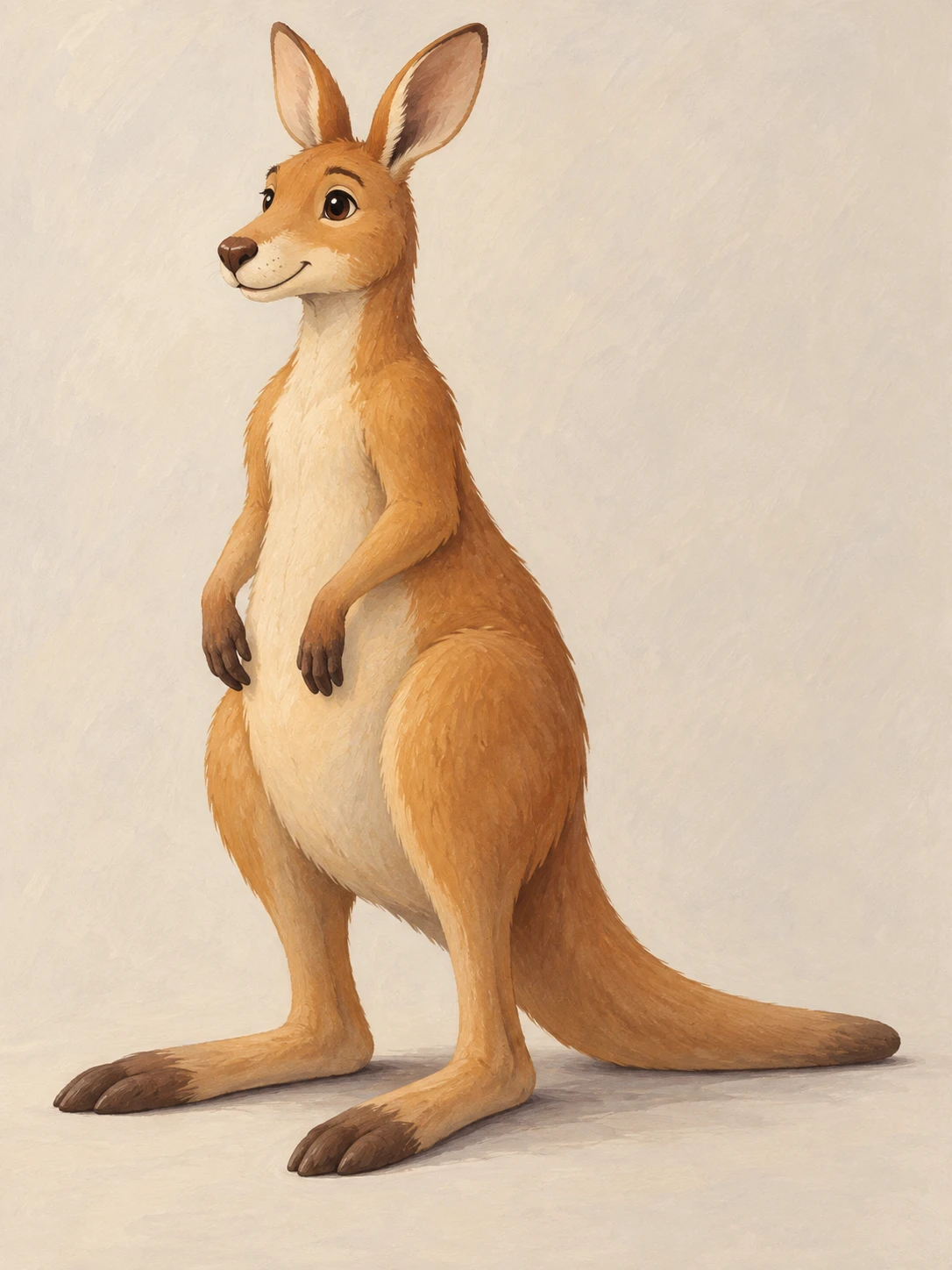
Resting Kangaroo · Three-Point Support
Show a character’s weight and stability through a resting pose supported by two feet and its tail.
Resting Kangaroo · Three-Point Support
- Shape & line
- Build the torso as a rounded upright mass over broad haunches, and draw the tail thick at its root, sloping down toward image-right before resting along the floor. Give each long foot a visibly flattened underside; let the tail’s lower contour flatten at its separate rear contact so the pose reads as a three-point support.
- Color & light
- Use warm ochre fur, a pale cream belly, and muted brown outlines. Light the upper-left-facing surfaces softly from image-upper-left, then place short, darker shadows directly beneath both feet and the grounded tail segment; extend their softer edges toward image-lower-right.
- Texture & material
- Render the character in opaque gouache with broad matte color areas and a little visible brush grain. Add only a few short fur strokes along the cheeks and outer haunches, keeping the feet and tail contact contours crisp enough to show where the soft body presses against the ground.
- Composition
- Arrange the two feet and rear tail contact as a broad triangular footprint in the image plane, with the belly visually centered above that base. Leave a small background gap between the feet and another between the rear haunch and descending tail, so each support remains readable at thumbnail size.
Priority
Make the three grounded supports and the settled body weight immediately readable.
What to avoid & what to check
Avoid a floating tail, tiptoe feet, or overlapping contacts that hide the support arrangement.
At thumbnail size, confirm that both feet and the rear tail visibly meet the same ground plane.
Exact prompt for this example
SUBJECT
One original kangaroo character resting upright, with both long hind feet and the lower portion of its thick tail touching the same ground plane. Its short forearms hang loosely in front of its belly, and its relaxed face has upright ears and a small closed smile.

COMPOSITION
Show the entire character in a three-quarter view, facing image-left. Place both hind feet toward the lower-left and lower-center of the image; extend the tail behind the body toward the lower-right. Keep all three support contacts visible, with generous plain background around the ears and tail.

STYLE GUIDE
1. Shape & line
Build the torso as a rounded upright mass over broad haunches, and draw the tail thick at its root, sloping down toward image-right before resting along the floor. Give each long foot a visibly flattened underside; let the tail’s lower contour flatten at its separate rear contact so the pose reads as a three-point support.

2. Color & light
Use warm ochre fur, a pale cream belly, and muted brown outlines. Light the upper-left-facing surfaces softly from image-upper-left, then place short, darker shadows directly beneath both feet and the grounded tail segment; extend their softer edges toward image-lower-right.

3. Texture & material
Render the character in opaque gouache with broad matte color areas and a little visible brush grain. Add only a few short fur strokes along the cheeks and outer haunches, keeping the feet and tail contact contours crisp enough to show where the soft body presses against the ground.

4. Composition
Arrange the two feet and rear tail contact as a broad triangular footprint in the image plane, with the belly visually centered above that base. Leave a small background gap between the feet and another between the rear haunch and descending tail, so each support remains readable at thumbnail size.

PRIORITY
Preserve the requested identity, count, action, composition and output settings. Apply the style rules within those constraints; a style reference must not replace the subject or layout. Within the style: Make the three grounded supports and the settled body weight immediately readable.

AVOID
Avoid a floating tail, tiptoe feet, or overlapping contacts that hide the support arrangement.

OUTPUT
Create one portrait-format 3:4 character illustration with no lettering, captions, logos, or watermark.

SELF-CHECK
At thumbnail size, confirm that both feet and the rear tail visibly meet the same ground plane.
Model information comes from image provenance. The same prompt may produce a different result.