Text to imageIllustrationStyle guide
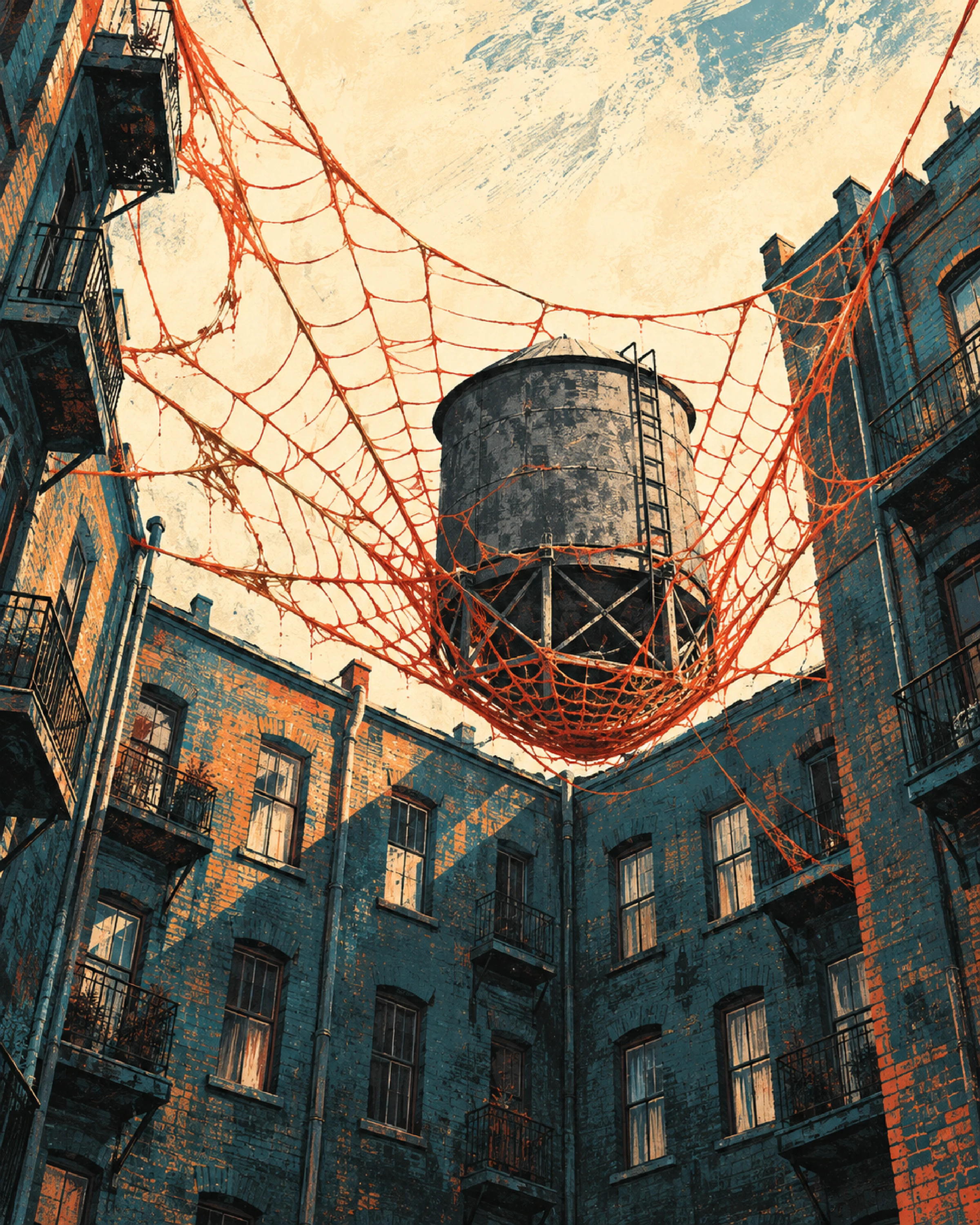
A Water Tank Caught in a Giant Web
A courtyard-sized spiderweb catches a fallen rooftop water tank. Bowed vermilion strands meet heavy apartment blocks through dragged ink and slipping print layers in an experimental poster illustration.
Remix this referenceA Water Tank Caught in a Giant Web
- Form language
- Compress forms into blunt, slightly skewed masses and elastic sweeping bands; simplify small details into interrupted rhythmic marks.
- Contour
- Alternate broad dry-brush edges with fine trailing lines; let contours break, feather, and occasionally merge into adjacent masses.
- Mark-making
- Combine dragged brush strokes with uneven brayer scuffs and lightly slipped print impressions; vary pressure and interruption naturally.
- Surface rendering
- Build tones through translucent overprints, pooled ink, and exposed paper; use broken transitions rather than uniformly smooth modeling.
Priority
Keep the experimental ink-and-print process visibly present in the finished poster illustration.
What to avoid & what to check
Exact prompt for this example
MODULE OWNERSHIP
subject: Subject count, type, stable proportions and landmarks, resting face geometry, hair shape, physical materials, garment construction and permanent marks. No emotion, movement, color assignment or rendering recipe.
expression: Facial soft-tissue displacement and pupil direction, muscle coordination, regional intensity, asymmetry and onset/peak/release. No head/body pose, stable appearance, skin color or rendering.
gesture: Head/neck/body/limb orientation, joint movement, support, contact and pose-caused occlusion using existing anatomy. No eye/pupil movement, emotion, identity, props inventory or camera.
props: Prop count, type, construction, physical material and scale relative to the subject. Holding/contact belongs to gesture, position to composition, color to palette.
scene: Environment elements, terrain, backdrop/floor presence and structural detail. No canvas positions, camera, lighting, assigned colors or render texture.
camera: Projection, focal-length impression, camera elevation/yaw/roll, viewing distance and crop. No actor pose, world placement, lighting or canvas aspect ratio.
composition: Normalized 0-100% canvas positions, scale in frame, depth/overlap, focal hierarchy and margins. No joint pose, camera projection, rendering, subject/prop inventory or emotion.
palette: Color anchors, hue/saturation/value ranges, colors assigned to parts and approximate color coverage. No illumination direction, shading algorithm, physical material or layout.
lighting: Light-source direction/softness/intensity, ambient illumination, physical shadow direction/length and highlight position. Absence of directional illumination is allowed. No shading technique, palette or material changes.
style: Reusable form abstraction, contour weight/taper/edge quality, medium and mark scale/density/direction, surface rendering and tonal transition technique. No fixed subject proportions, anatomy, identity, expression, pose, palette, light-source direction, camera or layout.
output: Image count, aspect ratio, size, file/alpha requirements and global lettering/logo/watermark restrictions. No background scenery, crop, style, identity or pose.

SUBJECT
inventory: One enormous spiderweb; no spider or other creature.
geometry: A radial web large enough to cradle a rooftop tank, with irregular spiral bands and a deeply bowed central pocket.
resting-face: No face or facial landmarks apply.
appearance: Silk strands gather into thicker junctions; torn outer sectors and uneven strand spacing may vary naturally.

PRIORITY


AVOID


CHECK


GESTURE
head: No head or neck control targets apply.
torso: The web hangs from its outer attachments, with its central pocket bowed downward.
limbs: No limb or joint control targets apply.
contact: The web's central pocket supports the tank from underneath; outer strands attach to the surrounding buildings.

PRIORITY


AVOID


CHECK


PROPS
inventory: One ordinary rooftop water tank, substantially smaller than the full web.
construction: A cylindrical steel tank with a shallow domed lid, attached access ladder, and buckled supporting frame.

PRIORITY


AVOID


CHECK


SCENE
inventory: An empty apartment courtyard with brick facades, balconies, drainpipes, paved ground, and open sky.
structure: Repeated domestic windows establish ordinary building scale; an incomplete rooftop tank plinth suggests the accident.

PRIORITY


AVOID


CHECK


CAMERA
projection: Broad wide-angle perspective with readable architectural convergence.
viewpoint: Look obliquely upward from courtyard level, with a level horizon and no camera roll.
crop: Show the entire tank and central web pocket; crop outer web radii and portions of the surrounding buildings.

PRIORITY


AVOID


CHECK


COMPOSITION
placement: The web sweeps across most of the frame; its tank-filled pocket hangs below and right of center.
depth: Facades recede behind the web; strands overlap both the front and rear of the tank.
spacing: Make the tank-web junction the first read, then the windows; leave an uneven opening of sky above the pocket.

PRIORITY


AVOID


CHECK


PALETTE
colors: Warm ivory, deep petrol teal, burnt vermilion, and soot gray form a restricted palette.
assignment: Use ivory for sky and paper reserves, petrol teal for buildings, vermilion for silk, and soot gray for the tank.
balance: Muted dark architecture carries most of the color mass; the stronger vermilion gives the web its unusual presence.

PRIORITY


AVOID


CHECK


LIGHTING
sources: Broad afternoon light enters from upper left, supported by soft courtyard ambient light.
shadows: Balconies cast long, softened shadows down and right; the tank's underside remains substantially darker.
highlights: Broad highlights touch the tank's upper-left shoulder and the upper-facing strand junctions.

PRIORITY


AVOID


CHECK


STYLE GUIDE
form-language: Compress forms into blunt, slightly skewed masses and elastic sweeping bands; simplify small details into interrupted rhythmic marks.
contour: Alternate broad dry-brush edges with fine trailing lines; let contours break, feather, and occasionally merge into adjacent masses.
mark-making: Combine dragged brush strokes with uneven brayer scuffs and lightly slipped print impressions; vary pressure and interruption naturally.
surface-rendering: Build tones through translucent overprints, pooled ink, and exposed paper; use broken transitions rather than uniformly smooth modeling.

PRIORITY
Keep the experimental ink-and-print process visibly present in the finished poster illustration.

AVOID


CHECK


OUTPUT
format: One portrait image, 4:5 aspect ratio, 2400 × 3000 pixels, opaque PNG.
restrictions: No lettering, logos, signatures, or watermarks.

PRIORITY


AVOID


CHECK
Model information comes from image provenance. The same prompt may produce a different result.