Text to imageArt stylesStyle guide
Sand in the Amphitheater
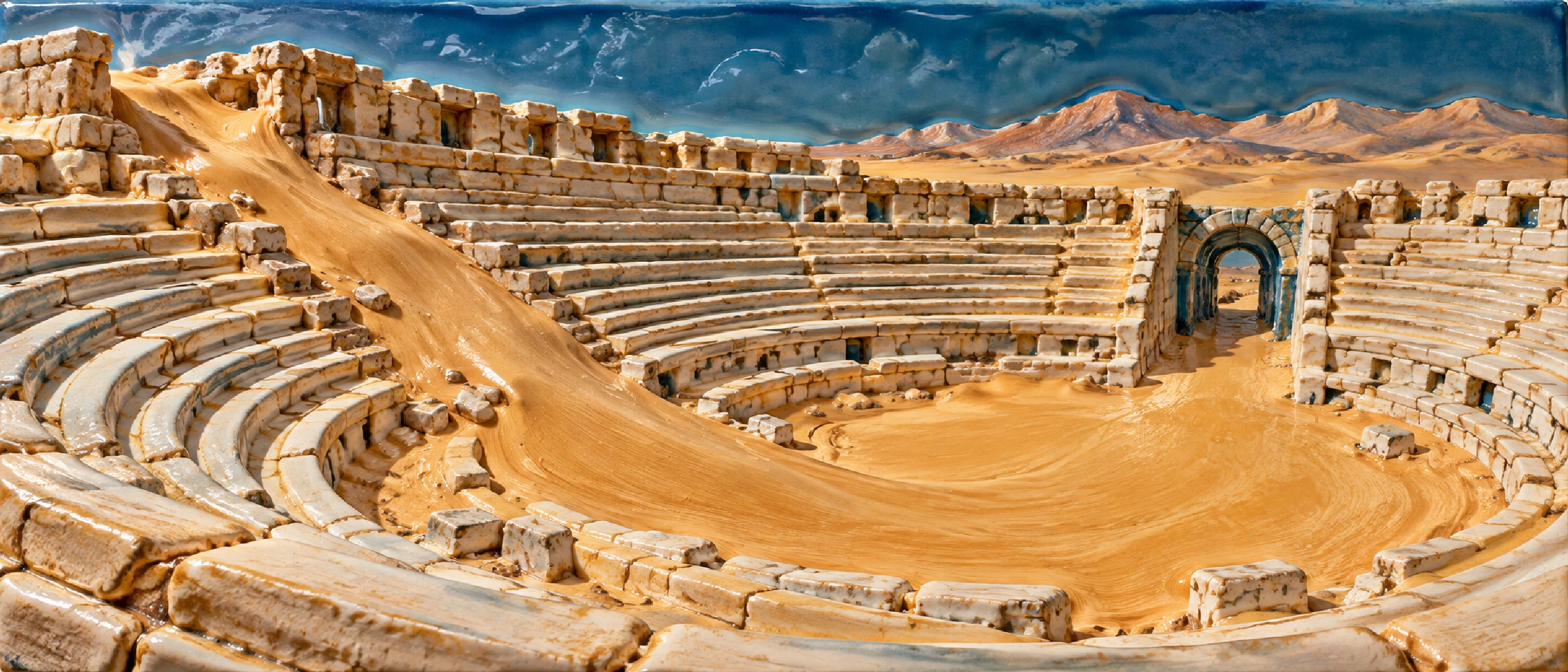
A dune crosses the tiers of an abandoned amphitheater and reaches its arena. Rounded ceramic relief and glaze gathered in grooves give the panoramic landscape tactile depth.
Remix this referenceSand in the Amphitheater
- Form language
- Translate large shapes into hand-modeled ceramic relief: rounded shelves, shallow basins and softened wedges with irregular handmade transitions.
- Contour
- Let raised lips and shallow incisions define edges; vary their firmness and occasionally merge adjacent boundaries without drawn outlines.
- Mark-making
- Use broad thumb-smoothed passages interrupted by loose curved tool traces; let small irregularities vary naturally across the relief.
- Surface rendering
- Model glossy glaze as translucent pools in grooves and thinner veils over crests; keep gentle tonal swells and occasional softly mottled patches.
Priority
The image must visibly read as modeled, glazed ceramic relief.
What to avoid & what to check
Exact prompt for this example
MODULE OWNERSHIP
subject: Subject count, type, stable proportions and landmarks, resting face geometry, hair shape, physical materials, garment construction and permanent marks. No emotion, movement, color assignment or rendering recipe.
expression: Facial soft-tissue displacement and pupil direction, muscle coordination, regional intensity, asymmetry and onset/peak/release. No head/body pose, stable appearance, skin color or rendering.
gesture: Head/neck/body/limb orientation, joint movement, support, contact and pose-caused occlusion using existing anatomy. No eye/pupil movement, emotion, identity, props inventory or camera.
props: Prop count, type, construction, physical material and scale relative to the subject. Holding/contact belongs to gesture, position to composition, color to palette.
scene: Environment elements, terrain, backdrop/floor presence and structural detail. No canvas positions, camera, lighting, assigned colors or render texture.
camera: Projection, focal-length impression, camera elevation/yaw/roll, viewing distance and crop. No actor pose, world placement, lighting or canvas aspect ratio.
composition: Normalized 0-100% canvas positions, scale in frame, depth/overlap, focal hierarchy and margins. No joint pose, camera projection, rendering, subject/prop inventory or emotion.
palette: Color anchors, hue/saturation/value ranges, colors assigned to parts and approximate color coverage. No illumination direction, shading algorithm, physical material or layout.
lighting: Light-source direction/softness/intensity, ambient illumination, physical shadow direction/length and highlight position. Absence of directional illumination is allowed. No shading technique, palette or material changes.
style: Reusable form abstraction, contour weight/taper/edge quality, medium and mark scale/density/direction, surface rendering and tonal transition technique. No fixed subject proportions, anatomy, identity, expression, pose, palette, light-source direction, camera or layout.
output: Image count, aspect ratio, size, file/alpha requirements and global lettering/logo/watermark restrictions. No background scenery, crop, style, identity or pose.

SUBJECT
inventory: No discrete figures or standalone subjects; the architecture and sand belong to the environment.
geometry: No separate subject proportions or landmarks apply.
resting-face: No faces are present.
appearance: No subject-specific garments, hair or permanent marks apply.

PRIORITY


AVOID


CHECK


PROPS
inventory: No separate props.
construction: No prop construction applies.

PRIORITY


AVOID


CHECK


SCENE
inventory: An abandoned open-air limestone amphitheater, encroaching dunes, a roofless entrance passage and distant desert ridges.
structure: A broad sand ramp links a breached seating rim to the arena; exposed tiers and a narrow passage preserve the theater's curved structure.

PRIORITY


AVOID


CHECK


CAMERA
projection: Gently flattened perspective with a moderate wide-angle impression and restrained depth convergence.
viewpoint: An elevated oblique view looks across the seating bowl; keep the camera level in roll.
crop: A panoramic view includes the arena, much of the rim and a shallow band of distant terrain; crop some near tiers at the bottom.

PRIORITY


AVOID


CHECK


COMPOSITION
placement: The sand breach begins near the left fifth; its broad curve leads through the lower middle toward a small passage in the right third.
depth: Overlapping tiers frame the arena; the distant ridges remain subordinate to the continuous sand route.
spacing: Give the arena a generous quiet opening and leave breathing room above the far rim.

PRIORITY


AVOID


CHECK


PALETTE
colors: Use honey ochre, chalk ivory, petrol blue and a small amount of dusty apricot.
assignment: Ochre belongs to sand, ivory to exposed stone, petrol blue to the sky and passage interior, and apricot to distant ridges.
balance: Warm pale colors dominate; the blue provides a few deep pauses without overpowering the sand.

PRIORITY


AVOID


CHECK


LIGHTING
sources: Broad low daylight enters from the upper left with gentle ambient fill.
shadows: Tier shadows extend to the right with softened ends; recesses retain readable darkness.
highlights: Highlights rest on upper-left ridges and broad raised crests, with only a few concentrated glints.

PRIORITY


AVOID


CHECK


STYLE GUIDE
form-language: Translate large shapes into hand-modeled ceramic relief: rounded shelves, shallow basins and softened wedges with irregular handmade transitions.
contour: Let raised lips and shallow incisions define edges; vary their firmness and occasionally merge adjacent boundaries without drawn outlines.
mark-making: Use broad thumb-smoothed passages interrupted by loose curved tool traces; let small irregularities vary naturally across the relief.
surface-rendering: Model glossy glaze as translucent pools in grooves and thinner veils over crests; keep gentle tonal swells and occasional softly mottled patches.

PRIORITY
The image must visibly read as modeled, glazed ceramic relief.

AVOID


CHECK


OUTPUT
format: One finished image, 21:9 aspect ratio, 2520 × 1080 pixels, opaque PNG.
restrictions: No lettering, logos, signatures or watermarks.

PRIORITY


AVOID


CHECK


FINAL INTEGRATION
scene + composition + style: The environmental structure supplies a readable journey, while the relief treatment gives each transition a tactile continuity.
Model information comes from image provenance. The same prompt may produce a different result.