Text to imageCafe & brandStyle guide
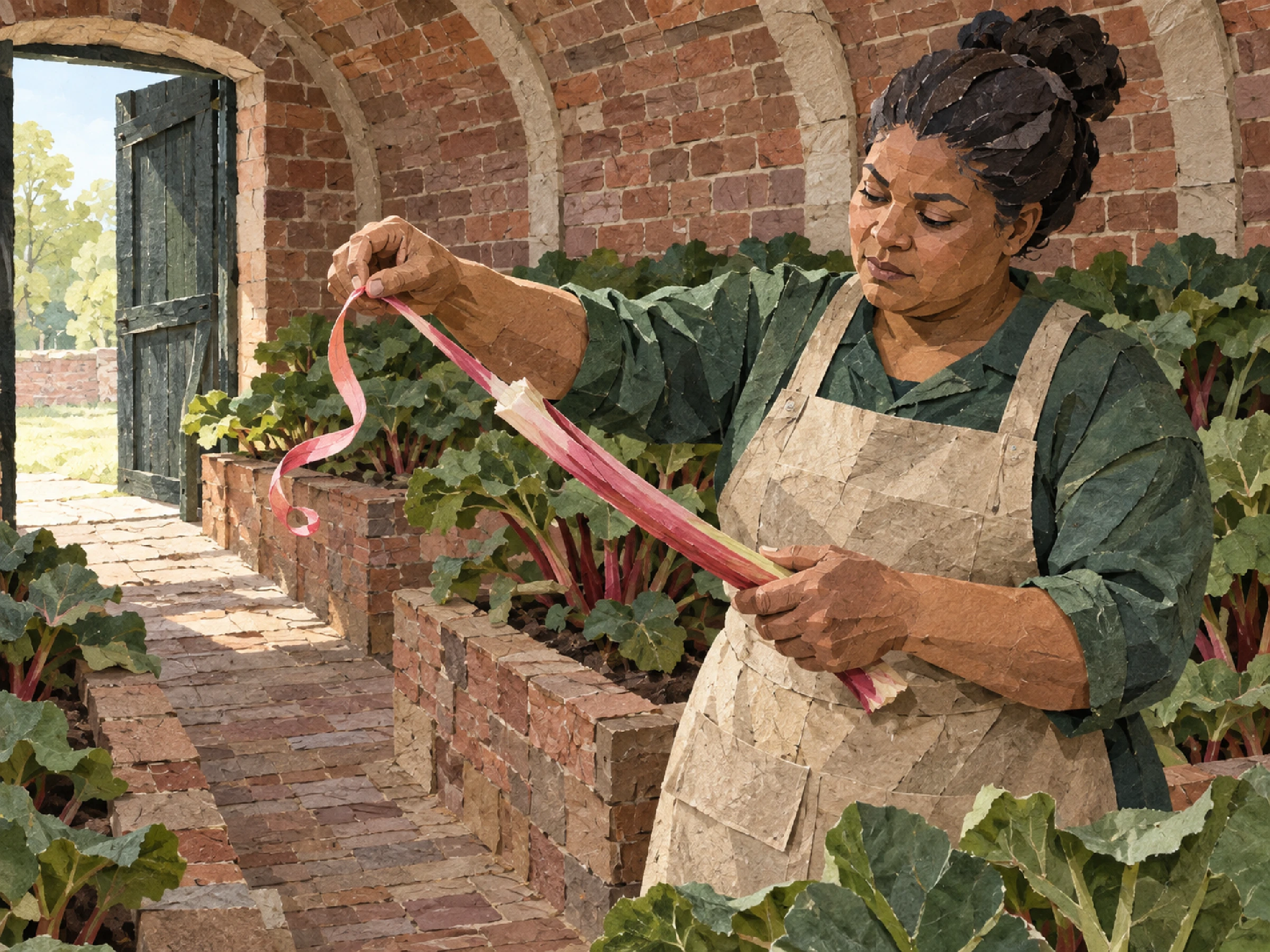
Peeling Rhubarb in the Forcing Shed
A woman draws a long peel from a rhubarb stalk inside a layered forcing shed. Lifted paper edges and curling pieces turn the harvest into tactile campaign artwork for a seasonal food brand.
Remix this referencePeeling Rhubarb in the Forcing Shed
- Form language
- Build forms from broad cut silhouettes and a few folded inserts; allow small shape variations within a consistent handmade vocabulary.
- Contour
- Mix decisive scissor curves with occasional torn edges; use overlapping boundaries instead of a continuous drawn outline.
- Mark-making
- Use sparse rubbed pigment and broad dry-brush streaks on individual pieces, with naturally uneven pressure.
- Surface rendering
- Keep visible paper thickness, lifted corners and matte fibers; create tonal changes through layered papers and rubbed patches.
Priority
The finished image must read unmistakably as layered cut-paper collage with tactile overlaps.
What to avoid & what to check
Exact prompt for this example
MODULE OWNERSHIP
subject: Subject count, type, stable proportions and landmarks, resting face geometry, hair shape, physical materials, garment construction and permanent marks. No emotion, movement, color assignment or rendering recipe.
expression: Facial soft-tissue displacement and pupil direction, muscle coordination, regional intensity, asymmetry and onset/peak/release. No head/body pose, stable appearance, skin color or rendering.
gesture: Head/neck/body/limb orientation, joint movement, support, contact and pose-caused occlusion using existing anatomy. No eye/pupil movement, emotion, identity, props inventory or camera.
props: Prop count, type, construction, physical material and scale relative to the subject. Holding/contact belongs to gesture, position to composition, color to palette.
scene: Environment elements, terrain, backdrop/floor presence and structural detail. No canvas positions, camera, lighting, assigned colors or render texture.
camera: Projection, focal-length impression, camera elevation/yaw/roll, viewing distance and crop. No actor pose, world placement, lighting or canvas aspect ratio.
composition: Normalized 0-100% canvas positions, scale in frame, depth/overlap, focal hierarchy and margins. No joint pose, camera projection, rendering, subject/prop inventory or emotion.
palette: Color anchors, hue/saturation/value ranges, colors assigned to parts and approximate color coverage. No illumination direction, shading algorithm, physical material or layout.
lighting: Light-source direction/softness/intensity, ambient illumination, physical shadow direction/length and highlight position. Absence of directional illumination is allowed. No shading technique, palette or material changes.
style: Reusable form abstraction, contour weight/taper/edge quality, medium and mark scale/density/direction, surface rendering and tonal transition technique. No fixed subject proportions, anatomy, identity, expression, pose, palette, light-source direction, camera or layout.
output: Image count, aspect ratio, size, file/alpha requirements and global lettering/logo/watermark restrictions. No background scenery, crop, style, identity or pose.

SUBJECT
inventory: One adult woman, actor A, with a broad build and work-worn hands.
geometry: A sturdy torso, broad palms and a softly squared face establish an ordinary human silhouette.
resting-face: Straight brows, hooded upper lids, a broad nose and a full lower lip define the resting face.
appearance: Coiled hair forms a compact bun; a woven shirt sits beneath a canvas bib apron with a broad pocket.

PRIORITY


AVOID


CHECK


EXPRESSION — ACTOR A
brows: Inner brows draw slightly together without a deep crease.
lids: Upper lids lower slightly; lower lids remain gently firm.
cheeks: Cheeks remain relaxed with only slight tension beside the mouth.
nose: Nostrils remain at rest without flaring or wrinkling.
mouth: Lips meet lightly, with one corner compressed a little more.
jaw: The jaw stays closed without a visible clench.
gaze: Both pupils track the point where the peel separates.
coordination: Mild brow tension and the asymmetric lip press carry restrained concentration.
timing: Hold the apex of steady concentration.

PRIORITY


AVOID


CHECK


GESTURE
head: Her neck inclines forward and her chin dips toward her hands.
torso: Her torso turns gently against the pull, with weight settled through both legs.
limbs: Her right elbow stays tucked while the left arm extends outward and upward in one continuous sweeping pull.
contact: The right hand braces the stalk while the left thumb and forefinger pinch its separated peel.

PRIORITY


AVOID


CHECK


PROPS
inventory: One forearm-length rhubarb stalk with a single long peel still attached at one end.
construction: The stalk has firm fibrous ribs and a moist broken end; its peel is thin and naturally curling.

PRIORITY


AVOID


CHECK


SCENE
inventory: A brick forcing shed contains sunken growing beds, broad rhubarb leaves and a heavy open doorway.
structure: Low bed walls repeat beneath a barrel vault; a worn brick aisle connects the beds to the threshold.

PRIORITY


AVOID


CHECK


CAMERA
projection: Use natural perspective with a moderately wide focal-length impression.
viewpoint: Look from chest height at an oblique angle across the aisle, with a level camera.
crop: Frame a medium-wide view, cutting the figure below the knees while retaining both hands and the peel.

PRIORITY


AVOID


CHECK


COMPOSITION
placement: The figure occupies the right half; the hands and curling peel bridge toward the open left half.
depth: Cropped foreground leaves overlap the lower figure; successive bed walls lead into the shed.
spacing: Make the peeling hands the first focal point, the face second; leave a clear gap around the fine peel.

PRIORITY


AVOID


CHECK


PALETTE
colors: Use rhubarb pink, bottle green, warm clay and pale oat, supported by muted skin browns.
assignment: Pink marks stalk and peel; green fills leaves and shirt; oat covers the apron; clay belongs to masonry.
balance: Let green and clay dominate broad areas, with pale relief and a concentrated pink accent.

PRIORITY


AVOID


CHECK


LIGHTING
sources: Broad daylight enters from the open doorway at upper left, with gentle ambient fill inside.
shadows: Soft shadows fall down and right; close overlaps cast short, readable contact shadows.
highlights: Light catches upper-left edges and the exposed stalk interior without sharp glare.

PRIORITY


AVOID


CHECK


STYLE GUIDE
form-language: Build forms from broad cut silhouettes and a few folded inserts; allow small shape variations within a consistent handmade vocabulary.
contour: Mix decisive scissor curves with occasional torn edges; use overlapping boundaries instead of a continuous drawn outline.
mark-making: Use sparse rubbed pigment and broad dry-brush streaks on individual pieces, with naturally uneven pressure.
surface-rendering: Keep visible paper thickness, lifted corners and matte fibers; create tonal changes through layered papers and rubbed patches.

PRIORITY
The finished image must read unmistakably as layered cut-paper collage with tactile overlaps.

AVOID


CHECK


OUTPUT
format: One image, landscape 4:3, 2400 × 1800 pixels, opaque PNG.
restrictions: No lettering, logos or watermarks.

PRIORITY


AVOID


CHECK


FINAL INTEGRATION
gesture + composition: Let the hand action establish the visual route through the surrounding layers.
lighting + style: Use illumination to reveal the collage's physical layering without overwhelming its handmade marks.
Model information comes from image provenance. The same prompt may produce a different result.