Text to imageSpace & architectureStyle guide
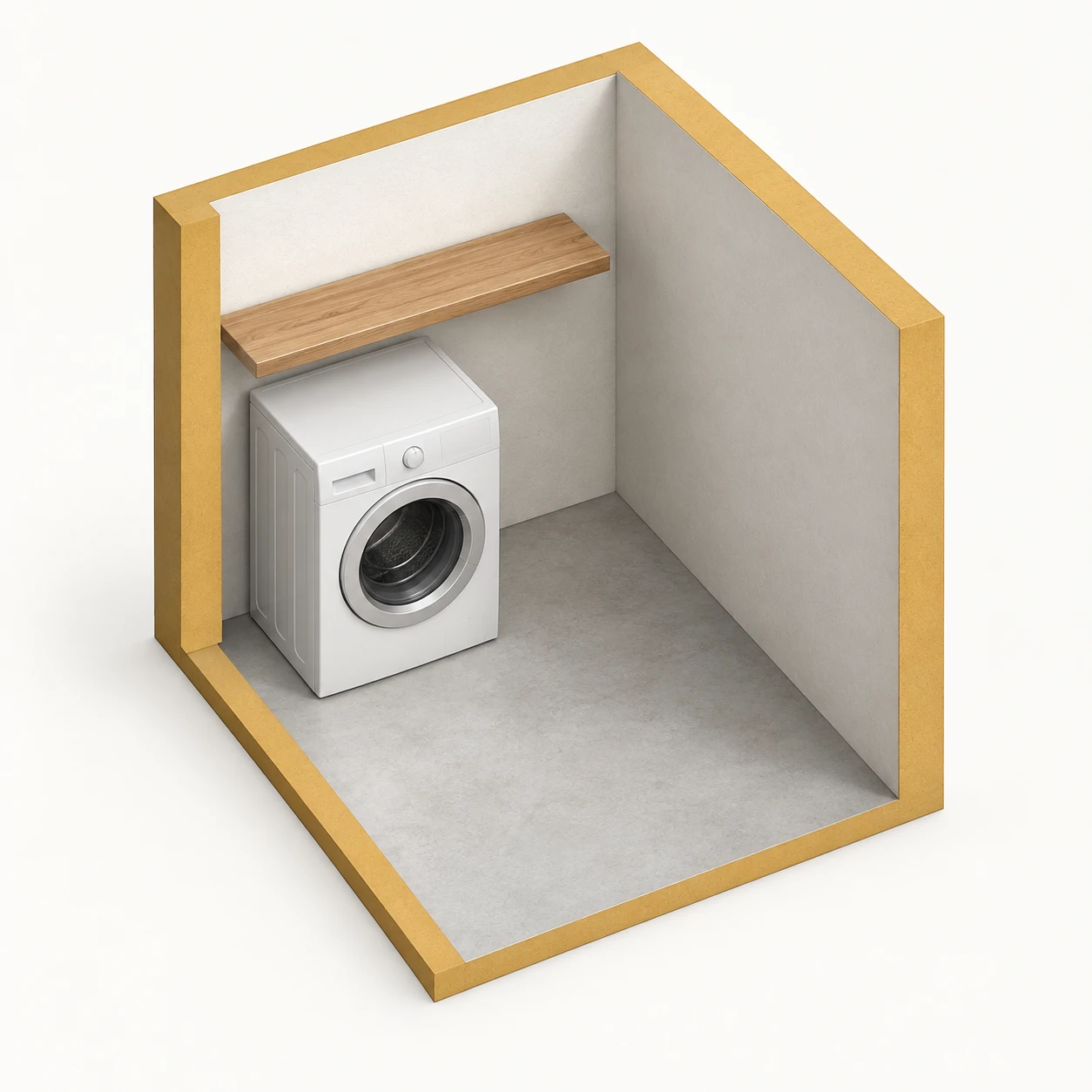
Small Laundry Room · Architectural Cutaway
Reveal a small laundry room by removing its ceiling and front walls, distinguishing solid wall cuts from interior surfaces.
Small Laundry Room · Architectural Cutaway
- Shape & line
- Construct the room with straight verticals and two consistent diagonal axis directions without perspective convergence. Give the retained walls visible thickness, and close their exposed top and end cuts with solid cap shapes so they read as sliced walls rather than thin screens.
- Color & light
- Fill every exposed wall cut face with muted ochre, while keeping interior wall surfaces warm white and the floor pale gray. Use soft light from the upper image-left to shade the image-right interior wall slightly darker, preserving the ochre cuts as a distinct flat color.
- Texture & material
- Render the walls as smooth matte plaster and the washing machine as smooth painted metal with a restrained highlight along its upper edge. Keep the shelf lightly grained wood, and use subtle surface marks that do not break the continuous wall cut faces.
- Composition
- Place the washing machine toward the rear image-left, leaving an open strip of floor between it and the retained image-right wall. End the shelf before that wall so a visible gap separates them, and keep the front opening unobstructed to reveal the room's footprint.
Priority
Make the solid wall cut faces and the open interior immediately distinguishable.
What to avoid & what to check
Avoid paper-thin walls, converging axonometric axes and floating cut caps.
Check that every visible wall cut closes its thickness and the open front reveals the floor perimeter.
Exact prompt for this example
SUBJECT
One compact rectangular laundry room containing one washing machine against the rear wall and one short shelf directly above it. Remove the ceiling and the two walls facing the viewer to expose the interior; retain the rear and image-right walls, with visible thickness along their cut edges.

COMPOSITION
Show the whole room as an elevated axonometric cutaway, looking down through the open front-left corner. Keep the floor perimeter, wall cut faces, washing machine and shelf clearly readable, with generous blank space around the room.

STYLE GUIDE
1. Shape & line
Construct the room with straight verticals and two consistent diagonal axis directions without perspective convergence. Give the retained walls visible thickness, and close their exposed top and end cuts with solid cap shapes so they read as sliced walls rather than thin screens.

2. Color & light
Fill every exposed wall cut face with muted ochre, while keeping interior wall surfaces warm white and the floor pale gray. Use soft light from the upper image-left to shade the image-right interior wall slightly darker, preserving the ochre cuts as a distinct flat color.

3. Texture & material
Render the walls as smooth matte plaster and the washing machine as smooth painted metal with a restrained highlight along its upper edge. Keep the shelf lightly grained wood, and use subtle surface marks that do not break the continuous wall cut faces.

4. Composition
Place the washing machine toward the rear image-left, leaving an open strip of floor between it and the retained image-right wall. End the shelf before that wall so a visible gap separates them, and keep the front opening unobstructed to reveal the room's footprint.

PRIORITY
Preserve the requested identity, count, action, composition and output settings. Apply the style rules within those constraints; a style reference must not replace the subject or layout. Within the style: Make the solid wall cut faces and the open interior immediately distinguishable.

AVOID
Avoid paper-thin walls, converging axonometric axes and floating cut caps.

OUTPUT
One architectural illustration in a square aspect ratio, with no labels, dimensions, lettering or watermark.

SELF-CHECK
Check that every visible wall cut closes its thickness and the open front reveals the floor perimeter.
Model information comes from image provenance. The same prompt may produce a different result.