Text to imageIllustrationStyle guide
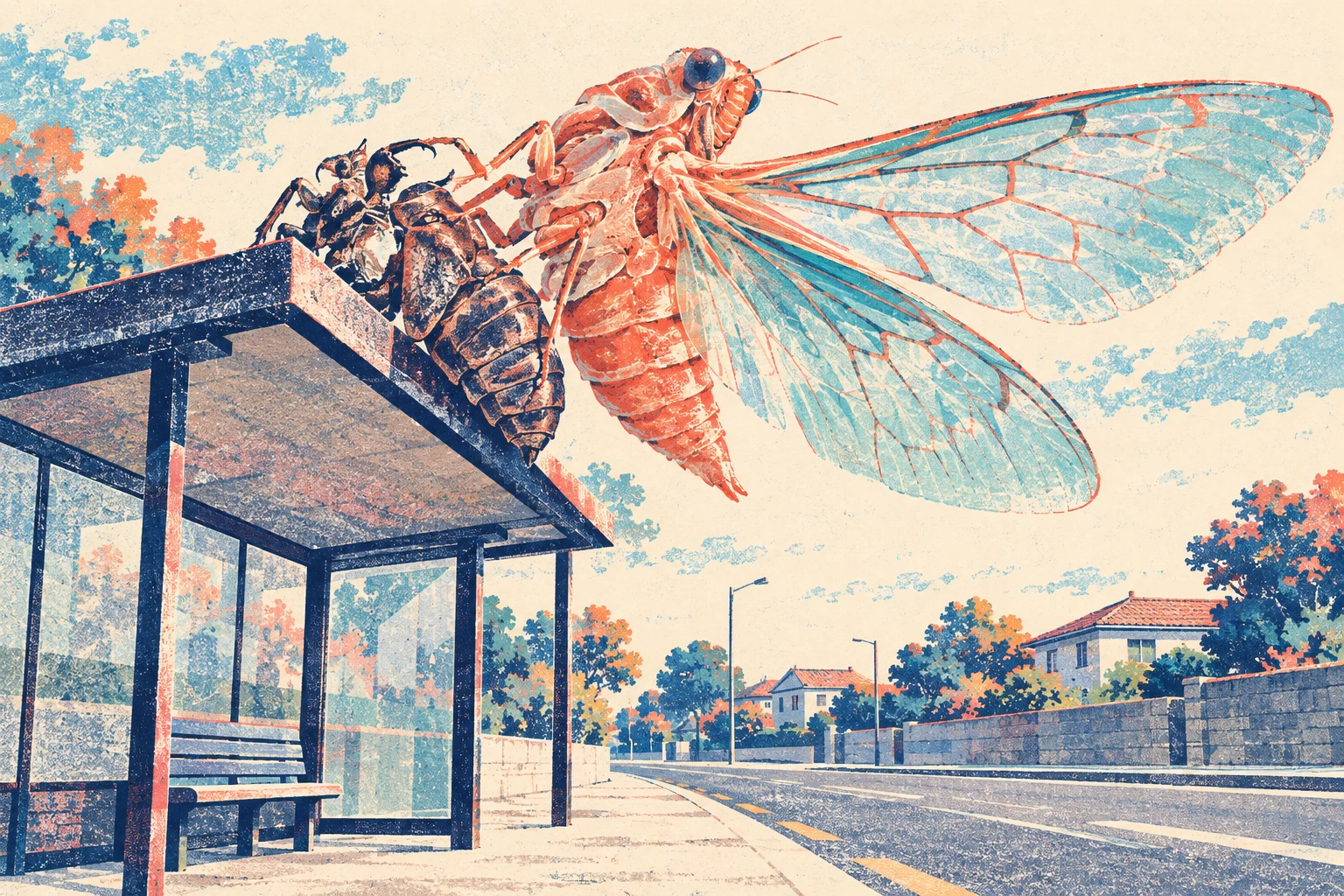
Cicada Emerging Above the Bus Shelter
A giant cicada emerges from its shell above an ordinary bus shelter. Porous ink grain and playful registration offsets give this unexpected dawn transformation a tactile printed presence.
Remix this referenceCicada Emerging Above the Bus Shelter
- Form language
- Reduce forms to interlocking cut shapes, retaining open gaps and a few fine internal bridges; let secondary detail vary within this vocabulary.
- Contour
- Combine blunt, slightly ragged ink edges with occasional fine keylines; let selected plate boundaries drift into playful registration offsets.
- Mark-making
- Use irregular dry grains and short roller streaks that gather unevenly across broad shapes, with naturally varied size and spacing.
- Surface rendering
- Build tones from porous riso ink fields and transparent overprints; exposed paper interrupts lighter passages while overlaps deepen locally.
Priority
Make riso grain, translucent overprinting and selective misregistration integral to the printed look
What to avoid & what to check
Exact prompt for this example
MODULE OWNERSHIP
subject: Subject count, type, stable proportions and landmarks, resting face geometry, hair shape, physical materials, garment construction and permanent marks. No emotion, movement, color assignment or rendering recipe.
expression: Facial soft-tissue displacement and pupil direction, muscle coordination, regional intensity, asymmetry and onset/peak/release. No head/body pose, stable appearance, skin color or rendering.
gesture: Head/neck/body/limb orientation, joint movement, support, contact and pose-caused occlusion using existing anatomy. No eye/pupil movement, emotion, identity, props inventory or camera.
props: Prop count, type, construction, physical material and scale relative to the subject. Holding/contact belongs to gesture, position to composition, color to palette.
scene: Environment elements, terrain, backdrop/floor presence and structural detail. No canvas positions, camera, lighting, assigned colors or render texture.
camera: Projection, focal-length impression, camera elevation/yaw/roll, viewing distance and crop. No actor pose, world placement, lighting or canvas aspect ratio.
composition: Normalized 0-100% canvas positions, scale in frame, depth/overlap, focal hierarchy and margins. No joint pose, camera projection, rendering, subject/prop inventory or emotion.
palette: Color anchors, hue/saturation/value ranges, colors assigned to parts and approximate color coverage. No illumination direction, shading algorithm, physical material or layout.
lighting: Light-source direction/softness/intensity, ambient illumination, physical shadow direction/length and highlight position. Absence of directional illumination is allowed. No shading technique, palette or material changes.
style: Reusable form abstraction, contour weight/taper/edge quality, medium and mark scale/density/direction, surface rendering and tonal transition technique. No fixed subject proportions, anatomy, identity, expression, pose, palette, light-source direction, camera or layout.
output: Image count, aspect ratio, size, file/alpha requirements and global lettering/logo/watermark restrictions. No background scenery, crop, style, identity or pose.

SUBJECT
inventory: One enormous adult cicada, actor A; no people or other living creatures.
geometry: A broad thorax, tapered segmented abdomen and two pairs of long veined wings establish recognizable cicada construction.
resting-face: Widely separated compound eyes, short antennae and a small mouth shield; no human facial anatomy.
appearance: A chitinous body and thin, soft membranous wings with branching veins; no clothing or decorative markings.

PRIORITY


AVOID


CHECK


EXPRESSION — ACTOR A
brows: No brow acting applies; leave this region still.
lids: No eyelid acting applies; do not imply a blink or squint.
cheeks: No cheek displacement applies; keep the facial surface at rest.
nose: No nasal acting applies; do not suggest wrinkling or flaring.
mouth: Keep the mouth area still, without opening, curling or compression.
jaw: No visible jaw articulation accompanies the moment.
gaze: No pupil-direction control applies; do not imply a human gaze shift.
coordination: Maintain a uniformly resting face without human emotional muscle cues.
timing: Hold the resting state at the depicted instant, with no facial onset or release.

PRIORITY


AVOID


CHECK


GESTURE
head: A lifts its head slightly away from the shell, keeping the antennae freely extended.
torso: A arches outward from the split shell, its abdomen hanging free.
limbs: Front legs brace against the shell; other visible legs loosen from the opening as the wings begin unfolding.
contact: A remains supported by the shell; the shell's hooked feet grip the shelter's roof lip.

PRIORITY


AVOID


CHECK


PROPS
inventory: One cast cicada shell, matching A's body scale.
construction: The hollow brittle exoskeleton retains clawed legs and an open dorsal split with curled edges.

PRIORITY


AVOID


CHECK


SCENE
inventory: A suburban roadside bus shelter, pavement, bus lane, low boundary wall and house roofs.
structure: The shelter has a shallow canopy, narrow supports, a glazed side panel and an integrated bench.

PRIORITY


AVOID


CHECK


CAMERA
projection: Use gently compressed perspective with a normal-lens impression.
viewpoint: Look diagonally along the roadside from pedestrian chest height, with a slight upward view and level roll.
crop: Use a wide environmental view containing the complete cicada, shell and shelter.

PRIORITY


AVOID


CHECK


COMPOSITION
placement: Set the shelter left of center; let the emerging cicada extend diagonally toward the open upper right. Let the shell dwarf the shelter roof.
depth: Make body and wings primary, the overlapping shell secondary, and receding street structures the scale cue. Keep house roofs in the distance.
spacing: Keep generous sky around the wings and an open road wedge below, with ample margins around the silhouette.

PRIORITY


AVOID


CHECK


PALETTE
colors: Use warm ivory, buoyant coral, clear turquoise and deep indigo, with restrained middle values.
assignment: Assign coral to A's body, turquoise to its wings, indigo to shell and shelter frame, and ivory to sky and open ground.
balance: Let ivory dominate; concentrate coral, use indigo sparingly, and give turquoise a broad supporting presence.

PRIORITY


AVOID


CHECK


LIGHTING
sources: Broad soft morning light arrives from the upper left, supported by gentle ambient sky illumination.
shadows: Soft shadows fall toward the lower right, gathering beneath the canopy and at the shell's contact points.
highlights: Keep delicate highlights along the upper-left wing rims and the exposed crest of the thorax.

PRIORITY


AVOID


CHECK


STYLE GUIDE
form-language: Reduce forms to interlocking cut shapes, retaining open gaps and a few fine internal bridges; let secondary detail vary within this vocabulary.
contour: Combine blunt, slightly ragged ink edges with occasional fine keylines; let selected plate boundaries drift into playful registration offsets.
mark-making: Use irregular dry grains and short roller streaks that gather unevenly across broad shapes, with naturally varied size and spacing.
surface-rendering: Build tones from porous riso ink fields and transparent overprints; exposed paper interrupts lighter passages while overlaps deepen locally.

PRIORITY
Make riso grain, translucent overprinting and selective misregistration integral to the printed look

AVOID


CHECK


OUTPUT
format: One finished illustration.
restrictions: Deliver one opaque PNG, 1800 × 1200 pixels, landscape 3:2. No lettering, logos or watermarks.

PRIORITY


AVOID


CHECK


FINAL INTEGRATION
subject + props + gesture: Read the adult and shell as successive states of the same creature, connected through emergence.
Model information comes from image provenance. The same prompt may produce a different result.