Text to imageLandscapeStyle guide
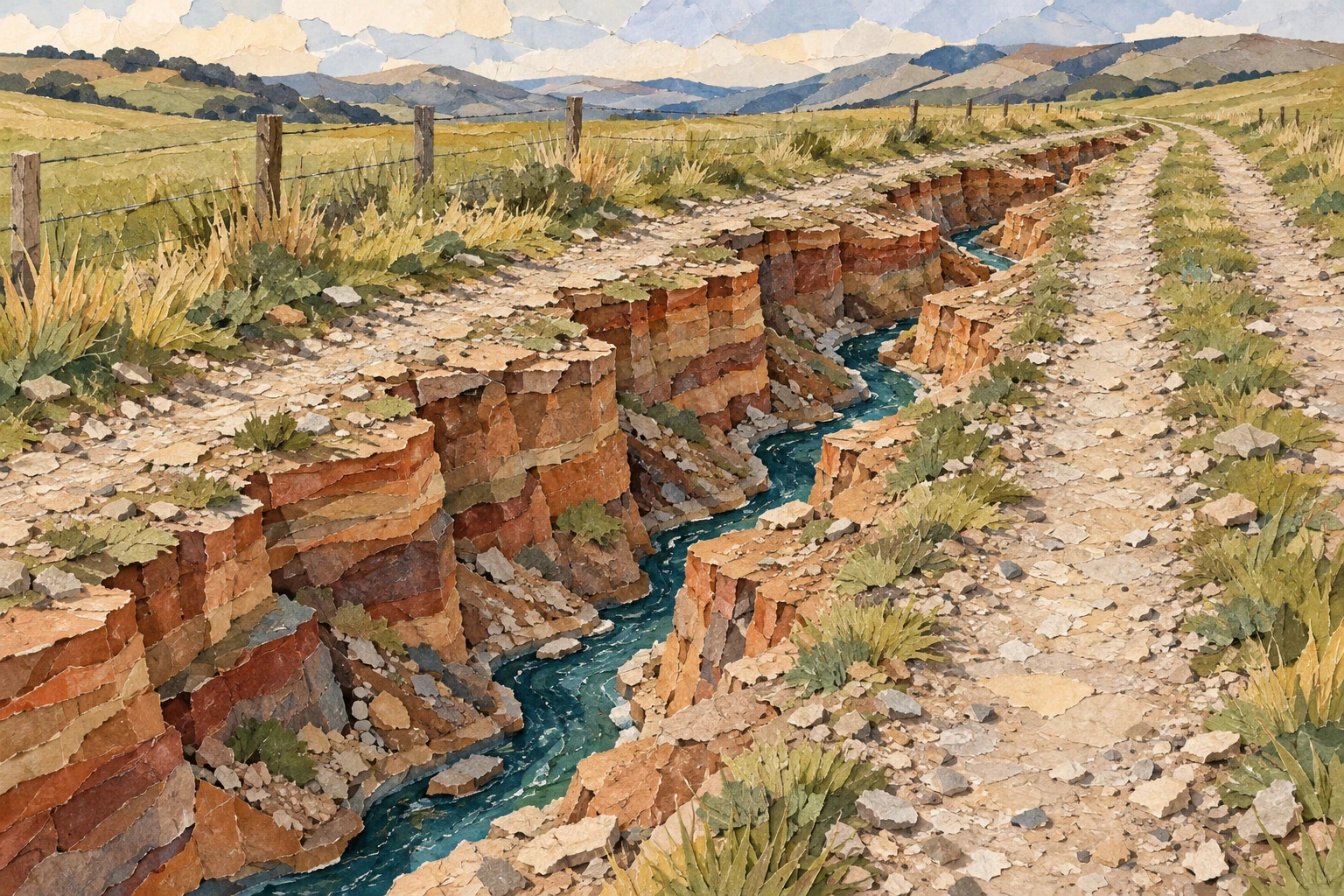
A Canyon in a Farm Track
An ordinary wheel rut becomes a deep miniature river canyon. Layered cut paper reveals the surprising scale difference between its cliffs and the surrounding pasture.
Remix this referenceA Canyon in a Farm Track
- Form language
- Build forms from nested, irregular cut-paper silhouettes; simplify small detail into a few expressive interlocking shapes.
- Contour
- Let scissor-cut edges alternate between long confident arcs and small blunt notches; occasional torn edges soften transitions.
- Mark-making
- Use sparse rubbed pigment and loose dry-brush streaks within the paper pieces, allowing natural differences in pressure and rhythm.
- Surface rendering
- Keep visible paper thickness and tactile overlaps; combine opaque pieces with occasional translucent layers and softly mottled tones.
Priority
The finished image must visibly read as layered cut-paper collage.
What to avoid & what to check
Exact prompt for this example
MODULE OWNERSHIP
subject: Subject count, type, stable proportions and landmarks, resting face geometry, hair shape, physical materials, garment construction and permanent marks. No emotion, movement, color assignment or rendering recipe.
expression: Facial soft-tissue displacement and pupil direction, muscle coordination, regional intensity, asymmetry and onset/peak/release. No head/body pose, stable appearance, skin color or rendering.
gesture: Head/neck/body/limb orientation, joint movement, support, contact and pose-caused occlusion using existing anatomy. No eye/pupil movement, emotion, identity, props inventory or camera.
props: Prop count, type, construction, physical material and scale relative to the subject. Holding/contact belongs to gesture, position to composition, color to palette.
scene: Environment elements, terrain, backdrop/floor presence and structural detail. No canvas positions, camera, lighting, assigned colors or render texture.
camera: Projection, focal-length impression, camera elevation/yaw/roll, viewing distance and crop. No actor pose, world placement, lighting or canvas aspect ratio.
composition: Normalized 0-100% canvas positions, scale in frame, depth/overlap, focal hierarchy and margins. No joint pose, camera projection, rendering, subject/prop inventory or emotion.
palette: Color anchors, hue/saturation/value ranges, colors assigned to parts and approximate color coverage. No illumination direction, shading algorithm, physical material or layout.
lighting: Light-source direction/softness/intensity, ambient illumination, physical shadow direction/length and highlight position. Absence of directional illumination is allowed. No shading technique, palette or material changes.
style: Reusable form abstraction, contour weight/taper/edge quality, medium and mark scale/density/direction, surface rendering and tonal transition technique. No fixed subject proportions, anatomy, identity, expression, pose, palette, light-source direction, camera or layout.
output: Image count, aspect ratio, size, file/alpha requirements and global lettering/logo/watermark restrictions. No background scenery, crop, style, identity or pose.

SUBJECT
inventory: One miniature river canyon, treated as a continuous geological landform; no people.
geometry: The canyon fits within an ordinary wheel rut; steep, stepped walls enclose a narrow, winding river.
resting-face: No face or facial landmarks apply.
appearance: Layered sedimentary rock has broken ledges, loose scree and exposed strata; local fractures may vary naturally.

PRIORITY


AVOID


CHECK


PROPS
inventory: No separate props.
construction: No prop construction applies.

PRIORITY


AVOID


CHECK


SCENE
inventory: A gravel farm track, rough pasture, a post-and-wire fence, low hills and open sky; no buildings.
structure: The canyon occupies one rut while the other remains ordinary; grass roots and track gravel establish everyday scale.

PRIORITY


AVOID


CHECK


CAMERA
projection: Moderate wide-angle perspective with gentle depth recession and no exaggerated edge stretching.
viewpoint: Look obliquely down from above track height, far enough away to read the canyon within its setting.
crop: Include the canyon mouth, its receding course and a narrow horizon; let the near track continue beyond the frame.

PRIORITY


AVOID


CHECK


COMPOSITION
placement: The canyon enters from the lower left and bends toward the upper right, dominating the foreground without centering.
depth: Overlapping cliff rims lead down to the river; the track and distant hills form successively quieter depth layers.
spacing: Make the river the first discovery and the ordinary rut the second; leave spacious pasture beside the dense cutaway.

PRIORITY


AVOID


CHECK


PALETTE
colors: Use terracotta, muted sage, deep petrol blue and warm bone, with restrained saturation.
assignment: Terracotta belongs to canyon strata, sage to pasture, petrol blue to the river, and bone to track and sky.
balance: Keep the broad surroundings pale and subdued; reserve the deepest values for the narrow river and rock recesses.

PRIORITY


AVOID


CHECK


LIGHTING
sources: Broad, soft daylight arrives from the upper left, with ample ambient fill.
shadows: Short shadows fall toward the lower right; canyon recesses remain shaded but legible.
highlights: Gentle highlights touch exposed ledges and a few river bends without sharp glare.

PRIORITY


AVOID


CHECK


STYLE GUIDE
form-language: Build forms from nested, irregular cut-paper silhouettes; simplify small detail into a few expressive interlocking shapes.
contour: Let scissor-cut edges alternate between long confident arcs and small blunt notches; occasional torn edges soften transitions.
mark-making: Use sparse rubbed pigment and loose dry-brush streaks within the paper pieces, allowing natural differences in pressure and rhythm.
surface-rendering: Keep visible paper thickness and tactile overlaps; combine opaque pieces with occasional translucent layers and softly mottled tones.

PRIORITY
The finished image must visibly read as layered cut-paper collage.

AVOID


CHECK


OUTPUT
format: One image, landscape 3:2, 1536 × 1024 pixels, opaque PNG.
restrictions: No lettering, logos, signatures or watermarks.

PRIORITY


AVOID


CHECK
Model information comes from image provenance. The same prompt may produce a different result.