Text to imageProductStyle guide
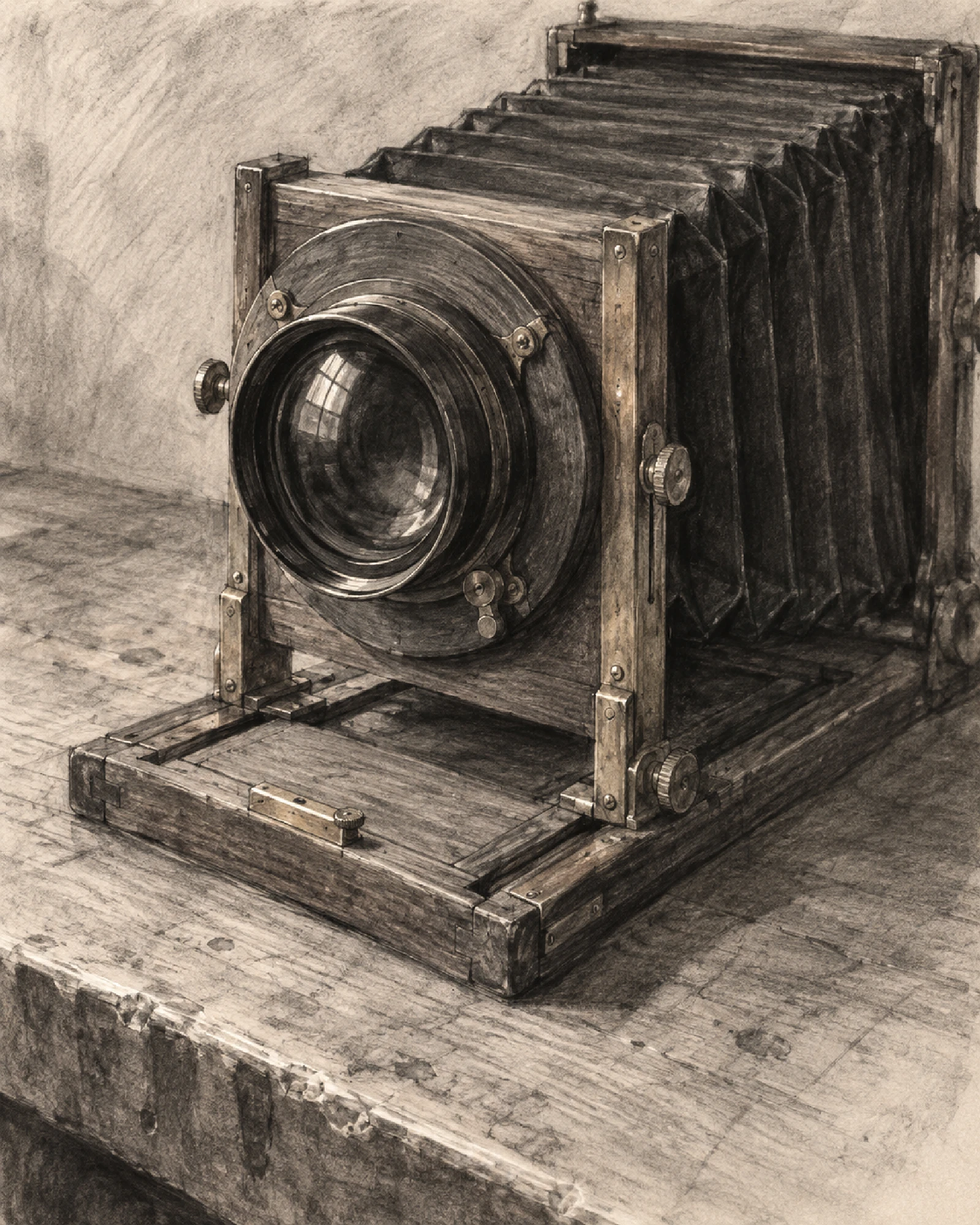
Bellows Camera on a Workbench
An intimate product drawing of a folding field camera, with rubbed charcoal and erased light describing its lens and bellows.
Remix this referenceBellows Camera on a Workbench
- Form language
- Observe large volumes before small details; simplify repeated structures while retaining slight handmade irregularity.
- Contour
- Use broken, pressure-varied charcoal edges; sharpen a few turns and let other boundaries dissolve into neighboring tone.
- Mark-making
- Combine broad side-of-stick rubs, loose curved searching strokes and finger-smudged passages; allow natural grain and stray traces.
- Surface rendering
- Accumulate smoky charcoal veils, compress selected darks, then lift broad light with an eraser; retain rubbed transitions around firmer accents.
Priority
Make observational charcoal visible through smudged masses and erased light.
What to avoid & what to check
Exact prompt for this example
MODULE OWNERSHIP
subject: Subject count, type, stable proportions and landmarks, resting face geometry, hair shape, physical materials, garment construction and permanent marks. No emotion, movement, color assignment or rendering recipe.
expression: Facial soft-tissue displacement and pupil direction, muscle coordination, regional intensity, asymmetry and onset/peak/release. No head/body pose, stable appearance, skin color or rendering.
gesture: Head/neck/body/limb orientation, joint movement, support, contact and pose-caused occlusion using existing anatomy. No eye/pupil movement, emotion, identity, props inventory or camera.
props: Prop count, type, construction, physical material and scale relative to the subject. Holding/contact belongs to gesture, position to composition, color to palette.
scene: Environment elements, terrain, backdrop/floor presence and structural detail. No canvas positions, camera, lighting, assigned colors or render texture.
camera: Projection, focal-length impression, camera elevation/yaw/roll, viewing distance and crop. No actor pose, world placement, lighting or canvas aspect ratio.
composition: Normalized 0-100% canvas positions, scale in frame, depth/overlap, focal hierarchy and margins. No joint pose, camera projection, rendering, subject/prop inventory or emotion.
palette: Color anchors, hue/saturation/value ranges, colors assigned to parts and approximate color coverage. No illumination direction, shading algorithm, physical material or layout.
lighting: Light-source direction/softness/intensity, ambient illumination, physical shadow direction/length and highlight position. Absence of directional illumination is allowed. No shading technique, palette or material changes.
style: Reusable form abstraction, contour weight/taper/edge quality, medium and mark scale/density/direction, surface rendering and tonal transition technique. No fixed subject proportions, anatomy, identity, expression, pose, palette, light-source direction, camera or layout.
output: Image count, aspect ratio, size, file/alpha requirements and global lettering/logo/watermark restrictions. No background scenery, crop, style, identity or pose.

SUBJECT
inventory: One originally designed folding field photographic apparatus; no people or animals.
geometry: A circular lens board fronts short pleated bellows between rectangular standards above a projecting wooden bed.
resting-face: No facial anatomy applies.
appearance: Leather bellows, a hardwood frame, brass fittings and glass optics show modest handling wear.

PRIORITY


AVOID


CHECK


PROPS
inventory: No separate props.
construction: No prop construction applies.

PRIORITY


AVOID


CHECK


SCENE
inventory: A narrow workbench stands before a plain workshop wall.
structure: The bench has an uninterrupted top and a worn front edge; the wall has no shelving or fixtures.

PRIORITY


AVOID


CHECK


CAMERA
projection: Use a normal-lens perspective with restrained near-to-far enlargement.
viewpoint: View closely from above the front-left corner, revealing the lens face, one bellows side and the bed.
crop: Keep the lens complete; crop part of the rear standard and the projecting bed for an intimate detail.

PRIORITY


AVOID


CHECK


COMPOSITION
placement: Place the lens near 40% across and 35% down; the bellows recede diagonally toward the upper right.
depth: The lens rim overlaps the first bellows folds; the bed leads into a quieter bench-and-wall depth.
spacing: Let the lens rim lead, the folds follow, and a broad lower-left bench passage provide breathing room.

PRIORITY


AVOID


CHECK


PALETTE
colors: Use paper ivory, soft ash gray, smoky charcoal and near-black within a low-saturation neutral range.
assignment: Give the bellows and lens interior the deepest values; the frame, fittings, bench and wall use lighter grays.
balance: Middle grays dominate, with concentrated near-black passages and generous ivory reserves.

PRIORITY


AVOID


CHECK


LIGHTING
sources: A broad, soft window source enters from the upper left; subdued ambient light reaches the recesses.
shadows: Short cast shadows fall toward the lower right, with deeper shade between bellows folds.
highlights: Broad light catches the upper-left lens rim and bed edge; the glass holds one soft window reflection.

PRIORITY


AVOID


CHECK


STYLE GUIDE
form-language: Observe large volumes before small details; simplify repeated structures while retaining slight handmade irregularity.
contour: Use broken, pressure-varied charcoal edges; sharpen a few turns and let other boundaries dissolve into neighboring tone.
mark-making: Combine broad side-of-stick rubs, loose curved searching strokes and finger-smudged passages; allow natural grain and stray traces.
surface-rendering: Accumulate smoky charcoal veils, compress selected darks, then lift broad light with an eraser; retain rubbed transitions around firmer accents.

PRIORITY
Make observational charcoal visible through smudged masses and erased light.

AVOID


CHECK


OUTPUT
format: One finished image, 4:5 portrait, 1600 × 2000 pixels, opaque PNG.
restrictions: No lettering, logos, signatures or watermarks.

PRIORITY


AVOID


CHECK


FINAL INTEGRATION
subject + style: Let the drawing remain exploratory while preserving the product's recognizable construction.
Model information comes from image provenance. The same prompt may produce a different result.