Text to imageIllustrationStyle guide
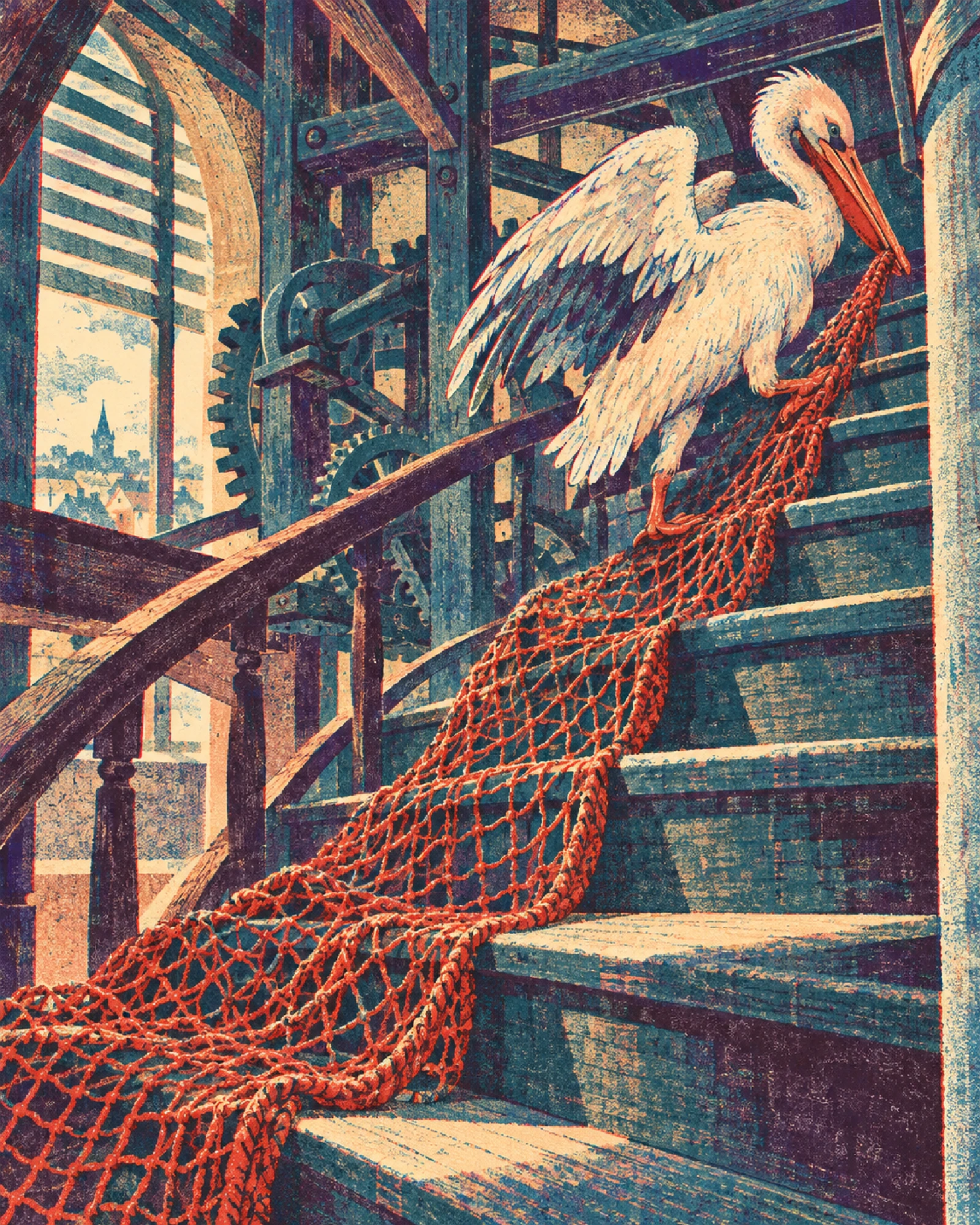
Pelican Hauling a Net in a Clock Tower
A pelican climbs a clock-tower staircase with a net in its bill. The mesh trails through overlapping stairs and enormous clockworks, brought alive by grainy risograph ink and playful registration offsets.
Remix this referencePelican Hauling a Net in a Clock Tower
- Form language
- Simplify forms into broad interlocking masses, scalloped curves and blunt wedges; let small shapes vary within that vocabulary.
- Contour
- Use mostly ink-shape edges with occasional broken, uneven line accents; let separate plates create playful doubled boundaries.
- Mark-making
- Build risograph marks from irregular ink flecks and loose directional strokes, changing their density naturally rather than repeating a texture tile.
- Surface rendering
- Let translucent ink layers produce rich overprints; use grain-softened tonal patches and paper breaks instead of uniformly solid surfaces.
Priority
Make grainy risograph overprinting and playful registration offsets visibly define the image.
What to avoid & what to check
Exact prompt for this example
MODULE OWNERSHIP
subject: Subject count, type, stable proportions and landmarks, resting face geometry, hair shape, physical materials, garment construction and permanent marks. No emotion, movement, color assignment or rendering recipe.
expression: Facial soft-tissue displacement and pupil direction, muscle coordination, regional intensity, asymmetry and onset/peak/release. No head/body pose, stable appearance, skin color or rendering.
gesture: Head/neck/body/limb orientation, joint movement, support, contact and pose-caused occlusion using existing anatomy. No eye/pupil movement, emotion, identity, props inventory or camera.
props: Prop count, type, construction, physical material and scale relative to the subject. Holding/contact belongs to gesture, position to composition, color to palette.
scene: Environment elements, terrain, backdrop/floor presence and structural detail. No canvas positions, camera, lighting, assigned colors or render texture.
camera: Projection, focal-length impression, camera elevation/yaw/roll, viewing distance and crop. No actor pose, world placement, lighting or canvas aspect ratio.
composition: Normalized 0-100% canvas positions, scale in frame, depth/overlap, focal hierarchy and margins. No joint pose, camera projection, rendering, subject/prop inventory or emotion.
palette: Color anchors, hue/saturation/value ranges, colors assigned to parts and approximate color coverage. No illumination direction, shading algorithm, physical material or layout.
lighting: Light-source direction/softness/intensity, ambient illumination, physical shadow direction/length and highlight position. Absence of directional illumination is allowed. No shading technique, palette or material changes.
style: Reusable form abstraction, contour weight/taper/edge quality, medium and mark scale/density/direction, surface rendering and tonal transition technique. No fixed subject proportions, anatomy, identity, expression, pose, palette, light-source direction, camera or layout.
output: Image count, aspect ratio, size, file/alpha requirements and global lettering/logo/watermark restrictions. No background scenery, crop, style, identity or pose.

SUBJECT
inventory: A is one adult pelican, the only animal; no people are present.
geometry: A broad-bodied bird with a long pouched bill, flexible neck, broad wings and short webbed feet.
resting-face: Small round eyes sit near the bill root; the bill has a long straight upper ridge and a soft lower pouch.
appearance: Layered flight feathers, a short feathered crown and bare leathery pouch; no garments or permanent markings.

PRIORITY


AVOID


CHECK


EXPRESSION — ACTOR A
brows: No independent brow action; the upper orbital tissue remains relaxed.
lids: The visible upper lid lowers slightly; the lower lid stays gently taut.
cheeks: Tissue below the visible eye stays still, without puffing or lifting.
nose: Tissue around the nostril remains still, without wrinkling.
mouth: The bill edges close firmly; the gape corners remain unpulled.
jaw: The lower jaw stays raised with mild tension; the pouch does not inflate.
gaze: The visible pupil directs backward and downward toward the net's gripped edge.
coordination: Mild lid tension and firm closure convey effort without a human grimace or forced symmetry.
timing: Hold a quiet apex of sustained effort, with no blink or opening transition.

PRIORITY


AVOID


CHECK


GESTURE
head: A bends its neck back and down, turning its bill toward the trailing net.
torso: The body pitches forward into the climb, with the tail counterbalancing behind.
limbs: One webbed foot supports the bird on a tread; the other reaches the next step, with wings half spread.
contact: The bill pinches the net's thick edge while the loose mesh drags over the stair nosings.

PRIORITY


AVOID


CHECK


PROPS
inventory: One fishing net, large in scale relative to A's body.
construction: Plant-fiber cord forms open diamond mesh with a thicker continuous perimeter; no attached floats or weights.

PRIORITY


AVOID


CHECK


SCENE
inventory: A clock-tower interior with a winding wooden stair, roof beams, exposed clockworks and an arched louver opening.
structure: Broad treads wrap around the clock's support frame; intermeshing gears and crossbeams connect the tower levels.

PRIORITY


AVOID


CHECK


CAMERA
projection: Perspective with a moderately wide lens impression, enough to reveal the tower's enclosing depth.
viewpoint: View diagonally upward from just above the lower stair flight, with a level camera roll.
crop: An environmental view includes the whole bird and most of the net; near beams and stairs continue beyond the edges.

PRIORITY


AVOID


CHECK


COMPOSITION
placement: A occupies the upper-right third; the net spans several steps beside A and sweeps toward the lower left, making their connection the first read.
depth: Near stair edges overlap the trailing mesh; clockworks sit behind A, with beams bridging foreground and distance.
spacing: Leave an open interval around the bill and gripped edge; denser architectural overlaps frame the outer margins.

PRIORITY


AVOID


CHECK


PALETTE
colors: Warm paper cream, petrol teal, vermilion and deep plum form a small, expressive ink palette.
assignment: Cream belongs to A's feathers; vermilion to the bill and net; teal to stairs and gears; plum to structural accents.
balance: Cream and teal dominate; vermilion stays vivid and selective, while plum supplies the deepest values.

PRIORITY


AVOID


CHECK


LIGHTING
sources: Broad daylight enters from the upper left through the tower opening, with gentle ambient fill.
shadows: Soft cast shadows fall down and right across the treads; deeper recesses remain subdued.
highlights: The upper bill ridge, shoulder feathers and opening-facing stair edges receive the strongest light.

PRIORITY


AVOID


CHECK


STYLE GUIDE
form-language: Simplify forms into broad interlocking masses, scalloped curves and blunt wedges; let small shapes vary within that vocabulary.
contour: Use mostly ink-shape edges with occasional broken, uneven line accents; let separate plates create playful doubled boundaries.
mark-making: Build risograph marks from irregular ink flecks and loose directional strokes, changing their density naturally rather than repeating a texture tile.
surface-rendering: Let translucent ink layers produce rich overprints; use grain-softened tonal patches and paper breaks instead of uniformly solid surfaces.

PRIORITY
Make grainy risograph overprinting and playful registration offsets visibly define the image.

AVOID


CHECK


OUTPUT
format: Deliver one finished portrait illustration, 4:5 aspect ratio, 1600 × 2000 pixels, as an opaque PNG.
restrictions: No lettering, logos or watermarks.

PRIORITY


AVOID


CHECK


FINAL INTEGRATION
gesture + composition + style: Keep the pulling action legible through the overlaps, while print irregularities enrich rather than obscure the contact.
Model information comes from image provenance. The same prompt may produce a different result.