Text to imageIllustrationStyle guide
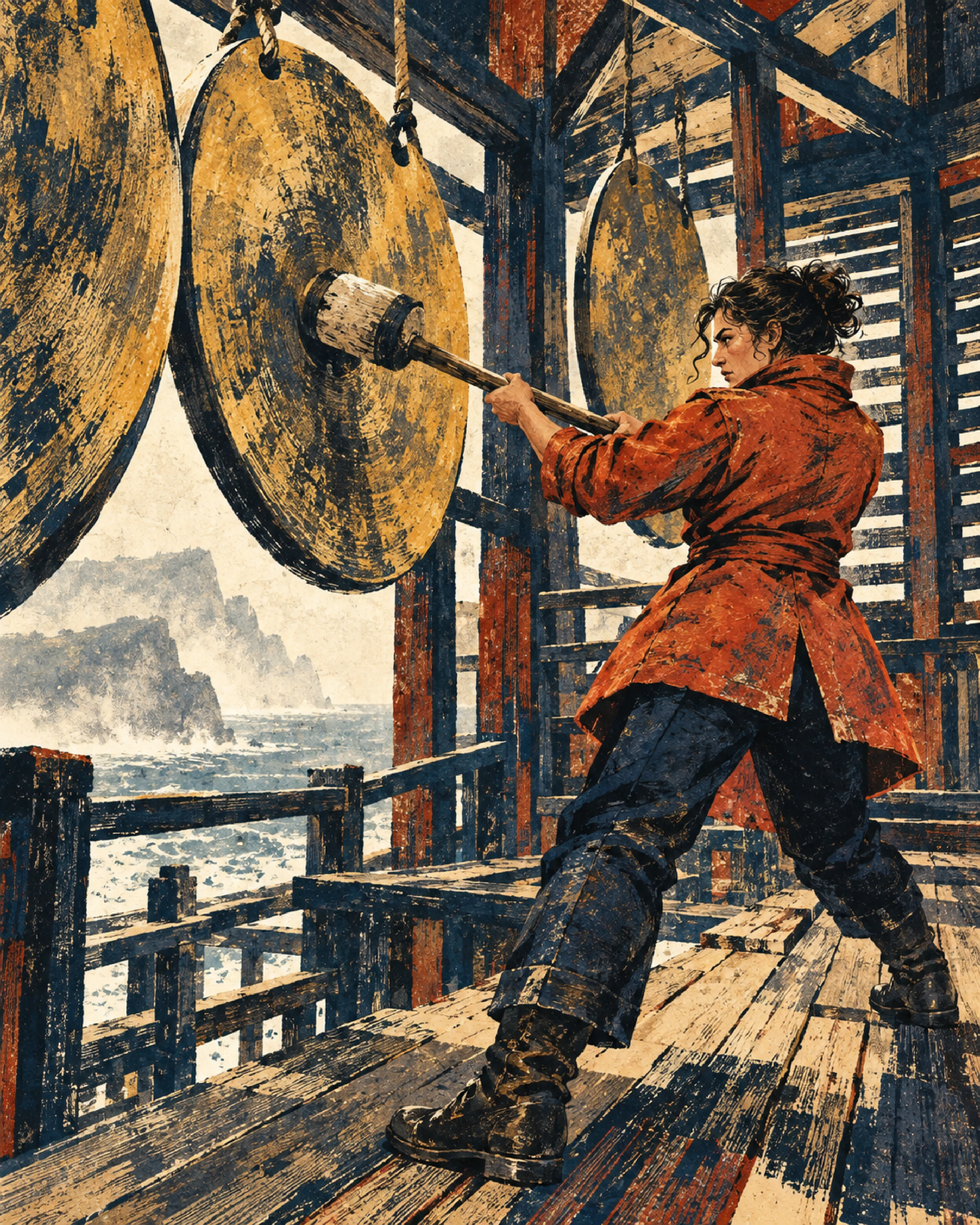
A Keeper Striking the Fog Gong
A keeper strikes an enormous gong inside a signal shed open to the sea. Bleeding ink and offset printed planes turn layered metal plates and timber passages into visible resonance.
Remix this referenceA Keeper Striking the Fog Gong
- Form language
- Reduce forms to blunt wedges, irregular ovals and interlocking bands; allow small variations within this asymmetric vocabulary.
- Contour
- Alternate swollen brush contours with scraped, interrupted edges; let some boundaries dissolve into adjacent printed masses.
- Mark-making
- Combine broad dragged ink strokes with rubbed lithographic marks and occasional blunt stamps; vary pressure and density naturally.
- Surface rendering
- Build tone through translucent overprints, broken opaque masses and exposed paper; slight registration slips create lively doubled edges.
Priority
Make fluid brush ink and imperfect print impressions visibly define the experimental poster illustration.
What to avoid & what to check
Exact prompt for this example
MODULE OWNERSHIP
subject: Subject count, type, stable proportions and landmarks, resting face geometry, hair shape, physical materials, garment construction and permanent marks. No emotion, movement, color assignment or rendering recipe.
expression: Facial soft-tissue displacement and pupil direction, muscle coordination, regional intensity, asymmetry and onset/peak/release. No head/body pose, stable appearance, skin color or rendering.
gesture: Head/neck/body/limb orientation, joint movement, support, contact and pose-caused occlusion using existing anatomy. No eye/pupil movement, emotion, identity, props inventory or camera.
props: Prop count, type, construction, physical material and scale relative to the subject. Holding/contact belongs to gesture, position to composition, color to palette.
scene: Environment elements, terrain, backdrop/floor presence and structural detail. No canvas positions, camera, lighting, assigned colors or render texture.
camera: Projection, focal-length impression, camera elevation/yaw/roll, viewing distance and crop. No actor pose, world placement, lighting or canvas aspect ratio.
composition: Normalized 0-100% canvas positions, scale in frame, depth/overlap, focal hierarchy and margins. No joint pose, camera projection, rendering, subject/prop inventory or emotion.
palette: Color anchors, hue/saturation/value ranges, colors assigned to parts and approximate color coverage. No illumination direction, shading algorithm, physical material or layout.
lighting: Light-source direction/softness/intensity, ambient illumination, physical shadow direction/length and highlight position. Absence of directional illumination is allowed. No shading technique, palette or material changes.
style: Reusable form abstraction, contour weight/taper/edge quality, medium and mark scale/density/direction, surface rendering and tonal transition technique. No fixed subject proportions, anatomy, identity, expression, pose, palette, light-source direction, camera or layout.
output: Image count, aspect ratio, size, file/alpha requirements and global lettering/logo/watermark restrictions. No background scenery, crop, style, identity or pose.

SUBJECT
inventory: One adult woman, actor A, the coastal signal keeper.
geometry: A sturdy human build with broad shoulders, a compact torso and substantial hands.
resting-face: A broad nose bridge, deep-set eyes and a square chin give the face a substantial profile.
appearance: Short clustered curls; a waxed-canvas coat with a broad collar and split hem, work trousers and leather boots.

PRIORITY


AVOID


CHECK


EXPRESSION — ACTOR A
brows: The visible brow draws slightly inward and down.
lids: The visible lower lid tightens beneath a moderately narrowed upper lid.
cheeks: The visible cheek firms subtly without lifting into a smile.
nose: The visible nostril opens slightly; the nose remains unwrinkled.
mouth: Lips press together, with the visible corner drawn slightly inward.
jaw: The jaw sets firmly without opening the mouth.
gaze: The visible pupil aims at the gong's contact point.
coordination: Mild upper-face tension supports firmer mouth tension; hidden facial regions remain unspecified.
timing: Capture the apex of concentration at impact, before the facial tension releases.

PRIORITY


AVOID


CHECK


GESTURE
head: Turn the head toward the striking surface with a slight neck incline, leaving the near-side profile visible.
torso: The torso turns through the swing, carrying the shoulders across the planted hips.
limbs: Both arms extend diagonally with yielding elbows; the front leg bears weight and the rear heel lifts.
contact: Hands grip separate sections of the mallet handle as its head meets the gong; the front boot presses into the deck.

PRIORITY


AVOID


CHECK


PROPS
inventory: Three suspended metal gongs, ranging from torso-sized to twice human height, and one long wooden mallet.
construction: Uneven oval plates hang from rope-threaded eyelets; the mallet has a cylindrical head wrapped in dense felt.

PRIORITY


AVOID


CHECK


SCENE
inventory: A sea-facing timber signal shed with plank flooring, staggered walkways, open louvers and a fogbound headland beyond.
structure: Exposed crossbeams support the hanging assemblies; gaps between walkways reveal the shed's lower framework.

PRIORITY


AVOID


CHECK


CAMERA
projection: Moderately wide perspective with a gently exaggerated sense of nearby scale.
viewpoint: An oblique side-rear view at waist height, with a slight upward pitch and level roll.
crop: Include the keeper's full figure; crop the nearest plate at a frame edge, and allow peripheral architecture to extend beyond the frame.

PRIORITY


AVOID


CHECK


COMPOSITION
placement: The keeper occupies the lower right third; the impact point just left of center is the primary focus. The seaward opening occupies the upper left.
depth: A foreground plate overlaps the shed; the keeper and struck plate lead into receding walkways and distant sea.
spacing: Leave space around hands and mallet head; dense beam masses surround open areas beside a spacious seaward opening.

PRIORITY


AVOID


CHECK


PALETTE
colors: Soot indigo, oxidized vermilion, muted sulphur yellow and warm ivory form a restricted palette.
assignment: Timber, hair and trousers use dark indigo; the coat vermilion, gongs sulphur, fog and open areas light ivory, skin warm ochre.
balance: Subdued darks occupy the largest share; lighter yellows and ivory are secondary, with vermilion as a concentrated accent.

PRIORITY


AVOID


CHECK


LIGHTING
sources: Soft daylight arrives broadly from upper left through the seaward opening, with weak ambient fill inside.
shadows: Broad, soft shadows fall toward the lower right beneath the beams and across the deck.
highlights: Restrained highlights catch the upper-left plate rims, shoulder ridge and mallet head.

PRIORITY


AVOID


CHECK


STYLE GUIDE
form-language: Reduce forms to blunt wedges, irregular ovals and interlocking bands; allow small variations within this asymmetric vocabulary.
contour: Alternate swollen brush contours with scraped, interrupted edges; let some boundaries dissolve into adjacent printed masses.
mark-making: Combine broad dragged ink strokes with rubbed lithographic marks and occasional blunt stamps; vary pressure and density naturally.
surface-rendering: Build tone through translucent overprints, broken opaque masses and exposed paper; slight registration slips create lively doubled edges.

PRIORITY
Make fluid brush ink and imperfect print impressions visibly define the experimental poster illustration.

AVOID


CHECK


OUTPUT
format: One finished illustration, portrait 4:5, 2400 × 3000 pixels, opaque PNG.
restrictions: One finished illustration, portrait 4:5, 2400 × 3000 pixels, opaque PNG; no lettering, logos or watermarks.

PRIORITY


AVOID


CHECK


FINAL INTEGRATION
expression + gesture + composition + style: Let the facial effort and contact gesture remain readable as experimental print edges enrich the layered setting.
Model information comes from image provenance. The same prompt may produce a different result.