Text to imageIllustrationStyle guide
Weaving a Reed Leaf Through the Fence
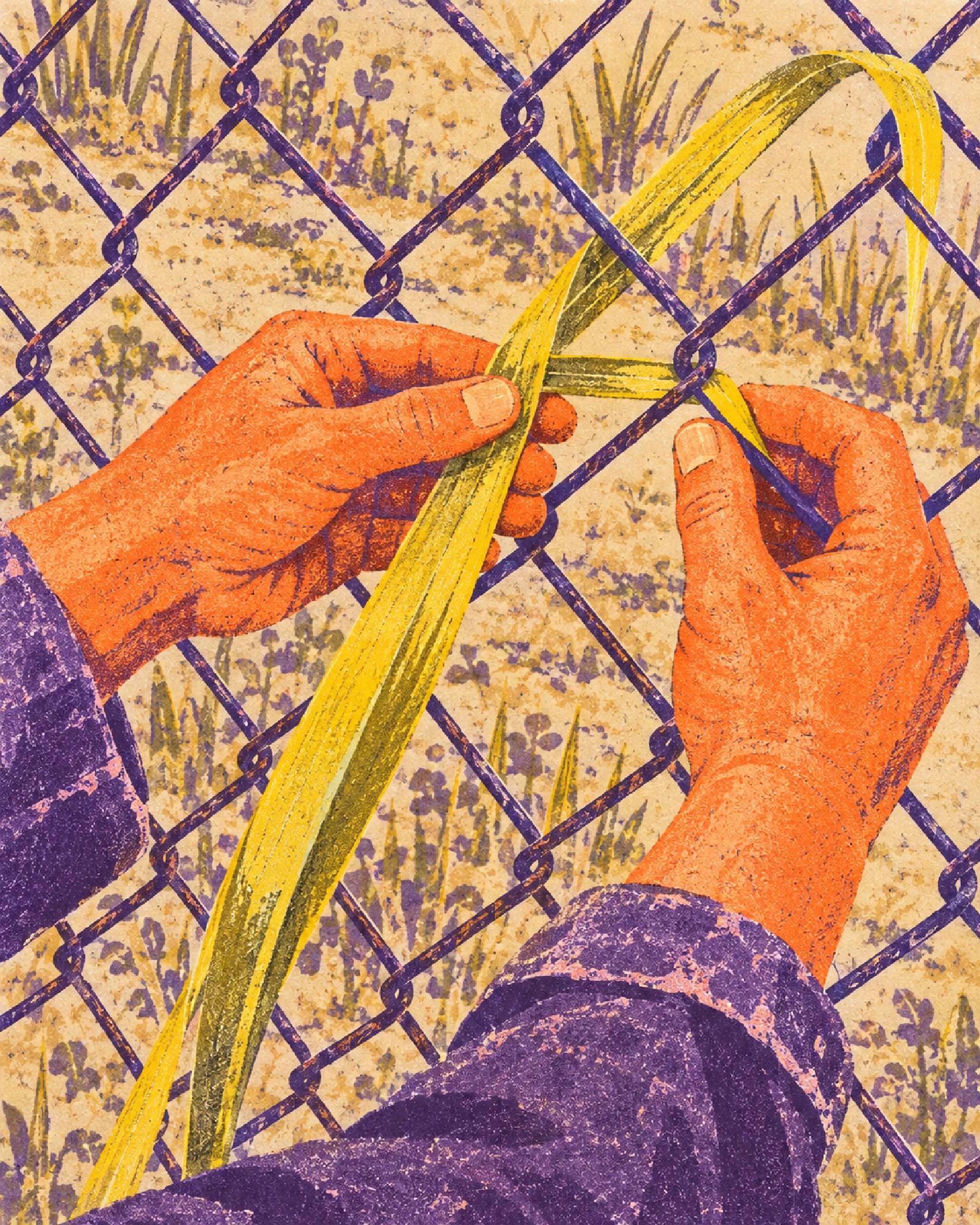
Two hands weave a long reed leaf through wire mesh. Rigid diamonds meet a supple loop in an intimate riso illustration with grainy ink and playful registration offsets.
Remix this referenceWeaving a Reed Leaf Through the Fence
- Form language
- Reduce forms to supple silhouettes and blunt geometric interruptions; permit small irregularities within a coherent cut-stencil language.
- Contour
- Alternate broad ink edges with broken, tapering lines; occasional displaced edge echoes reveal separate printing passes.
- Mark-making
- Use uneven riso grain, scattered stencil pinholes and brief scraped strokes; let mark density vary naturally.
- Surface rendering
- Build tone through translucent ink overlaps and porous solid patches; playful registration slips expose paper slivers beside dense overprints.
Priority
Preserve the visibly grainy, imperfectly registered character of a riso print.
What to avoid & what to check
Exact prompt for this example
MODULE OWNERSHIP
subject: Subject count, type, stable proportions and landmarks, resting face geometry, hair shape, physical materials, garment construction and permanent marks. No emotion, movement, color assignment or rendering recipe.
expression: Facial soft-tissue displacement and pupil direction, muscle coordination, regional intensity, asymmetry and onset/peak/release. No head/body pose, stable appearance, skin color or rendering.
gesture: Head/neck/body/limb orientation, joint movement, support, contact and pose-caused occlusion using existing anatomy. No eye/pupil movement, emotion, identity, props inventory or camera.
props: Prop count, type, construction, physical material and scale relative to the subject. Holding/contact belongs to gesture, position to composition, color to palette.
scene: Environment elements, terrain, backdrop/floor presence and structural detail. No canvas positions, camera, lighting, assigned colors or render texture.
camera: Projection, focal-length impression, camera elevation/yaw/roll, viewing distance and crop. No actor pose, world placement, lighting or canvas aspect ratio.
composition: Normalized 0-100% canvas positions, scale in frame, depth/overlap, focal hierarchy and margins. No joint pose, camera projection, rendering, subject/prop inventory or emotion.
palette: Color anchors, hue/saturation/value ranges, colors assigned to parts and approximate color coverage. No illumination direction, shading algorithm, physical material or layout.
lighting: Light-source direction/softness/intensity, ambient illumination, physical shadow direction/length and highlight position. Absence of directional illumination is allowed. No shading technique, palette or material changes.
style: Reusable form abstraction, contour weight/taper/edge quality, medium and mark scale/density/direction, surface rendering and tonal transition technique. No fixed subject proportions, anatomy, identity, expression, pose, palette, light-source direction, camera or layout.
output: Image count, aspect ratio, size, file/alpha requirements and global lettering/logo/watermark restrictions. No background scenery, crop, style, identity or pose.

SUBJECT
inventory: One adult human, represented by two hands and forearms.
geometry: Broad palms, tapered fingers and short nails; small natural differences between the hands may vary.
resting-face: No facial geometry applies to this hand detail.
appearance: Bare hands and a cotton work jacket with loosely rolled cuffs; no permanent identifying marks.

PRIORITY


AVOID


CHECK


GESTURE
head: Head and neck performance is unspecified.
torso: Torso performance is unspecified.
limbs: The left wrist turns palm-up while the right arm reaches forward, bringing the fingertips toward each other.
contact: Left fingers feed the leaf through one mesh opening; right thumb and forefinger catch it through the next, forming a loose loop around wire.

PRIORITY


AVOID


CHECK


PROPS
inventory: One cut reed leaf, several hand lengths long and broader than a finger at its base.
construction: A continuous flexible blade with a central vein, fibrous edges and a gradually tapering tip.

PRIORITY


AVOID


CHECK


SCENE
inventory: A garden boundary of chain-link fencing, with sparse grasses and bare earth beyond.
structure: Interlocking wire diamonds form an open screen; grasses and earth provide a continuous outdoor backdrop.

PRIORITY


AVOID


CHECK


CAMERA
projection: Gentle perspective with a short-telephoto impression.
viewpoint: An intimate view from slightly above, oblique to the fence plane, without camera roll.
crop: Crop tightly around the hands and leaf, including partial forearms and excluding the face.

PRIORITY


AVOID


CHECK


COMPOSITION
placement: Hands gather in the lower-left half; the loop opens toward the upper right; forearms exit the bottom and left edges.
depth: Wire alternately overlaps and passes behind the leaf; the distant garden remains subordinate.
spacing: Fingertip exchange leads the eye into the generous loop and an airy mesh opening; wire diamonds extend beyond every edge.

PRIORITY


AVOID


CHECK


PALETTE
colors: Warm oat, persimmon orange, deep violet and acid yellow form a compact palette.
assignment: Orange hands, violet wire and sleeves, yellow leaf, and oat with muted mixtures for the garden.
balance: Oat and violet dominate; orange provides a substantial warm accent and yellow a narrow, vivid accent.

PRIORITY


AVOID


CHECK


LIGHTING
sources: Broad, soft daylight enters from the upper left with ample ambient fill.
shadows: Hands and wire cast soft, short shadows toward the lower right.
highlights: Restrained highlights follow upper-left knuckles and the leaf's raised central vein.

PRIORITY


AVOID


CHECK


STYLE GUIDE
form-language: Reduce forms to supple silhouettes and blunt geometric interruptions; permit small irregularities within a coherent cut-stencil language.
contour: Alternate broad ink edges with broken, tapering lines; occasional displaced edge echoes reveal separate printing passes.
mark-making: Use uneven riso grain, scattered stencil pinholes and brief scraped strokes; let mark density vary naturally.
surface-rendering: Build tone through translucent ink overlaps and porous solid patches; playful registration slips expose paper slivers beside dense overprints.

PRIORITY
Preserve the visibly grainy, imperfectly registered character of a riso print.

AVOID


CHECK


OUTPUT
format: One finished image, portrait 4:5, 1600 × 2000 pixels, opaque PNG.
restrictions: No lettering, logos or watermarks.

PRIORITY


AVOID


CHECK


FINAL INTEGRATION
gesture + composition: Keep the threading contact readable within the overlapping arrangement.
style + palette: Let ink overlaps enrich the limited palette while preserving its distinct anchors.
Model information comes from image provenance. The same prompt may produce a different result.