Text to imageComicsStyle guide
Reaching for a Hat on a Mammoth Tusk
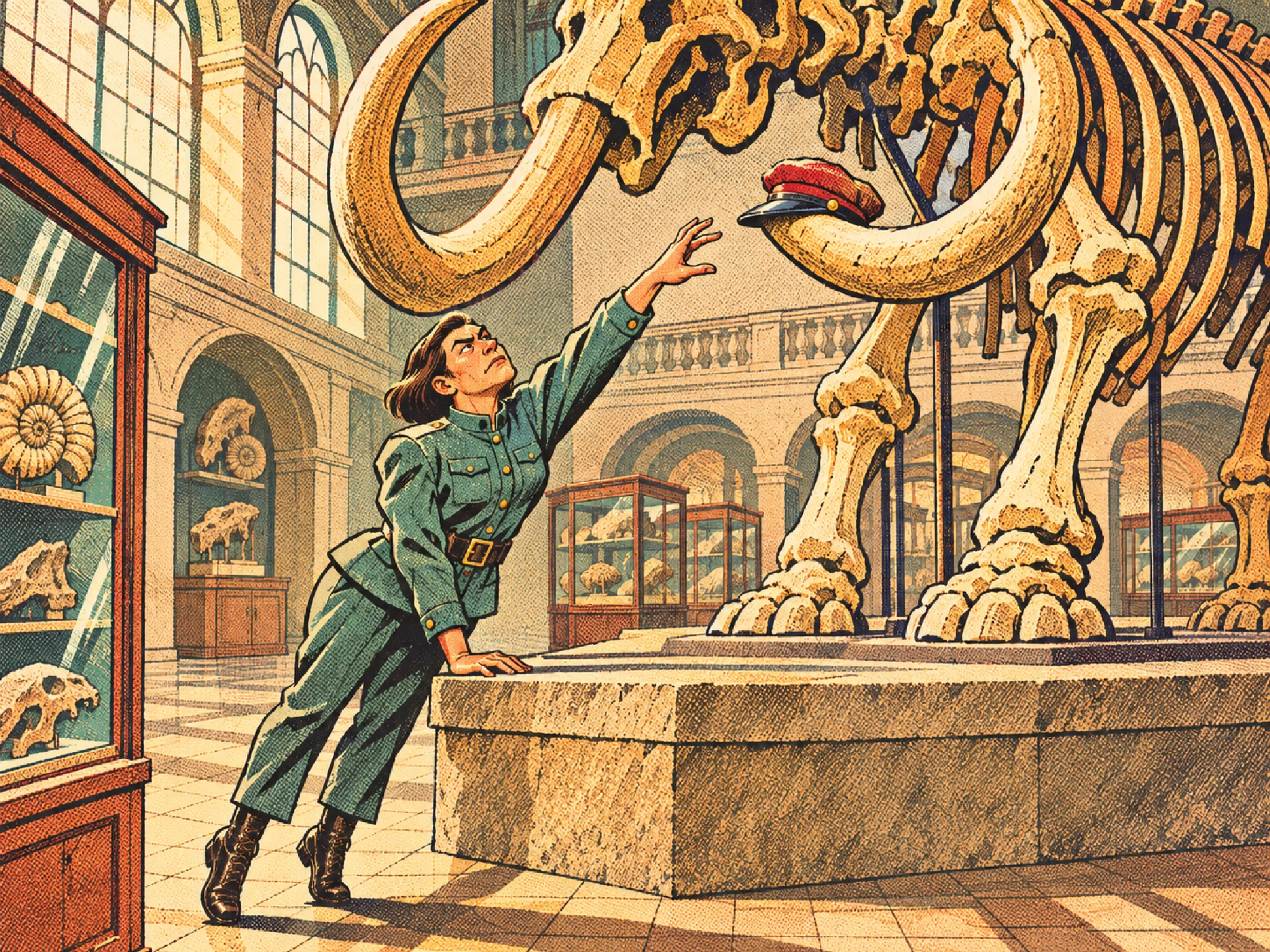
A museum guard stretches onto tiptoe for her hat caught on a mammoth tusk. Heavy brushwork, coarse halftones and imperfect color registration give the layered fossil hall a comic charge.
Remix this referenceReaching for a Hat on a Mammoth Tusk
- Form language
- Compress complex forms into interlocking wedges, arcs and broad masses; retain selective irregularities instead of mechanically repeating shapes.
- Contour
- Use brush-ink contours that swell on long turns and taper sharply at breaks, with occasional dry skips and blunt interior accents.
- Mark-making
- Lay coarse screened dots in broad patches, interrupted by short directional hatching; let dot edges and ink deposits vary naturally.
- Surface rendering
- Build tones from exposed paper, halftone steps and pooled solid ink; slight color misregistration gives edges a worn printed vibration.
Priority
Rendering medium: retro halftone comic illustration in brush ink and imperfect color printing.
What to avoid & what to check
Exact prompt for this example
MODULE OWNERSHIP
subject: Subject count, type, stable proportions and landmarks, resting face geometry, hair shape, physical materials, garment construction and permanent marks. No emotion, movement, color assignment or rendering recipe.
expression: Facial soft-tissue displacement and pupil direction, muscle coordination, regional intensity, asymmetry and onset/peak/release. No head/body pose, stable appearance, skin color or rendering.
gesture: Head/neck/body/limb orientation, joint movement, support, contact and pose-caused occlusion using existing anatomy. No eye/pupil movement, emotion, identity, props inventory or camera.
props: Prop count, type, construction, physical material and scale relative to the subject. Holding/contact belongs to gesture, position to composition, color to palette.
scene: Environment elements, terrain, backdrop/floor presence and structural detail. No canvas positions, camera, lighting, assigned colors or render texture.
camera: Projection, focal-length impression, camera elevation/yaw/roll, viewing distance and crop. No actor pose, world placement, lighting or canvas aspect ratio.
composition: Normalized 0-100% canvas positions, scale in frame, depth/overlap, focal hierarchy and margins. No joint pose, camera projection, rendering, subject/prop inventory or emotion.
palette: Color anchors, hue/saturation/value ranges, colors assigned to parts and approximate color coverage. No illumination direction, shading algorithm, physical material or layout.
lighting: Light-source direction/softness/intensity, ambient illumination, physical shadow direction/length and highlight position. Absence of directional illumination is allowed. No shading technique, palette or material changes.
style: Reusable form abstraction, contour weight/taper/edge quality, medium and mark scale/density/direction, surface rendering and tonal transition technique. No fixed subject proportions, anatomy, identity, expression, pose, palette, light-source direction, camera or layout.
output: Image count, aspect ratio, size, file/alpha requirements and global lettering/logo/watermark restrictions. No background scenery, crop, style, identity or pose.

SUBJECT
inventory: A is one adult woman employed as a museum guard; no other living figures.
geometry: A has a sturdy build, a long nose, a broad chin and a compact head relative to her shoulders.
resting-face: Her resting features are straight brows, deep-set eyes, a wide mouth and softly folded lower cheeks.
appearance: Short hair forms a blunt wedge behind her ears; she wears a cloth stand-collar jacket, straight trousers and leather boots.

PRIORITY


AVOID


CHECK


EXPRESSION — ACTOR A
brows: Brows draw inward, with one inner end slightly higher.
lids: Upper lids narrow slightly; lower lids tighten beneath the pupils.
cheeks: Cheeks tense mildly without lifting into a smile.
nose: Nostrils widen subtly without wrinkling the bridge.
mouth: Lips press together, with one corner pulled sideways.
jaw: The jaw remains closed with a small tightening at its corners.
gaze: Both pupils aim upward toward the cap's nearest edge.
coordination: The concentrated eyes and crooked lip compression share a restrained comic strain.
timing: Freeze the apex of concentration, before the lips or lids relax.

PRIORITY


AVOID


CHECK


GESTURE
head: A extends her neck and tips her head back toward the tusk.
torso: Her torso stretches diagonally from a braced hip, with a slight sideways bend.
limbs: One arm reaches overhead with spread fingertips; the other stays low, while both heels lift unevenly.
contact: A stands with her weight supported by her boot toes; her low palm braces the plinth and her reaching fingers stop just short of the cap.

PRIORITY


AVOID


CHECK


PROPS
inventory: One mounted mammoth skeleton roughly three times A's height and one cloth uniform cap sized for her.
construction: Mineralized bones and sweeping tusks are joined by a discreet metal armature; the cap has a soft crown and stiff visor.

PRIORITY


AVOID


CHECK


SCENE
inventory: A paleontology hall with a stone display plinth, fossil cabinets, tiled flooring, tall windows and an arched gallery.
structure: Repeated gallery openings connect the hall to adjoining rooms; cabinet glass and recessed wall niches add structural layers.

PRIORITY


AVOID


CHECK


CAMERA
projection: Use moderately wide perspective with a spacious interior impression and restrained edge distortion.
viewpoint: View from chest height, slightly upward and obliquely across the display, with no roll.
crop: Include A's entire figure and the reaching gap; crop a cabinet edge and allow the mammoth's rear body and upper architecture to leave the frame.

PRIORITY


AVOID


CHECK


COMPOSITION
placement: A is positioned around 40% across the canvas; her hand and cap converge near 65% across and 30% down.
depth: A cabinet edge leads into A, overlapping tusks and ribs, then the distant gallery; the hand-cap gap leads attention.
spacing: Let the skeleton dominate the frame while preserving open space around her face, fingertips and the small cap.

PRIORITY


AVOID


CHECK


PALETTE
colors: Anchor the image in warm paper cream, mustard ochre, muted turquoise, brick red and near-black indigo.
assignment: Use ochre and cream for fossils, turquoise for the uniform, brick red for the cap, and indigo for deepest accents.
balance: Cream and ochre occupy most of the image; cooler passages support the small, stronger red accent and warm skin tones.

PRIORITY


AVOID


CHECK


LIGHTING
sources: Broad window light enters from the upper left, supported by gentle ambient illumination throughout the hall.
shadows: Soft-edged shadows fall toward the lower right; overlapping ribs cast distinct but softened bands.
highlights: Light catches the upper-left tusk rims, the raised sleeve ridge and the cap's exposed visor.

PRIORITY


AVOID


CHECK


STYLE GUIDE
form-language: Compress complex forms into interlocking wedges, arcs and broad masses; retain selective irregularities instead of mechanically repeating shapes.
contour: Use brush-ink contours that swell on long turns and taper sharply at breaks, with occasional dry skips and blunt interior accents.
mark-making: Lay coarse screened dots in broad patches, interrupted by short directional hatching; let dot edges and ink deposits vary naturally.
surface-rendering: Build tones from exposed paper, halftone steps and pooled solid ink; slight color misregistration gives edges a worn printed vibration.

PRIORITY
Rendering medium: retro halftone comic illustration in brush ink and imperfect color printing.

AVOID


CHECK


OUTPUT
format: One finished image, landscape 4:3, 2048 × 1536 pixels, opaque PNG.
restrictions: No dialogue, captions, readable signage, logos or watermarks.

PRIORITY


AVOID


CHECK


FINAL INTEGRATION
gesture + composition + props: Coordinate the reach and display overlap so the almost-achieved contact remains immediately legible.
style + lighting + palette: Translate the illumination through the print vocabulary while retaining clear separation between the limited colors.
Model information comes from image provenance. The same prompt may produce a different result.