Text to imageProductStyle guide
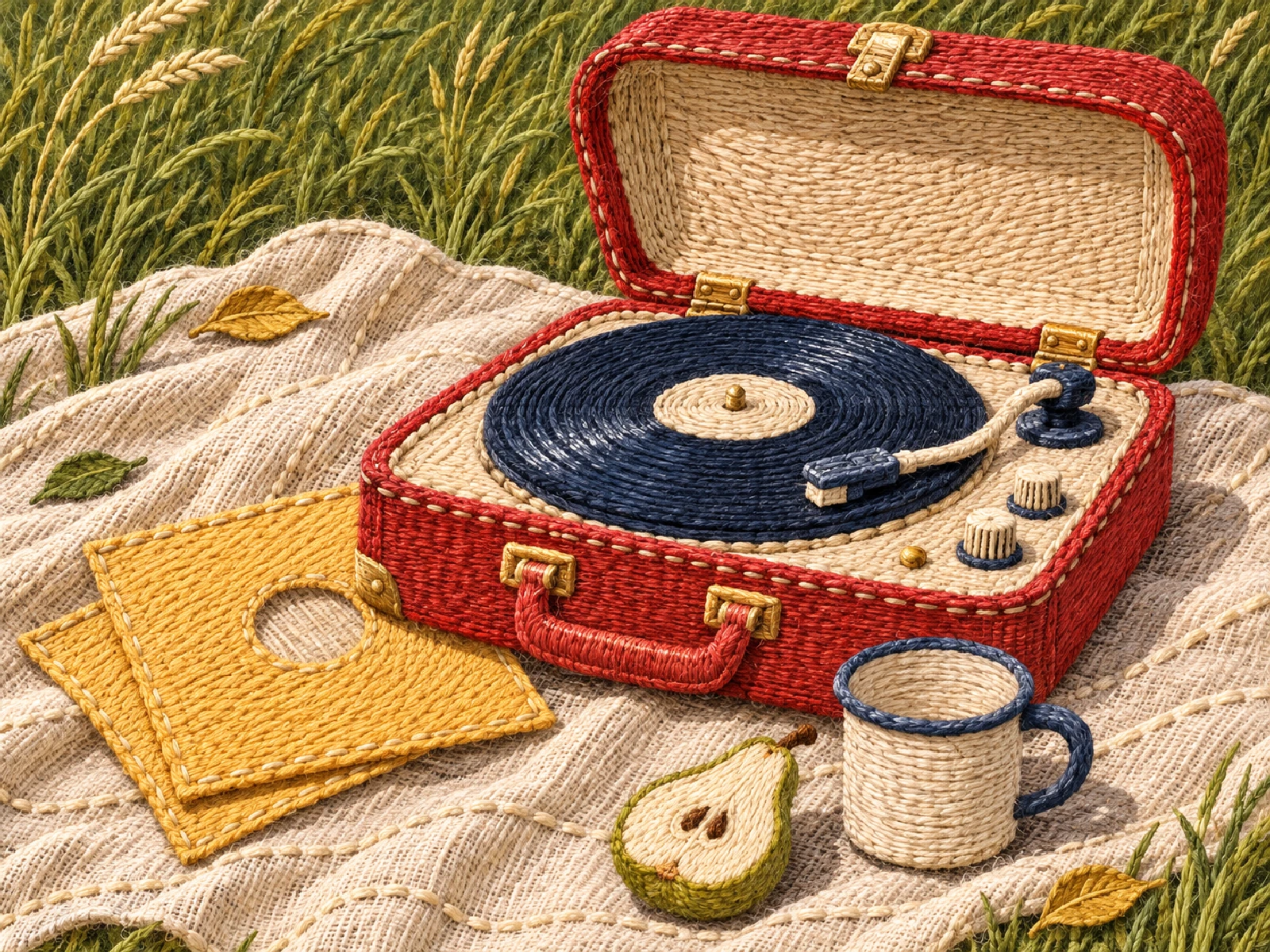
A Record Player on the Picnic Cloth
Record sleeves, a pear, and a cup overlap around an open suitcase record player. Raised thread turns the scattered aftermath of a picnic into a lively product illustration.
Remix this referenceA Record Player on the Picnic Cloth
- Form language
- Translate forms into supple embroidered patches, simplifying small details while allowing slightly uneven handmade shapes.
- Contour
- Use couched cords for selected boundaries and loose stitch endings elsewhere; avoid enclosing every shape with identical borders.
- Mark-making
- Combine broad satin-stitch bundles with running stitches and curved thread paths; vary stitch length with the local form.
- Surface rendering
- Keep raised strands and occasional base-cloth gaps visible; make tonal transitions through interleaved threads and changing stitch density.
Priority
The finished illustration must read as embroidered textile with palpable thread relief.
What to avoid & what to check
Exact prompt for this example
MODULE OWNERSHIP
subject: Subject count, type, stable proportions and landmarks, resting face geometry, hair shape, physical materials, garment construction and permanent marks. No emotion, movement, color assignment or rendering recipe.
expression: Facial soft-tissue displacement and pupil direction, muscle coordination, regional intensity, asymmetry and onset/peak/release. No head/body pose, stable appearance, skin color or rendering.
gesture: Head/neck/body/limb orientation, joint movement, support, contact and pose-caused occlusion using existing anatomy. No eye/pupil movement, emotion, identity, props inventory or camera.
props: Prop count, type, construction, physical material and scale relative to the subject. Holding/contact belongs to gesture, position to composition, color to palette.
scene: Environment elements, terrain, backdrop/floor presence and structural detail. No canvas positions, camera, lighting, assigned colors or render texture.
camera: Projection, focal-length impression, camera elevation/yaw/roll, viewing distance and crop. No actor pose, world placement, lighting or canvas aspect ratio.
composition: Normalized 0-100% canvas positions, scale in frame, depth/overlap, focal hierarchy and margins. No joint pose, camera projection, rendering, subject/prop inventory or emotion.
palette: Color anchors, hue/saturation/value ranges, colors assigned to parts and approximate color coverage. No illumination direction, shading algorithm, physical material or layout.
lighting: Light-source direction/softness/intensity, ambient illumination, physical shadow direction/length and highlight position. Absence of directional illumination is allowed. No shading technique, palette or material changes.
style: Reusable form abstraction, contour weight/taper/edge quality, medium and mark scale/density/direction, surface rendering and tonal transition technique. No fixed subject proportions, anatomy, identity, expression, pose, palette, light-source direction, camera or layout.
output: Image count, aspect ratio, size, file/alpha requirements and global lettering/logo/watermark restrictions. No background scenery, crop, style, identity or pose.

SUBJECT
inventory: One original suitcase record player; no people or animals.
geometry: A shallow rounded case contains a circular platter, curved tonearm, small control knobs, and a hinged lid.
resting-face: No facial anatomy applies.
appearance: Use a leatherette-wrapped plywood shell, metal fittings, a rubber platter, and molded control knobs.

PRIORITY


AVOID


CHECK


GESTURE
head: No head or neck joint control targets apply.
torso: The case sits level with its hinged lid raised open.
limbs: No limb joint control targets apply.
contact: The case base rests on the picnic cloth; the hinge supports the raised lid.

PRIORITY


AVOID


CHECK


PROPS
inventory: One vinyl record, two paper record sleeves, one enamel cup, and one halved pear.
construction: The record fits the platter; square sleeves are slightly wider, while the cup and pear are handheld in scale.

PRIORITY


AVOID


CHECK


SCENE
inventory: A creased picnic cloth rests in long meadow grass, with a few fallen leaves.
structure: The cloth has broad folds and an uneven hem; grass tufts emerge along its irregular boundary.

PRIORITY


AVOID


CHECK


CAMERA
projection: Use a natural perspective with a mild wide-angle impression and restrained convergence.
viewpoint: View the arrangement obliquely from above and from the player's front-right, with level roll.
crop: Use a close environmental view that retains the complete player while cropping portions of the surrounding picnic.

PRIORITY


AVOID


CHECK


COMPOSITION
placement: Place the player above and right of center; let the cloth and sleeves extend diagonally toward the lower-left edge.
depth: Align the record within the platter; overlap the sleeves with the case edge, and set the pear and cup farther forward.
spacing: Make the player the primary focus, with clustered overlaps and small open cloth intervals keeping its silhouette readable.

PRIORITY


AVOID


CHECK


PALETTE
colors: Use tomato red, ink blue, straw yellow, moss green, and soft cream.
assignment: Give the case tomato red, record ink blue, cloth cream, sleeves straw yellow, and grass and pear moss green.
balance: Let cream and green provide the broad ground, with concentrated red and blue and smaller straw-yellow passages.

PRIORITY


AVOID


CHECK


LIGHTING
sources: Soft daylight enters from the upper-left with gentle ambient fill.
shadows: Short shadows extend toward the lower-right; shallow stitch shadows reveal the thread relief.
highlights: Small highlights catch upper-left thread ridges and the exposed rims of the fittings.

PRIORITY


AVOID


CHECK


STYLE GUIDE
form-language: Translate forms into supple embroidered patches, simplifying small details while allowing slightly uneven handmade shapes.
contour: Use couched cords for selected boundaries and loose stitch endings elsewhere; avoid enclosing every shape with identical borders.
mark-making: Combine broad satin-stitch bundles with running stitches and curved thread paths; vary stitch length with the local form.
surface-rendering: Keep raised strands and occasional base-cloth gaps visible; make tonal transitions through interleaved threads and changing stitch density.

PRIORITY
The finished illustration must read as embroidered textile with palpable thread relief.

AVOID


CHECK


OUTPUT
format: Deliver one image at 4:3, 1600 × 1200 pixels, as an opaque PNG.
restrictions: No lettering, logos, signatures, borders, or watermarks; record labels and sleeves remain unlettered.

PRIORITY


AVOID


CHECK


FINAL INTEGRATION
subject + style + composition: Embroidered simplification and overlapping forms should preserve recognition of the player's essential construction.
Model information comes from image provenance. The same prompt may produce a different result.