Text to imageCafe & brandStyle guide
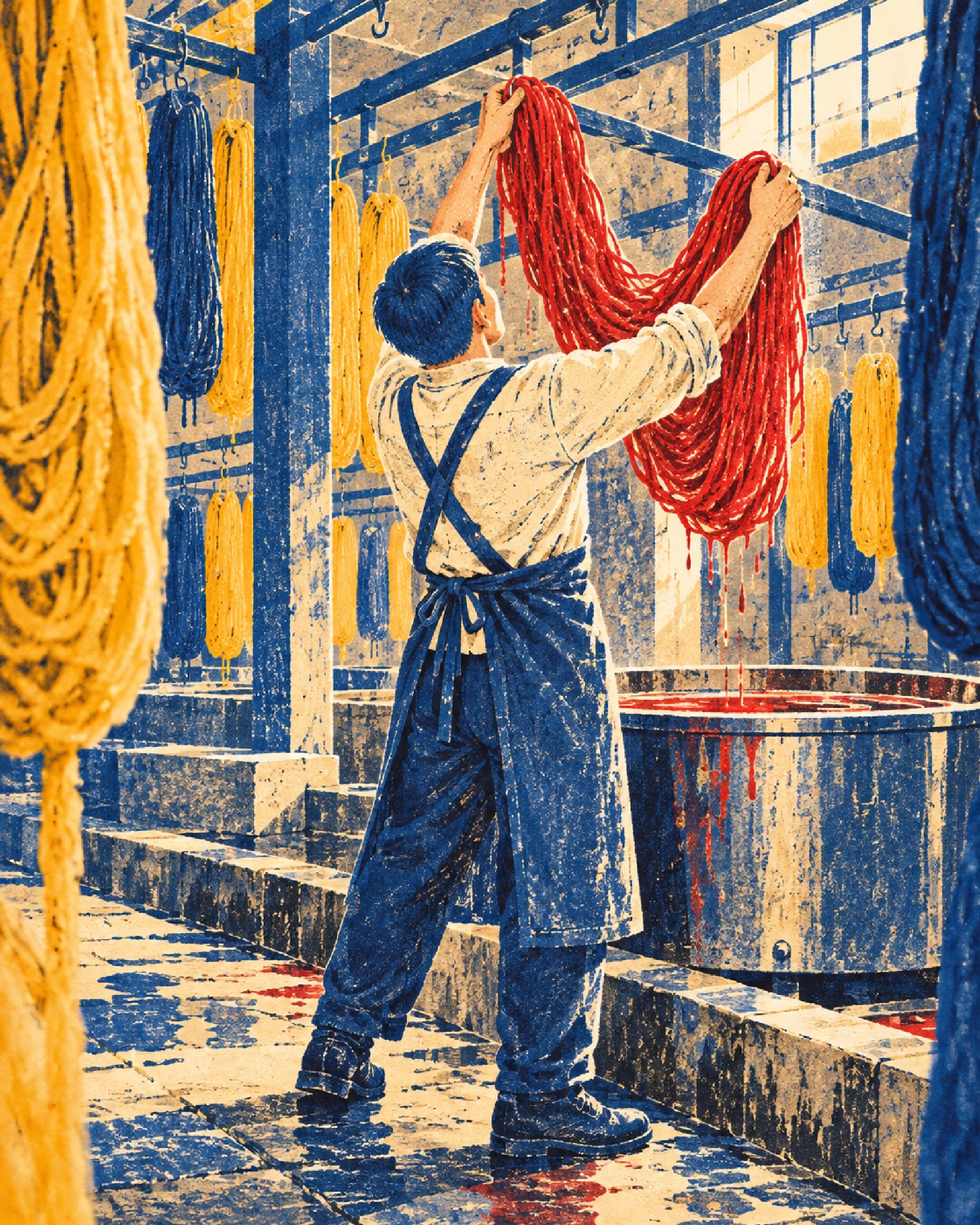
A Dyer Spreading a Skein Above the Vat
A dyer spreads a wet skein between both hands inside a layered workshop. Grainy riso impressions and playful registration offsets turn the gesture into a tactile yarn-brand image.
Remix this referenceA Dyer Spreading a Skein Above the Vat
- Form language
- Translate volumes into buoyant cut-stencil masses, using irregular internal gaps to separate neighboring forms.
- Contour
- Favor blunt, slightly ragged edges with occasional thin contour fragments and naturally uneven cuts.
- Mark-making
- Use grainy riso impressions and loose parallel strokes that curve and separate, with naturally varying density.
- Surface rendering
- Let translucent ink layers overprint into secondary tones; playful registration slips leave small exposed edge echoes.
Priority
Preserve the visibly imperfect grain and overlapping ink behavior of a riso print.
What to avoid & what to check
Exact prompt for this example
MODULE OWNERSHIP
subject: Subject count, type, stable proportions and landmarks, resting face geometry, hair shape, physical materials, garment construction and permanent marks. No emotion, movement, color assignment or rendering recipe.
expression: Facial soft-tissue displacement and pupil direction, muscle coordination, regional intensity, asymmetry and onset/peak/release. No head/body pose, stable appearance, skin color or rendering.
gesture: Head/neck/body/limb orientation, joint movement, support, contact and pose-caused occlusion using existing anatomy. No eye/pupil movement, emotion, identity, props inventory or camera.
props: Prop count, type, construction, physical material and scale relative to the subject. Holding/contact belongs to gesture, position to composition, color to palette.
scene: Environment elements, terrain, backdrop/floor presence and structural detail. No canvas positions, camera, lighting, assigned colors or render texture.
camera: Projection, focal-length impression, camera elevation/yaw/roll, viewing distance and crop. No actor pose, world placement, lighting or canvas aspect ratio.
composition: Normalized 0-100% canvas positions, scale in frame, depth/overlap, focal hierarchy and margins. No joint pose, camera projection, rendering, subject/prop inventory or emotion.
palette: Color anchors, hue/saturation/value ranges, colors assigned to parts and approximate color coverage. No illumination direction, shading algorithm, physical material or layout.
lighting: Light-source direction/softness/intensity, ambient illumination, physical shadow direction/length and highlight position. Absence of directional illumination is allowed. No shading technique, palette or material changes.
style: Reusable form abstraction, contour weight/taper/edge quality, medium and mark scale/density/direction, surface rendering and tonal transition technique. No fixed subject proportions, anatomy, identity, expression, pose, palette, light-source direction, camera or layout.
output: Image count, aspect ratio, size, file/alpha requirements and global lettering/logo/watermark restrictions. No background scenery, crop, style, identity or pose.

SUBJECT
inventory: A: one adult artisan.
geometry: An ordinarily proportioned adult with sturdy forearms and a compact head shape.
resting-face: Facial landmarks remain unspecified.
appearance: Short rounded cropped hair, a woven work shirt, and a heavy canvas apron with crossed back straps.

PRIORITY


AVOID


CHECK


EXPRESSION — ACTOR A
brows: Brow displacement remains unprescribed.
lids: Eyelid opening and tension remain unprescribed.
cheeks: Cheek lifting or compression remains unprescribed.
nose: Nasal soft-tissue movement remains unprescribed.
mouth: Lip shape and mouth opening remain unprescribed.
jaw: Jaw release or clenching remains unprescribed.
gaze: Pupil direction remains unprescribed.
coordination: Facial muscle coordination and asymmetry remain unprescribed.
timing: Neutral apex; no facial transition is prescribed.

PRIORITY


AVOID


CHECK


GESTURE
head: A faces away, with the neck gently extended toward the raised hands; the face stays concealed.
torso: A shifts weight slightly backward while keeping the torso upright above a planted stance.
limbs: Both arms reach upward and apart with softly bent elbows; separated feet support the stance.
contact: Each hand grips one side of the same yarn loop, drawing its strands apart under gentle tension.

PRIORITY


AVOID


CHECK


PROPS
inventory: One wet yarn skein, several drying skeins, and one waist-high dye vat.
construction: Long wool loops have loose ties; the broad stainless-steel vat has a rolled rim.

PRIORITY


AVOID


CHECK


SCENE
inventory: A deep dye workshop with drying rails, a high ventilation window, and a stone floor.
structure: Overhead rails span successive work bays; a recessed wash channel runs along the wall.

PRIORITY


AVOID


CHECK


CAMERA
projection: Moderate wide-angle perspective gives the workshop an enveloping depth.
viewpoint: View from just below shoulder height, behind A and slightly to one side, with no roll.
crop: Include A's full figure and the overhead rails; nearby hanging skeins may extend beyond the frame.

PRIORITY


AVOID


CHECK


COMPOSITION
placement: A occupies roughly 45% across the canvas; the skein above the low vat forms the primary focal span.
depth: Cropped foreground skeins frame A without covering the hands; rails and smaller skeins recede behind.
spacing: An open pocket between the arms separates the focal span from the denser layers at either side.

PRIORITY


AVOID


CHECK


PALETTE
colors: Tomato red, deep cobalt, butter yellow, and warm unprinted paper.
assignment: Red colors the handled yarn, cobalt the apron and structure, yellow the drying yarn, and paper the shirt and skin.
balance: Cobalt and paper carry broad passages; the handled skein carries the most saturated red.

PRIORITY


AVOID


CHECK


LIGHTING
sources: Soft window light comes from upper right, supported by diffuse workshop ambient light.
shadows: Broad shadows fall leftward beneath the vat and between overlapping yarn loops.
highlights: Light catches the upper-right vat rim and the outer edges of the handled yarn.

PRIORITY


AVOID


CHECK


STYLE GUIDE
form-language: Translate volumes into buoyant cut-stencil masses, using irregular internal gaps to separate neighboring forms.
contour: Favor blunt, slightly ragged edges with occasional thin contour fragments and naturally uneven cuts.
mark-making: Use grainy riso impressions and loose parallel strokes that curve and separate, with naturally varying density.
surface-rendering: Let translucent ink layers overprint into secondary tones; playful registration slips leave small exposed edge echoes.

PRIORITY
Preserve the visibly imperfect grain and overlapping ink behavior of a riso print.

AVOID


CHECK


OUTPUT
format: One image, 4:5 portrait, 1600 × 2000 pixels, opaque PNG.
restrictions: No lettering, logos, or watermarks.

PRIORITY


AVOID


CHECK
Model information comes from image provenance. The same prompt may produce a different result.