Text to imagePortraitStyle guide
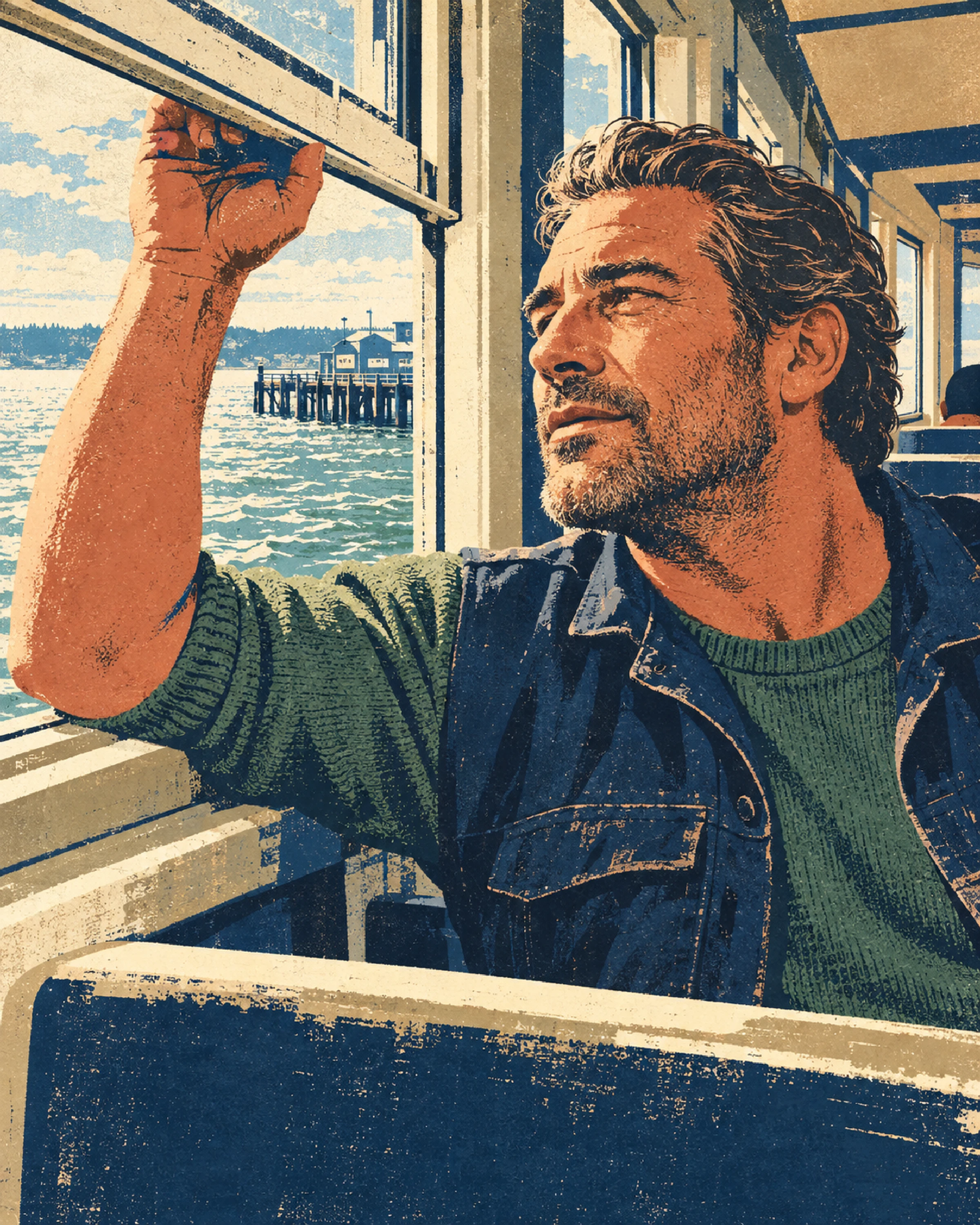
Man Raising the Ferry Window
A man lifts a ferry window and turns toward the sea air. His raised arm and the layered cabin structure create decisive screen-printed shape rhythms.
Remix this referenceMan Raising the Ferry Window
- Form language
- Reduce volumes to interlocking blocks and long countershapes; alternate broad masses with narrow cuts for decisive rhythm.
- Contour
- Use thick silhouette cuts that taper into fine internal notches; vary edge firmness without continuous outlining.
- Mark-making
- Show uneven ink pulls, occasional dry pinholes and small registration slips; let marks vary naturally within each pass.
- Surface rendering
- Build tone with overlapping screen-printed fields and exposed paper breaks; reserve rubbed transitions for a few turning planes.
Priority
Make graphic screen printing and decisive shape rhythms unmistakable.
What to avoid & what to check
Exact prompt for this example
MODULE OWNERSHIP
subject: Subject count, type, stable proportions and landmarks, resting face geometry, hair shape, physical materials, garment construction and permanent marks. No emotion, movement, color assignment or rendering recipe.
expression: Facial soft-tissue displacement and pupil direction, muscle coordination, regional intensity, asymmetry and onset/peak/release. No head/body pose, stable appearance, skin color or rendering.
gesture: Head/neck/body/limb orientation, joint movement, support, contact and pose-caused occlusion using existing anatomy. No eye/pupil movement, emotion, identity, props inventory or camera.
props: Prop count, type, construction, physical material and scale relative to the subject. Holding/contact belongs to gesture, position to composition, color to palette.
scene: Environment elements, terrain, backdrop/floor presence and structural detail. No canvas positions, camera, lighting, assigned colors or render texture.
camera: Projection, focal-length impression, camera elevation/yaw/roll, viewing distance and crop. No actor pose, world placement, lighting or canvas aspect ratio.
composition: Normalized 0-100% canvas positions, scale in frame, depth/overlap, focal hierarchy and margins. No joint pose, camera projection, rendering, subject/prop inventory or emotion.
palette: Color anchors, hue/saturation/value ranges, colors assigned to parts and approximate color coverage. No illumination direction, shading algorithm, physical material or layout.
lighting: Light-source direction/softness/intensity, ambient illumination, physical shadow direction/length and highlight position. Absence of directional illumination is allowed. No shading technique, palette or material changes.
style: Reusable form abstraction, contour weight/taper/edge quality, medium and mark scale/density/direction, surface rendering and tonal transition technique. No fixed subject proportions, anatomy, identity, expression, pose, palette, light-source direction, camera or layout.
output: Image count, aspect ratio, size, file/alpha requirements and global lettering/logo/watermark restrictions. No background scenery, crop, style, identity or pose.

SUBJECT
inventory: One original middle-aged human man, actor A.
geometry: A broad-built man with a long rectangular face, prominent nose bridge and substantial hands.
resting-face: Straight brows, hooded eyes, broad nostrils and a narrow upper lip above a fuller lower lip.
appearance: Swept-back wavy hair, close stubble and a canvas work vest over a knitted shirt; small garment details may vary.

PRIORITY


AVOID


CHECK


EXPRESSION — ACTOR A
brows: The inner brows settle apart as the central pinch releases.
lids: Upper lids ease downward; lower lids remain gently engaged.
cheeks: Cheek tension softens, with a slight lift beside one mouth corner.
nose: Nostrils relax without flaring or wrinkling.
mouth: Lips part for a quiet exhale; one corner lifts faintly.
jaw: The jaw releases slightly without opening into a yawn.
gaze: Pupils look sideways through the open window toward the water.
coordination: The softened brow and parted lips agree; retain the small asymmetry.
timing: Catch the release just after tension gives way to an exhale.

PRIORITY


AVOID


CHECK


GESTURE
head: Turn the head toward the window, with the chin lifted slightly into the opening.
torso: Lean the upper torso toward the window while keeping the shoulders loosely uneven.
limbs: Lift the left forearm diagonally with a bent elbow; the wrist extends beneath the sash rail.
contact: The left palm supports the lower rail as it rises above brow level; keep the face unobstructed.

PRIORITY


AVOID


CHECK


PROPS
inventory: No separate props.
construction: No prop construction applies.

PRIORITY


AVOID


CHECK


SCENE
inventory: A passenger ferry cabin with built-in benches, a sliding window and a view of water and a distant pier.
structure: Vertical sash guides, deep window reveals and repeated bench backs establish a working cabin; the floor is unseen.

PRIORITY


AVOID


CHECK


CAMERA
projection: Natural perspective with a moderate wide-lens impression and restrained near-field enlargement.
viewpoint: View from inside the cabin at shoulder height, with a shallow three-quarter yaw and no roll.
crop: An upper-torso portrait that includes the entire raised hand and enough cabin to feel inhabited.

PRIORITY


AVOID


CHECK


COMPOSITION
placement: Place the face high on the right, the lifted hand near the upper middle and the open window across the left.
depth: Overlap the forearm with the window structure; let bench backs recede behind the shoulder and the pier sit far beyond.
spacing: The face leads, the hand follows and the cabin supports; preserve an open interval between cheek and window edge.

PRIORITY


AVOID


CHECK


PALETTE
colors: Use deep ink blue, muted terracotta, sea-glass green and warm paper cream.
assignment: Assign terracotta to skin, green to the shirt, blue to vest and deep accents, and cream to window framing.
balance: Blue and cream form the broad fields; terracotta carries the concentrated warmth, with green as a quieter bridge.

PRIORITY


AVOID


CHECK


LIGHTING
sources: Broad daylight enters from the upper left through the window, supported by weak cabin bounce.
shadows: Soft shadows fall down and right, gathering beneath the chin and raised forearm.
highlights: Keep broad highlights on the window-facing brow, nose bridge and upper edge of the hand.

PRIORITY


AVOID


CHECK


STYLE GUIDE
form-language: Reduce volumes to interlocking blocks and long countershapes; alternate broad masses with narrow cuts for decisive rhythm.
contour: Use thick silhouette cuts that taper into fine internal notches; vary edge firmness without continuous outlining.
mark-making: Show uneven ink pulls, occasional dry pinholes and small registration slips; let marks vary naturally within each pass.
surface-rendering: Build tone with overlapping screen-printed fields and exposed paper breaks; reserve rubbed transitions for a few turning planes.

PRIORITY
Make graphic screen printing and decisive shape rhythms unmistakable.

AVOID


CHECK


OUTPUT
format: One finished image, portrait 4:5 aspect ratio, 2400 × 3000 pixels, opaque PNG.
restrictions: No lettering, logos, signatures or watermarks.

PRIORITY


AVOID


CHECK
Model information comes from image provenance. The same prompt may produce a different result.