Text to imageProductStyle guide
Pannier Beside the Lock
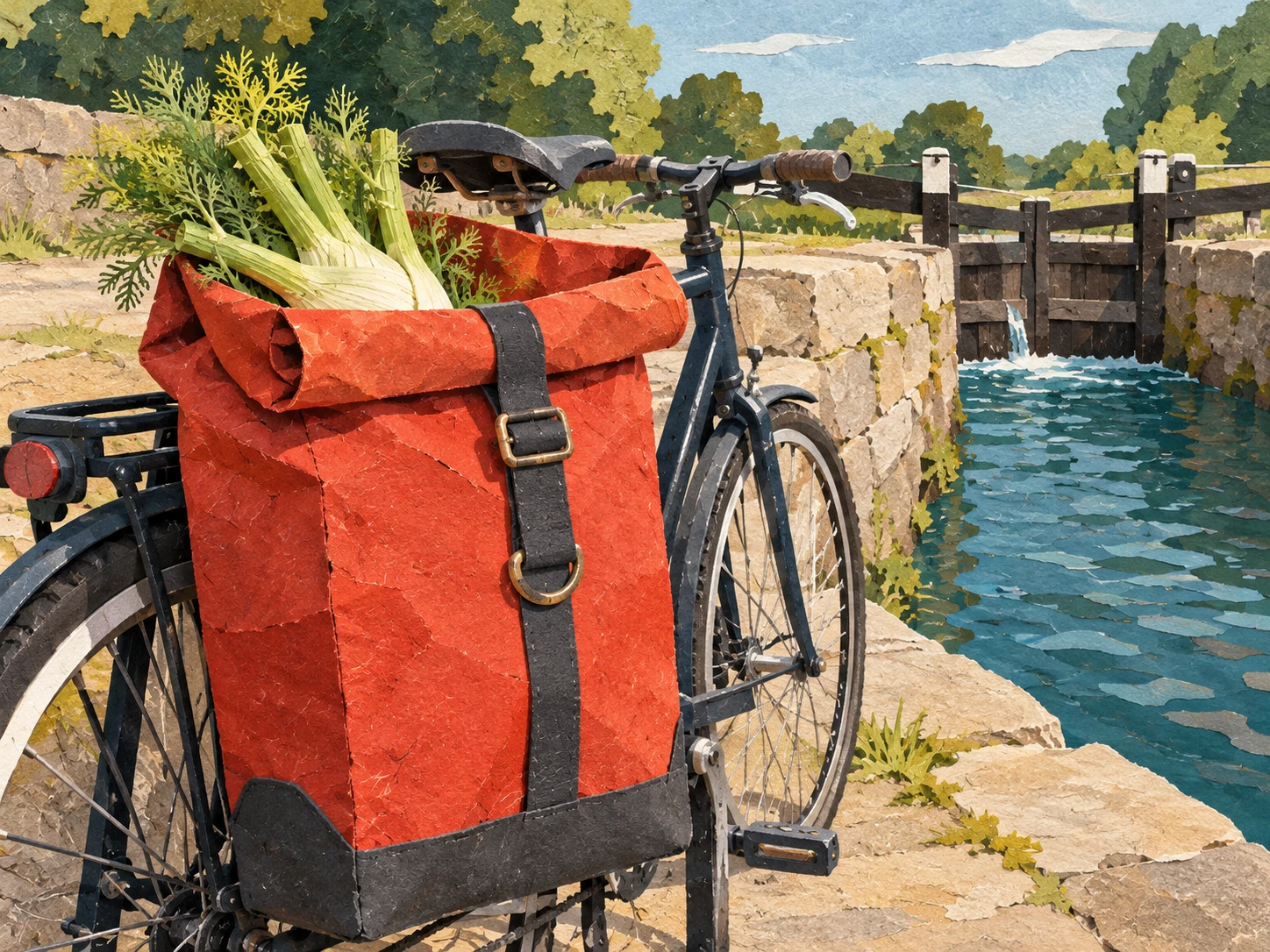
A roomy bicycle pannier and fresh fennel beside a canal lock, illustrated through tactile paper layers and spacious intervals.
Remix this referencePannier Beside the Lock
- Form language
- Build forms from nested cut-paper planes, simplifying minor detail into generous interlocking silhouettes.
- Contour
- Use scissor-cut edges with slight hand wobble; occasional torn edges soften transitions without an enclosing ink line.
- Mark-making
- Let sparse dragged pigment and visible paper fibers interrupt selected sheets; vary their density naturally.
- Surface rendering
- Make paper thickness and lifted overlaps tangible; use rubbed tonal patches within sheets rather than smooth digital modeling.
Priority
Preserve the tactile identity of layered cut-paper collage.
What to avoid & what to check
Exact prompt for this example
MODULE OWNERSHIP
subject: Subject count, type, stable proportions and landmarks, resting face geometry, hair shape, physical materials, garment construction and permanent marks. No emotion, movement, color assignment or rendering recipe.
expression: Facial soft-tissue displacement and pupil direction, muscle coordination, regional intensity, asymmetry and onset/peak/release. No head/body pose, stable appearance, skin color or rendering.
gesture: Head/neck/body/limb orientation, joint movement, support, contact and pose-caused occlusion using existing anatomy. No eye/pupil movement, emotion, identity, props inventory or camera.
props: Prop count, type, construction, physical material and scale relative to the subject. Holding/contact belongs to gesture, position to composition, color to palette.
scene: Environment elements, terrain, backdrop/floor presence and structural detail. No canvas positions, camera, lighting, assigned colors or render texture.
camera: Projection, focal-length impression, camera elevation/yaw/roll, viewing distance and crop. No actor pose, world placement, lighting or canvas aspect ratio.
composition: Normalized 0-100% canvas positions, scale in frame, depth/overlap, focal hierarchy and margins. No joint pose, camera projection, rendering, subject/prop inventory or emotion.
palette: Color anchors, hue/saturation/value ranges, colors assigned to parts and approximate color coverage. No illumination direction, shading algorithm, physical material or layout.
lighting: Light-source direction/softness/intensity, ambient illumination, physical shadow direction/length and highlight position. Absence of directional illumination is allowed. No shading technique, palette or material changes.
style: Reusable form abstraction, contour weight/taper/edge quality, medium and mark scale/density/direction, surface rendering and tonal transition technique. No fixed subject proportions, anatomy, identity, expression, pose, palette, light-source direction, camera or layout.
output: Image count, aspect ratio, size, file/alpha requirements and global lettering/logo/watermark restrictions. No background scenery, crop, style, identity or pose.

SUBJECT
inventory: One original roll-top bicycle pannier; no people or animals.
geometry: A tall, softly rectangular body has an open rollable throat, a reinforced base and a broad mounting panel.
resting-face: No face or facial landmarks apply.
appearance: Waxed canvas, woven webbing and rounded metal fittings define a practical, unadorned construction.

PRIORITY


AVOID


CHECK


PROPS
inventory: One city bicycle sized for the pannier and one fennel bunch small enough to fit inside it.
construction: The bicycle has a slender steel frame and tubular rear rack; the fennel combines firm bulbs with fine fronds.

PRIORITY


AVOID


CHECK


SCENE
inventory: A canal-side towpath, a masonry lock wall, water and a timber lock gate form the setting.
structure: Broad coping stones meet the towpath; the gate divides the waterway into simple connected recesses.

PRIORITY


AVOID


CHECK


CAMERA
projection: Use a natural perspective with a mild normal-lens impression and little edge distortion.
viewpoint: Look obliquely along the bicycle from baggage height, with a level horizon and a slight view into the bag.
crop: Use a medium-close view that includes the complete pannier while cropping portions of the bicycle.

PRIORITY


AVOID


CHECK


COMPOSITION
placement: The pannier dominates the lower-left third; the bicycle extends across the middle and the lock opens to the right.
depth: Fennel overlaps the bag opening; the bag overlaps the rack, followed by the lock wall and distant gate.
spacing: Make the bag the first read, then the fennel and canal; leave generous open intervals around the upper silhouette.

PRIORITY


AVOID


CHECK


PALETTE
colors: Use vermilion, deep petrol, oatmeal, pale citron and charcoal as the main anchors.
assignment: Give the bag vermilion, water petrol, masonry oatmeal, fennel citron and bicycle charcoal.
balance: Quiet oatmeal fields carry most of the image, with a concentrated warm accent and restrained dark structure.

PRIORITY


AVOID


CHECK


LIGHTING
sources: Broad daylight arrives from the upper left, supported by soft ambient light.
shadows: Short, soft shadows fall toward the lower right; close overlaps retain narrow contact shadows.
highlights: Keep highlights broad on upper-facing planes, with small restrained glints on exposed fittings.

PRIORITY


AVOID


CHECK


STYLE GUIDE
form-language: Build forms from nested cut-paper planes, simplifying minor detail into generous interlocking silhouettes.
contour: Use scissor-cut edges with slight hand wobble; occasional torn edges soften transitions without an enclosing ink line.
mark-making: Let sparse dragged pigment and visible paper fibers interrupt selected sheets; vary their density naturally.
surface-rendering: Make paper thickness and lifted overlaps tangible; use rubbed tonal patches within sheets rather than smooth digital modeling.

PRIORITY
Preserve the tactile identity of layered cut-paper collage.

AVOID


CHECK


OUTPUT
format: Not applicable.
restrictions: Deliver one finished 4:3 image, 2400 × 1800 pixels, as an opaque PNG; include no lettering, logos or watermarks.

PRIORITY


AVOID


CHECK


FINAL INTEGRATION
composition + style: Let the spacing between layered shapes keep the product silhouette legible while allowing handmade irregularity.
Model information comes from image provenance. The same prompt may produce a different result.