Text to imageArt stylesStyle guide
A Mountain Pass on a Cafeteria Tray
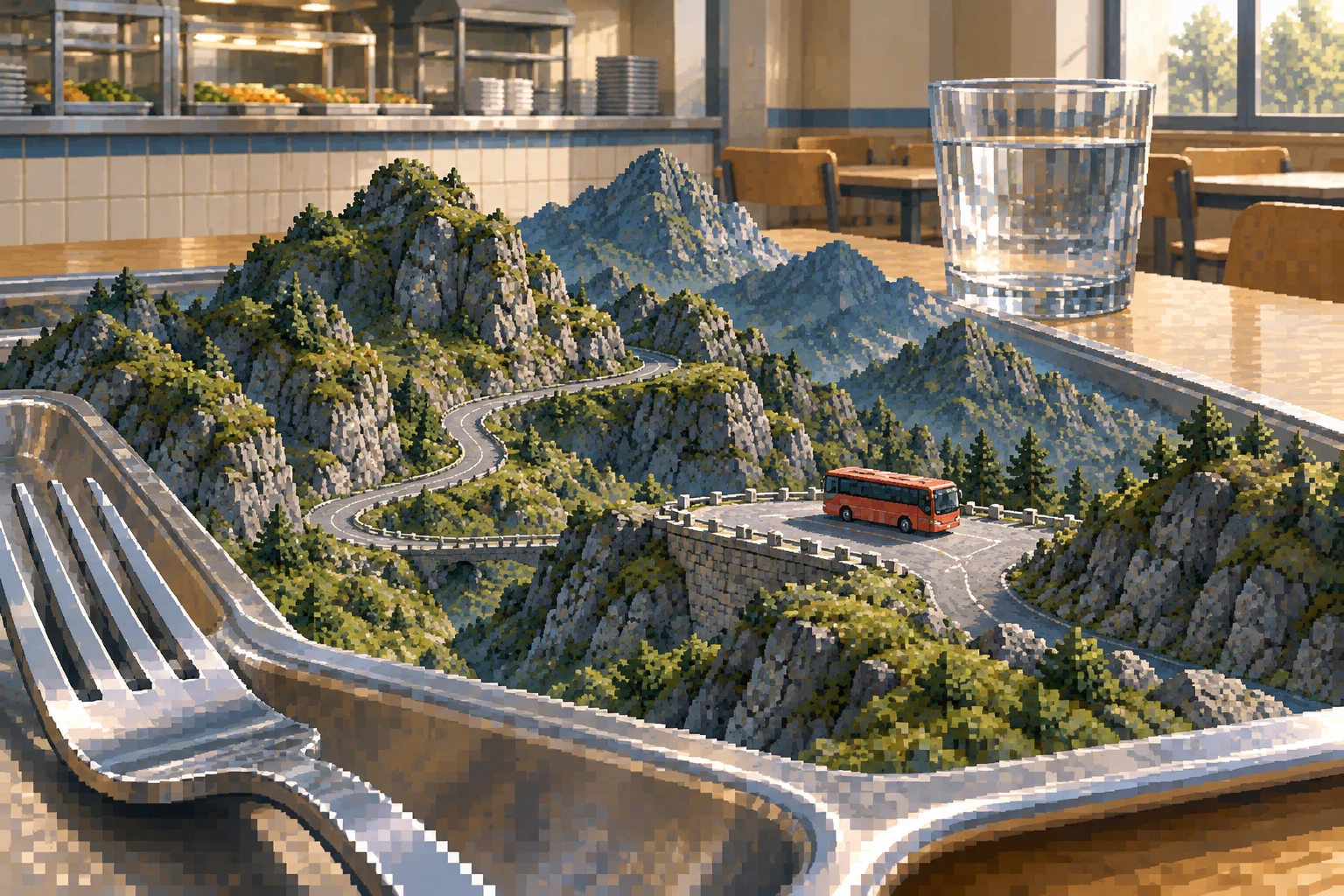
A tiny bus pauses on a mountain road contained by a cafeteria tray. A fork and water glass establish the impossible scale, while woven pixel clusters connect the dining room to the miniature wilderness.
Remix this referenceA Mountain Pass on a Cafeteria Tray
- Form language
- Build recognizable forms from interlocking rectangular clusters; simplify small details into stepped symbols rather than smooth miniatures.
- Contour
- Keep deliberate low-resolution stair steps, alternating chunky ledges with short broken edges; avoid uniformly outlined shapes.
- Mark-making
- Interleave short horizontal and vertical pixel runs like woven bands, allowing irregular gaps and occasional loose single blocks.
- Surface rendering
- Shift tone through clustered dither and overlapping block fields; vary their rhythm naturally while keeping every transition visibly pixel-built.
Priority
The woven cluster rhythm and unapologetically coarse edges define the image.
What to avoid & what to check
Exact prompt for this example
MODULE OWNERSHIP
subject: Subject count, type, stable proportions and landmarks, resting face geometry, hair shape, physical materials, garment construction and permanent marks. No emotion, movement, color assignment or rendering recipe.
expression: Facial soft-tissue displacement and pupil direction, muscle coordination, regional intensity, asymmetry and onset/peak/release. No head/body pose, stable appearance, skin color or rendering.
gesture: Head/neck/body/limb orientation, joint movement, support, contact and pose-caused occlusion using existing anatomy. No eye/pupil movement, emotion, identity, props inventory or camera.
props: Prop count, type, construction, physical material and scale relative to the subject. Holding/contact belongs to gesture, position to composition, color to palette.
scene: Environment elements, terrain, backdrop/floor presence and structural detail. No canvas positions, camera, lighting, assigned colors or render texture.
camera: Projection, focal-length impression, camera elevation/yaw/roll, viewing distance and crop. No actor pose, world placement, lighting or canvas aspect ratio.
composition: Normalized 0-100% canvas positions, scale in frame, depth/overlap, focal hierarchy and margins. No joint pose, camera projection, rendering, subject/prop inventory or emotion.
palette: Color anchors, hue/saturation/value ranges, colors assigned to parts and approximate color coverage. No illumination direction, shading algorithm, physical material or layout.
lighting: Light-source direction/softness/intensity, ambient illumination, physical shadow direction/length and highlight position. Absence of directional illumination is allowed. No shading technique, palette or material changes.
style: Reusable form abstraction, contour weight/taper/edge quality, medium and mark scale/density/direction, surface rendering and tonal transition technique. No fixed subject proportions, anatomy, identity, expression, pose, palette, light-source direction, camera or layout.
output: Image count, aspect ratio, size, file/alpha requirements and global lettering/logo/watermark restrictions. No background scenery, crop, style, identity or pose.

SUBJECT
inventory: One miniature intercity bus, with no visible occupants.
geometry: An elongated body, broad split windshield, recessed luggage panels and closely fitted wheels identify the bus.
resting-face: No face or facial landmarks apply.
appearance: Metal bodywork, glass windows and rubber tires; minor fittings may vary while preserving the bus silhouette.

PRIORITY


AVOID


CHECK


PROPS
inventory: One compartmented cafeteria tray, one dining fork and one drinking glass.
construction: Pressed steel tray with a rolled rim, steel fork and thick-bottomed glass; a fork tine exceeds the bus height.

PRIORITY


AVOID


CHECK


SCENE
inventory: A miniature mountain landscape within an ordinary cafeteria, with a tabletop and a tiled serving counter.
structure: Rocky ridges enclose a switchback road and a small roadside turnout; the cafeteria has simple practical architecture.

PRIORITY


AVOID


CHECK


CAMERA
projection: Moderate wide-angle perspective with clear near-to-far size changes.
viewpoint: Look obliquely down from seated dining height, with a level horizon and no roll.
crop: A close environmental view clips the near tray rim and part of the fork while retaining the mountain summits and cafeteria context.

PRIORITY


AVOID


CHECK


COMPOSITION
placement: The tray spans the lower two-thirds; the bus sits near 60% across and 58% down, at a break in the mountain mass.
depth: The fork overlaps the near rim; successive ridges lead to the bus, with the glass beyond and the serving counter in the distant cafeteria background.
spacing: Make the mountain road the first read, the bus its discovery, and the large utensils the scale reveal; leave open tabletop at one side.

PRIORITY


AVOID


CHECK


PALETTE
colors: Petrol blue, moss green, warm oatmeal and a small vermilion accent, with restrained saturation.
assignment: Use moss and petrol for the mountains, oatmeal for the cafeteria, blue-gray for the utensils and vermilion for the bus.
balance: Cool middle values dominate the landscape; pale surroundings provide relief and the bus supplies the smallest bright accent.

PRIORITY


AVOID


CHECK


LIGHTING
sources: Broad window light enters from the upper right, supported by gentle cafeteria ambient light.
shadows: Soft shadows fall toward the lower left, with deeper shelter beneath the ridges and tray rim.
highlights: Brief highlights catch the glass rim, fork shoulders and window-facing rock crests.

PRIORITY


AVOID


CHECK


STYLE GUIDE
form-language: Build recognizable forms from interlocking rectangular clusters; simplify small details into stepped symbols rather than smooth miniatures.
contour: Keep deliberate low-resolution stair steps, alternating chunky ledges with short broken edges; avoid uniformly outlined shapes.
mark-making: Interleave short horizontal and vertical pixel runs like woven bands, allowing irregular gaps and occasional loose single blocks.
surface-rendering: Shift tone through clustered dither and overlapping block fields; vary their rhythm naturally while keeping every transition visibly pixel-built.

PRIORITY
The woven cluster rhythm and unapologetically coarse edges define the image.

AVOID


CHECK


OUTPUT
format: One opaque image, landscape 3:2, 1536 × 1024 pixels; no lettering, logos or watermarks.
restrictions: One opaque image, landscape 3:2, 1536 × 1024 pixels; no lettering, logos or watermarks.

PRIORITY


AVOID


CHECK


FINAL INTEGRATION
props + scene + composition: The everyday dining objects make the landscape's impossible scale legible through their visual relationship.
style + lighting: Translate the broad illumination into the medium's block-based tonal vocabulary.
Model information comes from image provenance. The same prompt may produce a different result.