Text to imageAnimationStyle guide
A Giant Cone in the Seed House
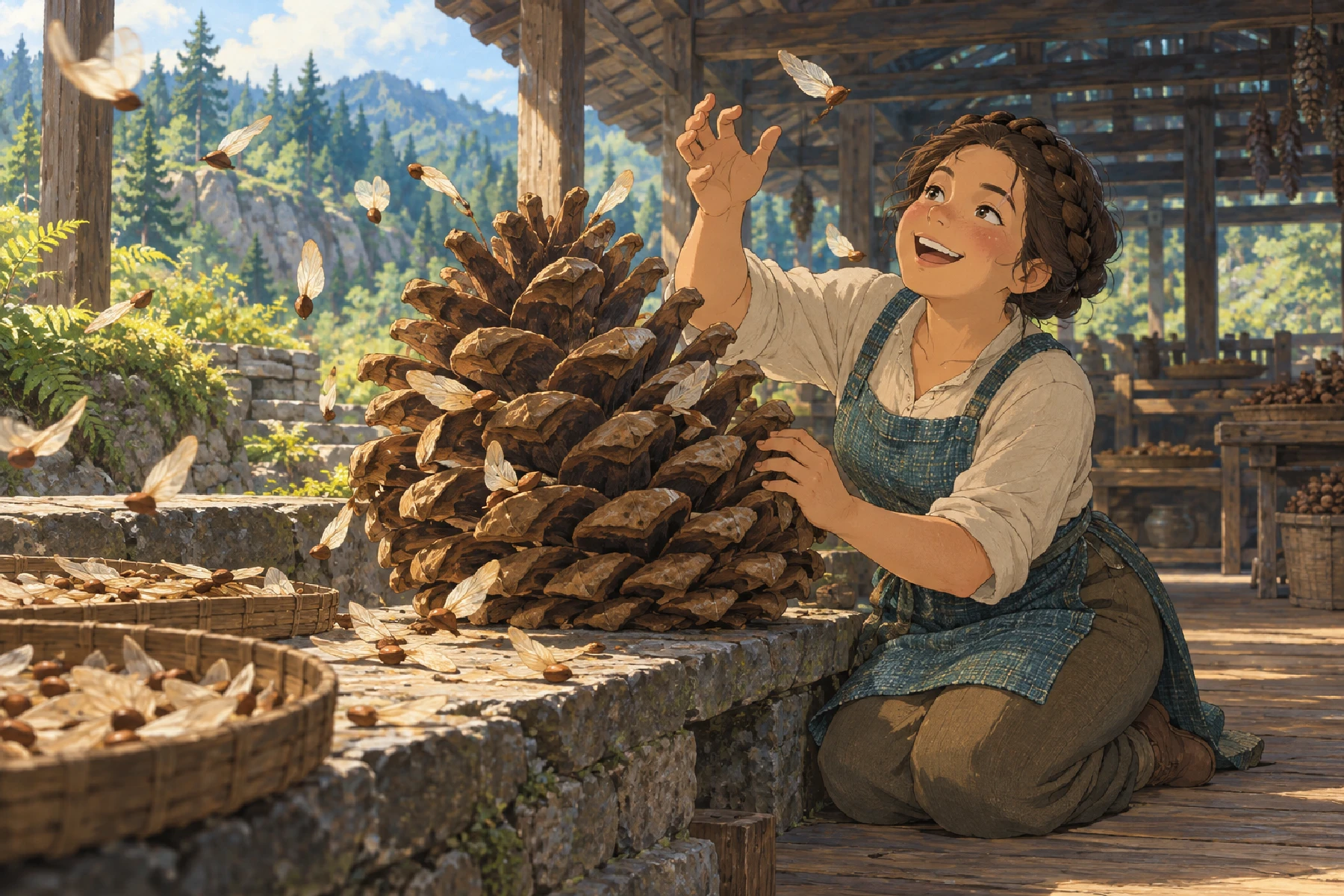
A seed keeper rocks back laughing as winged seeds spill from an enormous pine cone, with layers of conifer forest beyond the open drying house.
Remix this referenceA Giant Cone in the Seed House
- Form language
- Build broad interlocking painted planes first, then suggest smaller irregularities with selective patches; secondary details may vary naturally.
- Contour
- Alternate firm painted edges with softened or lost boundaries; reserve short tapered accents for necessary separations.
- Mark-making
- Layer unequal brush traces along each plane, with sparse broken dry-brush passages and occasional exposed underpainting.
- Surface rendering
- Let shallow paper-and-pigment grain interrupt uneven opaque paint; blend broad tonal changes while retaining local patchwork.
Priority
Rendering medium: 2D hand-painted animated-film background illustration; formal rendering reference: Studio Ghibli · 2020s · The Boy and the Heron (2023), background art
What to avoid & what to check
Exact prompt for this example
MODULE OWNERSHIP
subject: Subject count, type, stable proportions and landmarks, resting face geometry, hair shape, physical materials, garment construction and permanent marks. No emotion, movement, color assignment or rendering recipe.
expression: Facial soft-tissue displacement and pupil direction, muscle coordination, regional intensity, asymmetry and onset/peak/release. No head/body pose, stable appearance, skin color or rendering.
gesture: Head/neck/body/limb orientation, joint movement, support, contact and pose-caused occlusion using existing anatomy. No eye/pupil movement, emotion, identity, props inventory or camera.
props: Prop count, type, construction, physical material and scale relative to the subject. Holding/contact belongs to gesture, position to composition, color to palette.
scene: Environment elements, terrain, backdrop/floor presence and structural detail. No canvas positions, camera, lighting, assigned colors or render texture.
camera: Projection, focal-length impression, camera elevation/yaw/roll, viewing distance and crop. No actor pose, world placement, lighting or canvas aspect ratio.
composition: Normalized 0-100% canvas positions, scale in frame, depth/overlap, focal hierarchy and margins. No joint pose, camera projection, rendering, subject/prop inventory or emotion.
palette: Color anchors, hue/saturation/value ranges, colors assigned to parts and approximate color coverage. No illumination direction, shading algorithm, physical material or layout.
lighting: Light-source direction/softness/intensity, ambient illumination, physical shadow direction/length and highlight position. Absence of directional illumination is allowed. No shading technique, palette or material changes.
style: Reusable form abstraction, contour weight/taper/edge quality, medium and mark scale/density/direction, surface rendering and tonal transition technique. No fixed subject proportions, anatomy, identity, expression, pose, palette, light-source direction, camera or layout.
output: Image count, aspect ratio, size, file/alpha requirements and global lettering/logo/watermark restrictions. No background scenery, crop, style, identity or pose.

SUBJECT
inventory: One adult human woman, a seed keeper.
geometry: A sturdy build with broad hands, a rounded chin and a short nose; hair forms a compact braided crown.
resting-face: At rest, gently arched brows sit above almond-shaped eyes; the mouth is wide with a fuller lower lip.
appearance: A collarless linen shirt, woven work apron and loose trousers; a small crescent scar interrupts one eyebrow.

PRIORITY


AVOID


CHECK


EXPRESSION — ACTOR A
brows: Both brows lift slightly, with one outer end higher.
lids: Lower lids rise; one eye narrows more than the other.
cheeks: Cheeks bunch upward, more strongly on the narrowed-eye side.
nose: A faint crease forms beside the nose without a full wrinkle.
mouth: Corners pull outward and upward; parted lips reveal the upper teeth.
jaw: The jaw releases into a small, unforced opening.
gaze: Pupils track the nearest winged seed.
coordination: Cheek lift and mouth widening develop together, with uneven eye narrowing.
timing: Catch the first escaping laugh before the eyes close or the jaw opens fully.

PRIORITY


AVOID


CHECK


GESTURE
head: Her neck extends and her head tips back slightly, turning toward the raised hand.
torso: From a kneeling base, her torso rocks backward with a loose twist through the waist.
limbs: One arm reaches toward the cone; the other bends beside her cheek with fingers spread.
contact: One palm steadies the cone's lower scales; her knees and tucked feet support her on the floor.

PRIORITY


AVOID


CHECK


PROPS
inventory: One pine cone as large as the keeper's torso, with several of its winged seeds.
construction: Thick woody scales flare around a solid core; each small seed carries a thin, translucent membrane wing.

PRIORITY


AVOID


CHECK


SCENE
inventory: An open forest seed-drying house with a stone workbench, plank floor, roof beams and a conifer hillside beyond.
structure: Uneven masonry supports a slatted timber roof; broad open bays connect the interior to a fern-covered terrace.

PRIORITY


AVOID


CHECK


CAMERA
projection: Natural perspective with a normal-lens impression and gentle depth expansion.
viewpoint: View obliquely across the workbench at the keeper's eye height, with level roll.
crop: A medium-wide view includes the entire keeper and cone, with surrounding architecture extending beyond the edges.

PRIORITY


AVOID


CHECK


COMPOSITION
placement: The keeper occupies the right third and the cone sits just left of center; one seed beside her cheek anchors the focal encounter.
depth: Large near seeds overlap the bench edge; the cone overlaps her forearm, with open bays revealing distant forest.
spacing: Keep clear air around her face; let the seed scatter bridge the open left half and the denser area around the keeper.

PRIORITY


AVOID


CHECK


PALETTE
colors: Use forest teal, tobacco brown, muted apricot and parchment cream, with restrained saturation.
assignment: Teal belongs to forest and apron; brown to cone, beams and hair; apricot to skin; cream to shirt and seed wings.
balance: Broad subdued teal and brown fields support smaller warm apricot and pale cream accents.

PRIORITY


AVOID


CHECK


LIGHTING
sources: Broad afternoon daylight enters from the open left bays, softened by forest canopy and interior ambient light.
shadows: Soft shadows fall rightward beneath the scales and bench, deepening gently under the roof.
highlights: Small highlights catch left-facing scale edges, her cheek and the exposed seed membranes.

PRIORITY


AVOID


CHECK


STYLE GUIDE
form-language: Build broad interlocking painted planes first, then suggest smaller irregularities with selective patches; secondary details may vary naturally.
contour: Alternate firm painted edges with softened or lost boundaries; reserve short tapered accents for necessary separations.
mark-making: Layer unequal brush traces along each plane, with sparse broken dry-brush passages and occasional exposed underpainting.
surface-rendering: Let shallow paper-and-pigment grain interrupt uneven opaque paint; blend broad tonal changes while retaining local patchwork.

PRIORITY
Rendering medium: 2D hand-painted animated-film background illustration; formal rendering reference: Studio Ghibli · 2020s · The Boy and the Heron (2023), background art

AVOID


CHECK


OUTPUT
format: One finished landscape image, 3:2 aspect ratio, 1800 × 1200 pixels, opaque PNG.
restrictions: No lettering, logos or watermarks.

PRIORITY


AVOID


CHECK


FINAL INTEGRATION
expression + gesture + composition: Keep the facial response legible within the overlapping action, with each module retaining its own controls.
style + lighting + palette: Paint handling interprets the independently specified light and colors without replacing their decisions.
Art direction
스튜디오 지브리 / Studio Ghibli · 2020s · 그대들은 어떻게 살 것인가(2023)의 배경 미술 / The Boy and the Heron (2023), background art ↗- Establish broad form planes before describing smaller surface variations with painted patches
- Use hard and soft painted boundaries rather than strong continuous outlines
- Overlapping brush traces following the plane direction with sparse dry-brush marks
- Shallow paper-and-pigment texture, uneven painted planes and blended tonal transitions
Model information comes from image provenance. The same prompt may produce a different result.