Text to imageLandscapeStyle guide
Lakes Between Basalt Ridges
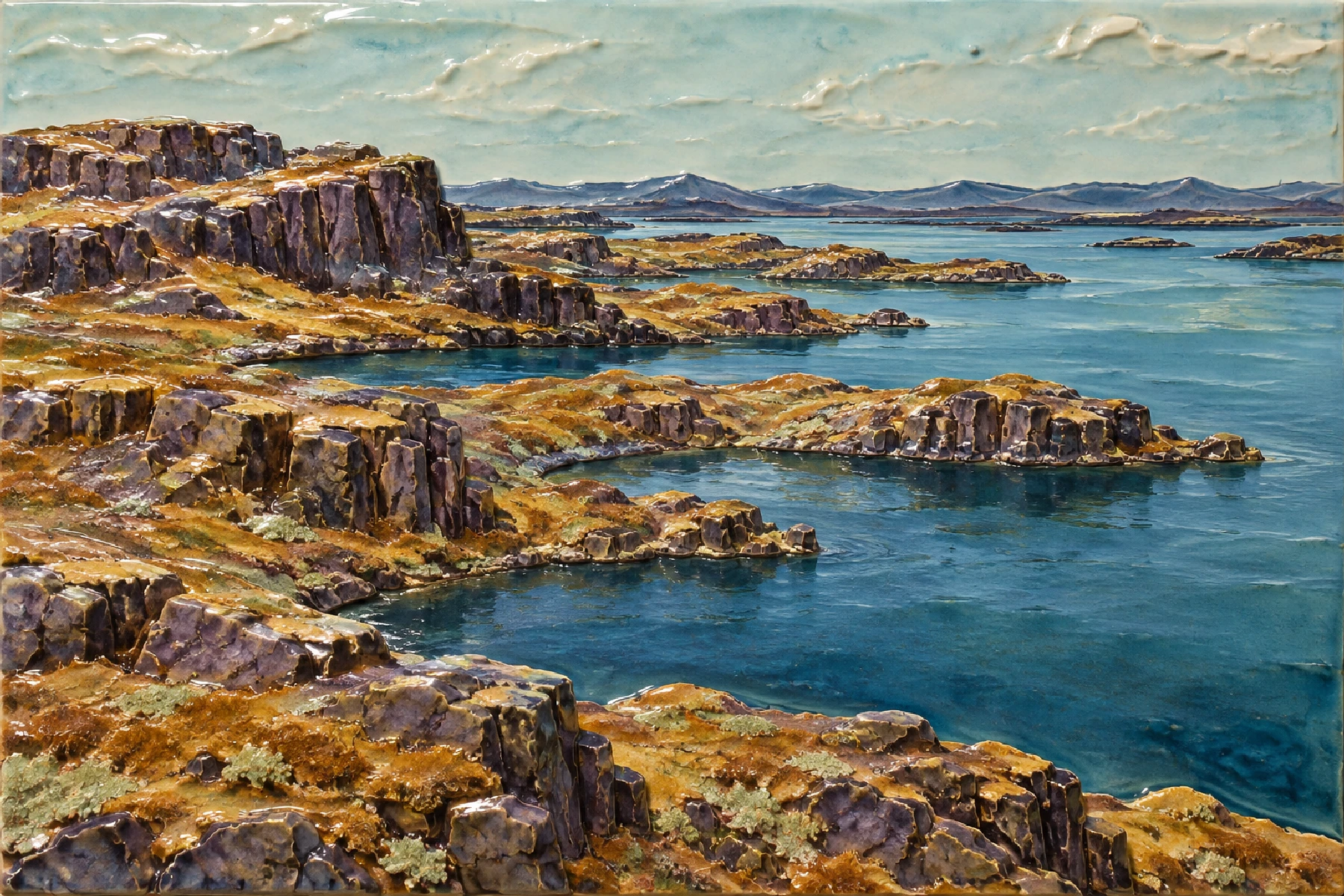
Long lakes thread between low basalt ridges. Raised ceramic relief and glaze pooled in recesses give the terrain weight and the water depth.
Remix this referenceLakes Between Basalt Ridges
- Form language
- Translate broad masses into shallow modeled relief, with rounded planes and selectively notched edges rather than miniature geological detail.
- Contour
- Let raised lips and incised seams define contours; vary their thickness slightly and soften occasional joins as if pressed by hand.
- Mark-making
- Use sparse dragged grooves and broad thumblike impressions; let their spacing vary naturally across uninterrupted modeled areas.
- Surface rendering
- Build translucent glaze depth through pooled recesses, thinner raised edges and softly mottled transitions; retain a few quiet satin passages.
Priority
The image must visibly read as modeled, glazed ceramic relief.
What to avoid & what to check
Exact prompt for this example
MODULE OWNERSHIP
subject: Subject count, type, stable proportions and landmarks, resting face geometry, hair shape, physical materials, garment construction and permanent marks. No emotion, movement, color assignment or rendering recipe.
expression: Facial soft-tissue displacement and pupil direction, muscle coordination, regional intensity, asymmetry and onset/peak/release. No head/body pose, stable appearance, skin color or rendering.
gesture: Head/neck/body/limb orientation, joint movement, support, contact and pose-caused occlusion using existing anatomy. No eye/pupil movement, emotion, identity, props inventory or camera.
props: Prop count, type, construction, physical material and scale relative to the subject. Holding/contact belongs to gesture, position to composition, color to palette.
scene: Environment elements, terrain, backdrop/floor presence and structural detail. No canvas positions, camera, lighting, assigned colors or render texture.
camera: Projection, focal-length impression, camera elevation/yaw/roll, viewing distance and crop. No actor pose, world placement, lighting or canvas aspect ratio.
composition: Normalized 0-100% canvas positions, scale in frame, depth/overlap, focal hierarchy and margins. No joint pose, camera projection, rendering, subject/prop inventory or emotion.
palette: Color anchors, hue/saturation/value ranges, colors assigned to parts and approximate color coverage. No illumination direction, shading algorithm, physical material or layout.
lighting: Light-source direction/softness/intensity, ambient illumination, physical shadow direction/length and highlight position. Absence of directional illumination is allowed. No shading technique, palette or material changes.
style: Reusable form abstraction, contour weight/taper/edge quality, medium and mark scale/density/direction, surface rendering and tonal transition technique. No fixed subject proportions, anatomy, identity, expression, pose, palette, light-source direction, camera or layout.
output: Image count, aspect ratio, size, file/alpha requirements and global lettering/logo/watermark restrictions. No background scenery, crop, style, identity or pose.

SUBJECT
inventory: No characters or animals are present.
geometry: No separate figure proportions or identity landmarks apply.
resting-face: No faces are present.
appearance: No character materials, garments or permanent marks apply.

PRIORITY


AVOID


CHECK


PROPS
inventory: No separate props.
construction: No prop construction applies.

PRIORITY


AVOID


CHECK


SCENE
inventory: Narrow freshwater lakes, low basalt ridges, lichen heath and an open stretch of distant water beneath sky.
structure: Uneven ridges divide connected lakes; broken column ends punctuate their banks, with heath filling shallow saddles.

PRIORITY


AVOID


CHECK


CAMERA
projection: A gently compressed perspective with a mild long-lens impression.
viewpoint: An elevated oblique view looks along the lakes from a neighboring ridge, with a level horizon.
crop: A broad landscape view includes nearby ridge ends, distant water and a modest band of sky.

PRIORITY


AVOID


CHECK


COMPOSITION
placement: Gather the strongest ridge cluster in the left half; let a widening lake open toward the right edge.
depth: Overlapping ridge ends lead toward distant water; the nearest lake bend is the focal point.
spacing: Alternate close land bands with generous water intervals; allow irregular shore rhythms and spacious upper margins.

PRIORITY


AVOID


CHECK


PALETTE
colors: Petrol blue, charcoal violet, pale celadon and restrained ochre form a muted, mineral palette.
assignment: Use petrol blue for lakes, charcoal violet for basalt, ochre for heath and pale celadon for sky.
balance: Cool middle values dominate; small warm accents interrupt the land, while the sky remains the palest area.

PRIORITY


AVOID


CHECK


LIGHTING
sources: Broad daylight arrives from the upper left with soft ambient fill.
shadows: Short, soft shadows fall to the lower right beneath raised edges and ridge overhangs.
highlights: Restrained highlights follow upper-left ridge lips and a few exposed water surfaces.

PRIORITY


AVOID


CHECK


STYLE GUIDE
form-language: Translate broad masses into shallow modeled relief, with rounded planes and selectively notched edges rather than miniature geological detail.
contour: Let raised lips and incised seams define contours; vary their thickness slightly and soften occasional joins as if pressed by hand.
mark-making: Use sparse dragged grooves and broad thumblike impressions; let their spacing vary naturally across uninterrupted modeled areas.
surface-rendering: Build translucent glaze depth through pooled recesses, thinner raised edges and softly mottled transitions; retain a few quiet satin passages.

PRIORITY
The image must visibly read as modeled, glazed ceramic relief.

AVOID


CHECK


OUTPUT
format: One finished image, landscape 3:2, 1800 × 1200 pixels, opaque PNG; no lettering, logos or watermarks.
restrictions: One finished image, landscape 3:2, 1800 × 1200 pixels, opaque PNG; no lettering, logos or watermarks.

PRIORITY


AVOID


CHECK
Model information comes from image provenance. The same prompt may produce a different result.