Text to imageProductStyle guide
One Steel Canister · Reflection-Gradient Shaping
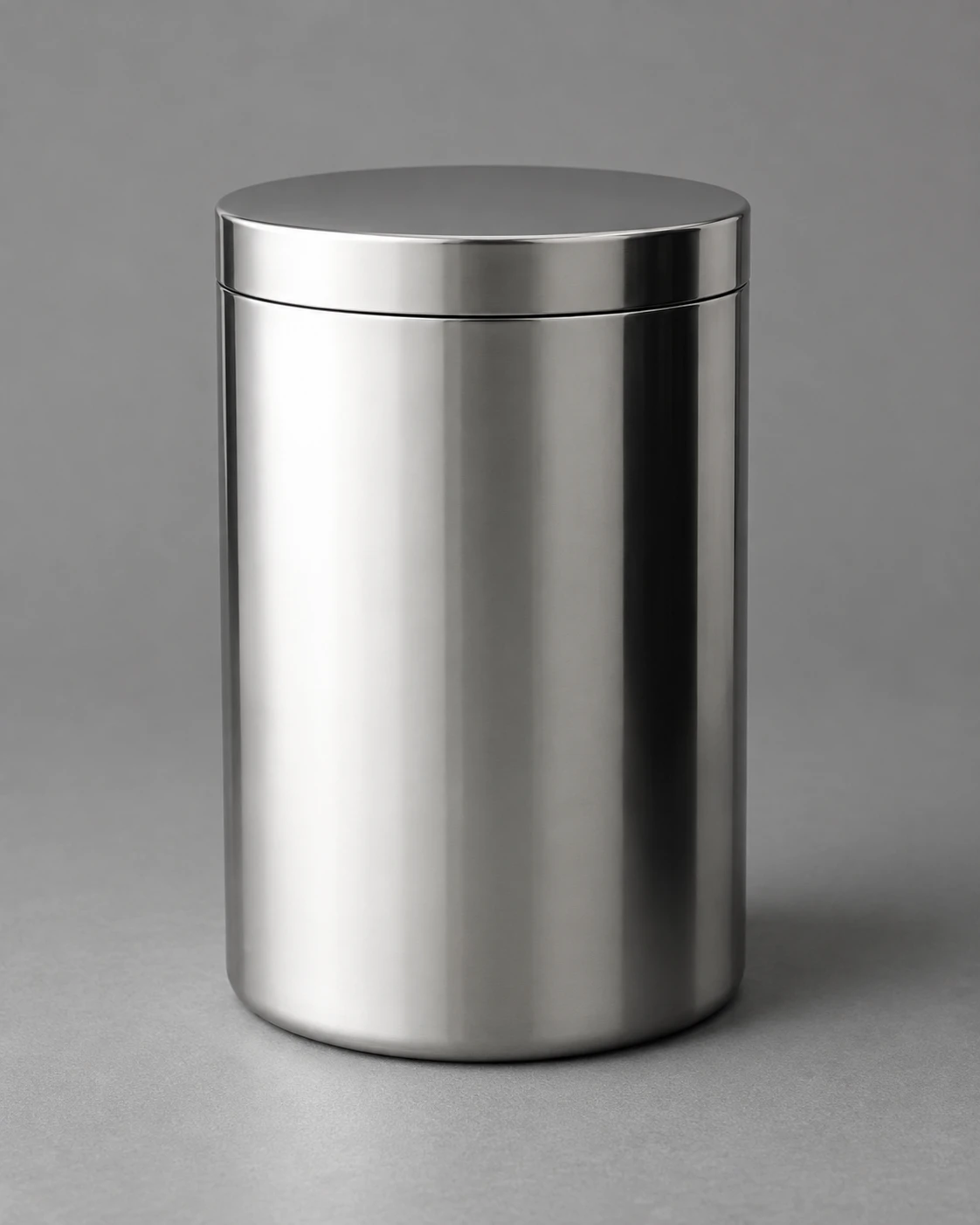
A product photograph using broad bright and narrow dark reflections to reveal the curvature of a smooth cylindrical steel canister.
One Steel Canister · Reflection-Gradient Shaping
- Shape & line
- Build the silhouette from two nearly parallel vertical sides, a shallow elliptical lid, and a gently rounded bottom edge; keep the lid seam thin and continuous so the cylinder reads as one simple assembled object.
- Color & light
- Place a large diffused white panel off-frame on image-left so its broad vertical reflection occupies the left half of the body and fades toward the center; place a black card off-frame on image-right so a narrower dark reflection bends around the right flank, with a slim gray outer edge remaining visible.
- Texture & material
- Render the steel as smooth and reflective, with continuous tonal transitions and crisp reflected-panel boundaries where appropriate; let the same reflection pattern compress across the rounded lower edge, while the matte tabletop stays softly textured and nonreflective.
- Composition
- Keep the canister dominant and fully in focus, leaving clear background space around both side edges; anchor the base with a compact contact shadow that extends softly toward image-right without merging into the dark reflection on the body.
Priority
Prioritize the reflected tonal gradient that makes the cylindrical curvature readable.
What to avoid & what to check
Avoid flat gray metal, blown-out white reflections, and reflections of a recognizable room.
Check that the broad left reflection and narrower right dark reflection visibly wrap around the same cylinder.
Exact prompt for this example
SUBJECT
One unbranded polished stainless-steel cylindrical canister with a closed, shallow fitted lid, standing upright on a matte neutral-gray surface. The lid shares the body's diameter and meets it at one clear horizontal seam.

COMPOSITION
A slightly elevated three-quarter product view showing the entire canister, its elliptical lid, and its base contact. Center the object with generous margins against a seamless gray background; keep the camera level enough that the vertical sides remain nearly parallel.

STYLE GUIDE
1. Shape & line
Build the silhouette from two nearly parallel vertical sides, a shallow elliptical lid, and a gently rounded bottom edge; keep the lid seam thin and continuous so the cylinder reads as one simple assembled object.

2. Color & light
Place a large diffused white panel off-frame on image-left so its broad vertical reflection occupies the left half of the body and fades toward the center; place a black card off-frame on image-right so a narrower dark reflection bends around the right flank, with a slim gray outer edge remaining visible.

3. Texture & material
Render the steel as smooth and reflective, with continuous tonal transitions and crisp reflected-panel boundaries where appropriate; let the same reflection pattern compress across the rounded lower edge, while the matte tabletop stays softly textured and nonreflective.

4. Composition
Keep the canister dominant and fully in focus, leaving clear background space around both side edges; anchor the base with a compact contact shadow that extends softly toward image-right without merging into the dark reflection on the body.

PRIORITY
Preserve the requested identity, count, action, composition and output settings. Apply the style rules within those constraints; a style reference must not replace the subject or layout. Within the style: Prioritize the reflected tonal gradient that makes the cylindrical curvature readable.

AVOID
Avoid flat gray metal, blown-out white reflections, and reflections of a recognizable room.

OUTPUT
One photorealistic product-reference image, portrait 4:5 aspect ratio, with no text, logos, labels, or watermarks.

SELF-CHECK
Check that the broad left reflection and narrower right dark reflection visibly wrap around the same cylinder.
Model information comes from image provenance. The same prompt may produce a different result.