Text to imageAnimationStyle guide
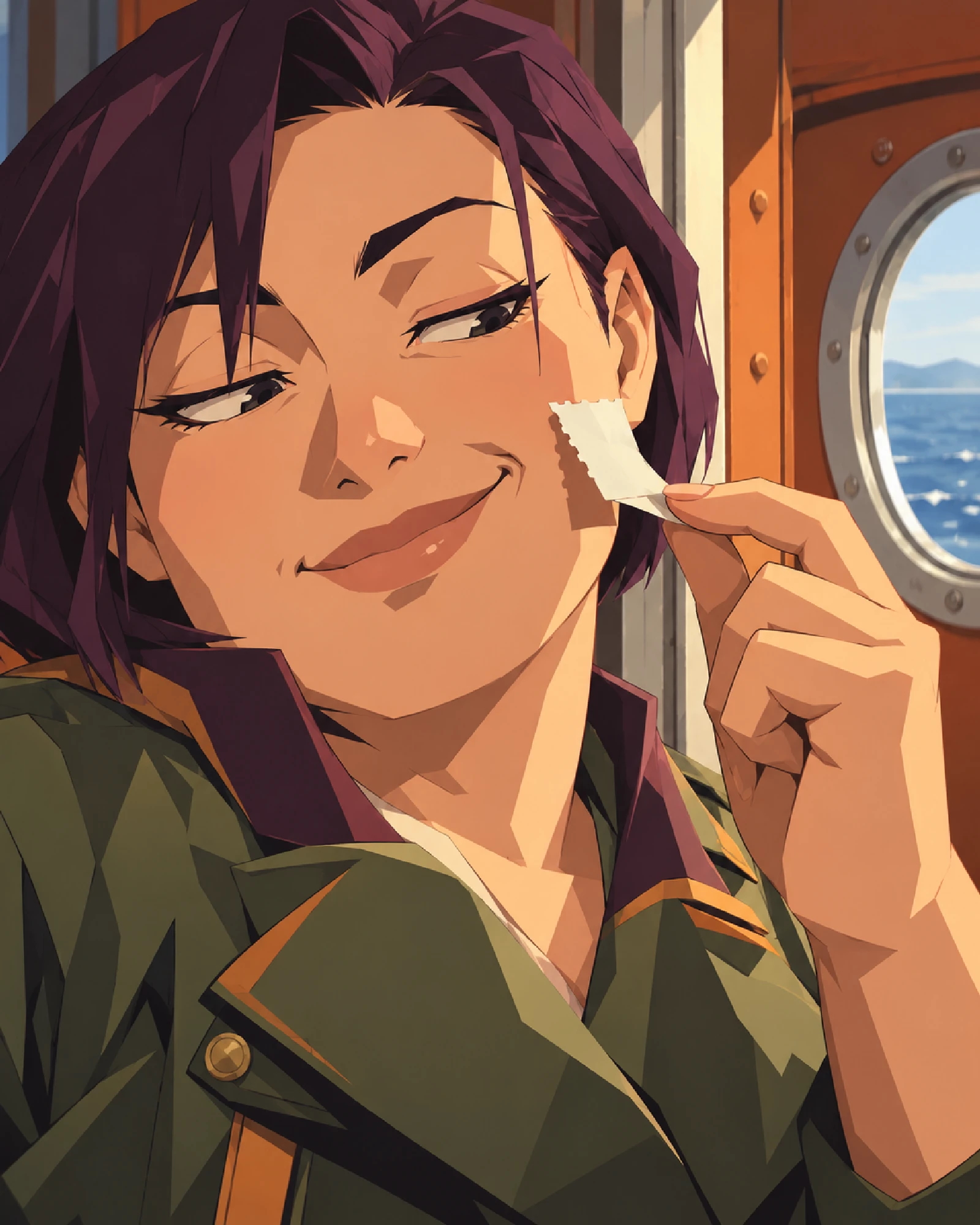
A Ferry Attendant Peeling a Ticket from Her Cheek
Leaning in a ferry vestibule, an attendant smiles as she peels a ticket from her cheek. An intimate crop makes the curling paper and crisp angular planes carry this small private moment.
Remix this referenceA Ferry Attendant Peeling a Ticket from Her Cheek
- Form language
- Translate surfaces into interlocking wedges and angular facets, using occasional unbroken curves to keep the abstraction supple.
- Contour
- Use strong exterior line-weight contrast, tapered corners and short sharp interior cuts; let selected edges disappear.
- Mark-making
- Place sparse sharp strokes and small angular facets at transitions; leave broad clean planes unmarked and vary accents naturally.
- Surface rendering
- Build a few sharply separated tonal planes in place of gradients; irregular facet boundaries keep the graphic finish lively.
Priority
Rendering medium: 2D angular Japanese anime graphic illustration; formal rendering reference: TRIGGER · 2010s · Promare (2019)
What to avoid & what to check
Exact prompt for this example
MODULE OWNERSHIP
subject: Subject count, type, stable proportions and landmarks, resting face geometry, hair shape, physical materials, garment construction and permanent marks. No emotion, movement, color assignment or rendering recipe.
expression: Facial soft-tissue displacement and pupil direction, muscle coordination, regional intensity, asymmetry and onset/peak/release. No head/body pose, stable appearance, skin color or rendering.
gesture: Head/neck/body/limb orientation, joint movement, support, contact and pose-caused occlusion using existing anatomy. No eye/pupil movement, emotion, identity, props inventory or camera.
props: Prop count, type, construction, physical material and scale relative to the subject. Holding/contact belongs to gesture, position to composition, color to palette.
scene: Environment elements, terrain, backdrop/floor presence and structural detail. No canvas positions, camera, lighting, assigned colors or render texture.
camera: Projection, focal-length impression, camera elevation/yaw/roll, viewing distance and crop. No actor pose, world placement, lighting or canvas aspect ratio.
composition: Normalized 0-100% canvas positions, scale in frame, depth/overlap, focal hierarchy and margins. No joint pose, camera projection, rendering, subject/prop inventory or emotion.
palette: Color anchors, hue/saturation/value ranges, colors assigned to parts and approximate color coverage. No illumination direction, shading algorithm, physical material or layout.
lighting: Light-source direction/softness/intensity, ambient illumination, physical shadow direction/length and highlight position. Absence of directional illumination is allowed. No shading technique, palette or material changes.
style: Reusable form abstraction, contour weight/taper/edge quality, medium and mark scale/density/direction, surface rendering and tonal transition technique. No fixed subject proportions, anatomy, identity, expression, pose, palette, light-source direction, camera or layout.
output: Image count, aspect ratio, size, file/alpha requirements and global lettering/logo/watermark restrictions. No background scenery, crop, style, identity or pose.

SUBJECT
inventory: One adult human ferry attendant, actor A.
geometry: A stocky build with a broad face, full cheeks, a short chin and a slightly crooked nose bridge.
resting-face: Heavy upper lids, straight brows and a wide mouth with a fuller lower lip define the resting face.
appearance: Short blunt bob tucked behind one ear; woven uniform jacket with overlapping lapels and a soft stand collar.

PRIORITY


AVOID


CHECK


EXPRESSION — ACTOR A
brows: The brow above the ticket lifts slightly; the other stays relaxed.
lids: Both upper lids remain low, with a stronger lower-lid lift beside the ticket.
cheeks: A small smile lifts both cheeks; the ticket edge draws a shallow local dimple.
nose: Nostrils stay relaxed without a nose wrinkle.
mouth: The ticket-side mouth corner rises farther, leaving a narrow amused opening.
jaw: The jaw releases slightly without a broad drop.
gaze: Pupils turn down toward the peeling ticket.
coordination: The uneven smile and quiet eyes read as private amusement at the discovery.
timing: Hold the apex of a small smile just after she notices what was stuck there.

PRIORITY


AVOID


CHECK


GESTURE
head: Her head inclines toward the raised right shoulder, leaving the ticket-side cheek exposed.
torso: Her upper torso rests obliquely against the doorway, with one shoulder bearing her weight.
limbs: The right elbow folds upward; thumb and index finger make a small pinch beside her cheek.
contact: Her fingers lift one ticket corner while its opposite end still clings to her cheek; her left shoulder meets the jamb.

PRIORITY


AVOID


CHECK


PROPS
inventory: One paper ferry ticket, roughly two finger-widths across.
construction: Thin damp paper with a perforated short edge, a blank face and a softly curled free corner.

PRIORITY


AVOID


CHECK


SCENE
inventory: A ferry vestibule with a metal door jamb, ribbed wall panel and a small porthole showing open water.
structure: The jamb has a deep folded return; the porthole sits in a thick circular rim. The floor is outside the view.

PRIORITY


AVOID


CHECK


CAMERA
projection: Perspective with a restrained short-telephoto impression.
viewpoint: An intimate eye-level three-quarter view from the ticket side, with a level camera.
crop: Close portrait cropped through the crown and upper chest; retain the complete pinching fingers.

PRIORITY


AVOID


CHECK


COMPOSITION
placement: The face fills the left two-thirds; the ticket and fingertips interrupt the open area on the right.
depth: Fingertips overlap the near cheek; the doorway recedes behind the shoulder and the porthole stays secondary.
spacing: The ticket-to-cheek separation is the focal hinge, followed by the mouth; leave breathing room around the curled edge.

PRIORITY


AVOID


CHECK


PALETTE
colors: Burnt orange, muted olive, warm ivory and deep plum, with a small cool slate accent.
assignment: Warm ochre skin, plum hair, olive jacket, ivory ticket, burnt-orange panels and slate water.
balance: Warm middle values dominate; pale paper and deep hair provide the strongest value separation.

PRIORITY


AVOID


CHECK


LIGHTING
sources: Broad daylight enters from the upper right, with weak vestibule ambient fill.
shadows: The ticket casts a short shadow down-left across the cheek; the far jaw remains softly shaded.
highlights: Light catches the lifted paper edge, near cheek ridge and upper knuckles.

PRIORITY


AVOID


CHECK


STYLE GUIDE
form-language: Translate surfaces into interlocking wedges and angular facets, using occasional unbroken curves to keep the abstraction supple.
contour: Use strong exterior line-weight contrast, tapered corners and short sharp interior cuts; let selected edges disappear.
mark-making: Place sparse sharp strokes and small angular facets at transitions; leave broad clean planes unmarked and vary accents naturally.
surface-rendering: Build a few sharply separated tonal planes in place of gradients; irregular facet boundaries keep the graphic finish lively.

PRIORITY
Rendering medium: 2D angular Japanese anime graphic illustration; formal rendering reference: TRIGGER · 2010s · Promare (2019)

AVOID


CHECK


OUTPUT
format: One finished image, portrait 4:5, 1600 × 2000 pixels, opaque PNG.
restrictions: No lettering, logos, captions or watermarks.

PRIORITY


AVOID


CHECK


FINAL INTEGRATION
expression + gesture + props: Coordinate the peeling contact with the local cheek displacement so the small discovery reads immediately.
lighting + style: Translate the physical illumination into the chosen tonal planes while retaining the paper's separation from the cheek.
Art direction
트리거 / TRIGGER · 2010s · 프로메어(2019) / Promare (2019) ↗- Abstract form surfaces into wedges, triangles and angular facets
- Strong exterior weight contrast with short sharp interior cuts
- Small angular facets and sharp marks, with no marks in clean planes
- A small set of sharply separated tonal planes in place of gradients
Model information comes from image provenance. The same prompt may produce a different result.