Text to imageCafe & brandStyle guide
Patchwork Canopy in the Repair Yard
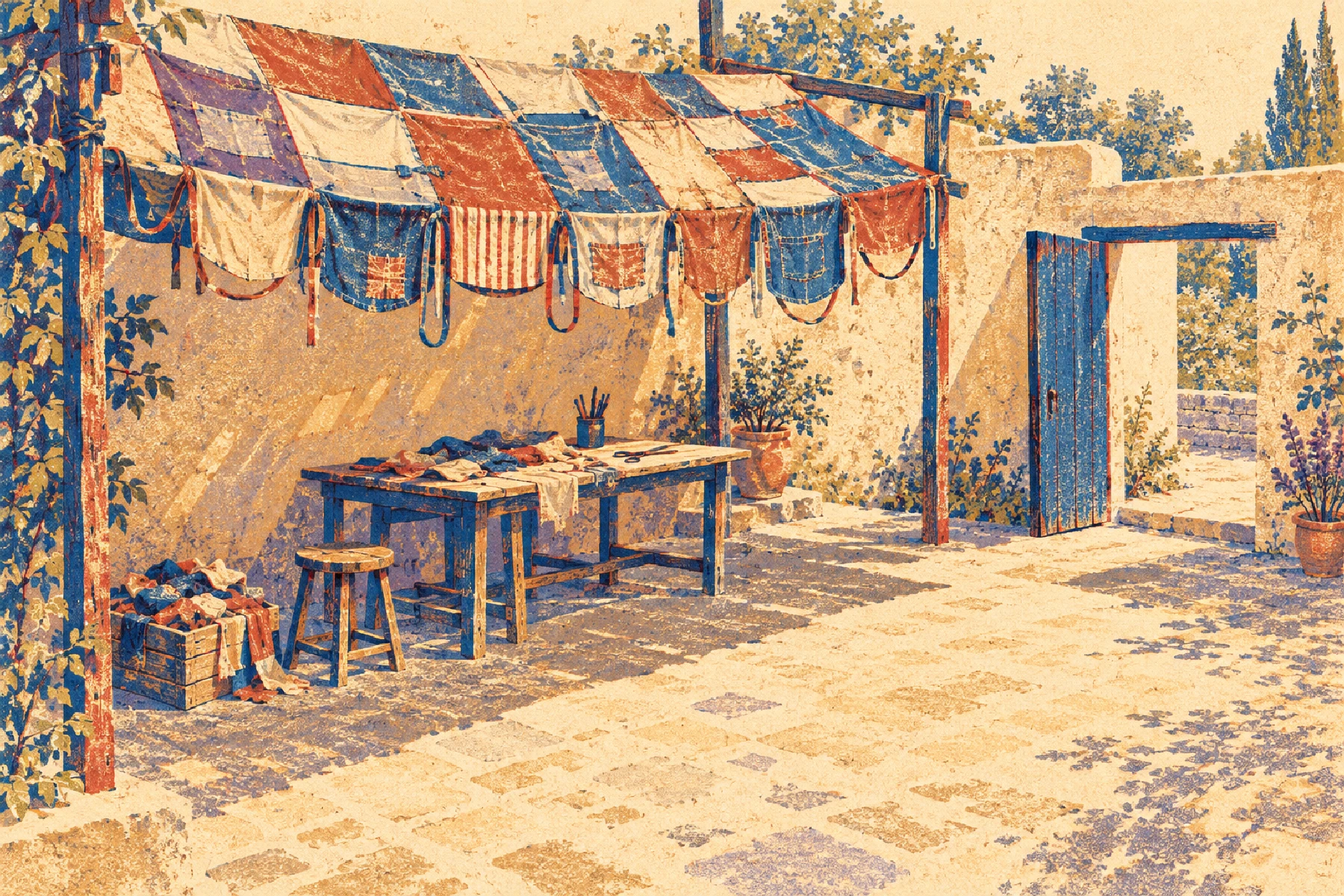
A brand illustration for a textile reuse studio: reclaimed work aprons become a courtyard canopy above a repair table. Spacious rhythm and lively riso misregistration celebrate fabric finding another purpose.
Remix this referencePatchwork Canopy in the Repair Yard
- Form language
- Reduce forms to broad interlocking shapes, allowing small irregularities and selective detail within a coherent graphic vocabulary.
- Contour
- Use slightly ragged printed silhouettes and occasional thin interior lines; let playful plate offsets create narrow doubled edges.
- Mark-making
- Riso grain breaks naturally into flecks and open pinholes; vary its density rather than applying an even texture overlay.
- Surface rendering
- Build tone through translucent ink overlap and coarse, imperfect halftone passages, retaining exposed paper between printed areas.
Priority
Make the riso grain and playful registration offsets visibly integral to the print.
What to avoid & what to check
Exact prompt for this example
MODULE OWNERSHIP
subject: Subject count, type, stable proportions and landmarks, resting face geometry, hair shape, physical materials, garment construction and permanent marks. No emotion, movement, color assignment or rendering recipe.
expression: Facial soft-tissue displacement and pupil direction, muscle coordination, regional intensity, asymmetry and onset/peak/release. No head/body pose, stable appearance, skin color or rendering.
gesture: Head/neck/body/limb orientation, joint movement, support, contact and pose-caused occlusion using existing anatomy. No eye/pupil movement, emotion, identity, props inventory or camera.
props: Prop count, type, construction, physical material and scale relative to the subject. Holding/contact belongs to gesture, position to composition, color to palette.
scene: Environment elements, terrain, backdrop/floor presence and structural detail. No canvas positions, camera, lighting, assigned colors or render texture.
camera: Projection, focal-length impression, camera elevation/yaw/roll, viewing distance and crop. No actor pose, world placement, lighting or canvas aspect ratio.
composition: Normalized 0-100% canvas positions, scale in frame, depth/overlap, focal hierarchy and margins. No joint pose, camera projection, rendering, subject/prop inventory or emotion.
palette: Color anchors, hue/saturation/value ranges, colors assigned to parts and approximate color coverage. No illumination direction, shading algorithm, physical material or layout.
lighting: Light-source direction/softness/intensity, ambient illumination, physical shadow direction/length and highlight position. Absence of directional illumination is allowed. No shading technique, palette or material changes.
style: Reusable form abstraction, contour weight/taper/edge quality, medium and mark scale/density/direction, surface rendering and tonal transition technique. No fixed subject proportions, anatomy, identity, expression, pose, palette, light-source direction, camera or layout.
output: Image count, aspect ratio, size, file/alpha requirements and global lettering/logo/watermark restrictions. No background scenery, crop, style, identity or pose.

SUBJECT
inventory: One patchwork shade canopy assembled from reclaimed work aprons; no people or animals.
geometry: A broad rectangular canopy retains rounded apron bibs and neck loops along its uneven lower edge.
resting-face: No facial geometry applies.
appearance: Woven cotton panels have exposed lapped joins, corner ties, and old repair patches; patch shapes may vary.

PRIORITY


AVOID


CHECK


PROPS
inventory: One low worktable, one stool, and one loose stack of fabric offcuts, all subordinate in scale to the canopy.
construction: The table and stool use plain timber frames; the offcuts are soft woven cloth with irregular cut edges.

PRIORITY


AVOID


CHECK


SCENE
inventory: A small repair courtyard has two plaster walls, a narrow open gateway, timber canopy posts, and a paving floor.
structure: Unequal wall heights and a shallow doorstep give the yard a modest, adapted workshop character.

PRIORITY


AVOID


CHECK


CAMERA
projection: Use gently flattened perspective with a normal-lens impression.
viewpoint: Look into the courtyard obliquely from slightly above wall height, with a level horizon.
crop: Show the whole canopy and worktable while allowing the outer courtyard walls to continue beyond the crop.

PRIORITY


AVOID


CHECK


COMPOSITION
placement: Gather the canopy and workshop in the upper-left portion; leave a generous open sweep toward the lower right.
depth: The canopy overlaps the rear wall; the table beneath it leads toward the gateway as a secondary destination.
spacing: Keep breathing room between the apron tabs, stool, and gateway; let the canopy remain the dominant shape.

PRIORITY


AVOID


CHECK


PALETTE
colors: Use rust red and lake blue as the main color anchors, warm straw as the base tone, and muted violet as a secondary accent.
assignment: Alternate rust and blue across the canopy; reserve straw for walls and floor, with blue on timber details.
balance: Let the paper tone occupy most of the image, with concentrated saturated accents in the canopy.

PRIORITY


AVOID


CHECK


LIGHTING
sources: Broad soft daylight arrives from the upper left, supported by gentle courtyard ambient light.
shadows: A broad canopy shadow falls down and right; smaller furniture shadows remain short and soft.
highlights: Keep highlights subdued, with slight brightness along upper-facing folds and timber edges.

PRIORITY


AVOID


CHECK


STYLE GUIDE
form-language: Reduce forms to broad interlocking shapes, allowing small irregularities and selective detail within a coherent graphic vocabulary.
contour: Use slightly ragged printed silhouettes and occasional thin interior lines; let playful plate offsets create narrow doubled edges.
mark-making: Riso grain breaks naturally into flecks and open pinholes; vary its density rather than applying an even texture overlay.
surface-rendering: Build tone through translucent ink overlap and coarse, imperfect halftone passages, retaining exposed paper between printed areas.

PRIORITY
Make the riso grain and playful registration offsets visibly integral to the print.

AVOID


CHECK


OUTPUT
format: One finished image, landscape 3:2, 1800 × 1200 pixels, opaque PNG; no lettering, logos, or watermarks.
restrictions: Deliver one finished image in landscape 3:2 at 1800 × 1200 pixels as an opaque PNG; no lettering, logos, or watermarks.

PRIORITY


AVOID


CHECK


FINAL INTEGRATION
subject + style: Keep the reclaimed construction legible through the printing irregularities without turning every patch into a diagram.
Model information comes from image provenance. The same prompt may produce a different result.