Text to imageCafe & brandStyle guide
Cloth Across a Dye Bowl
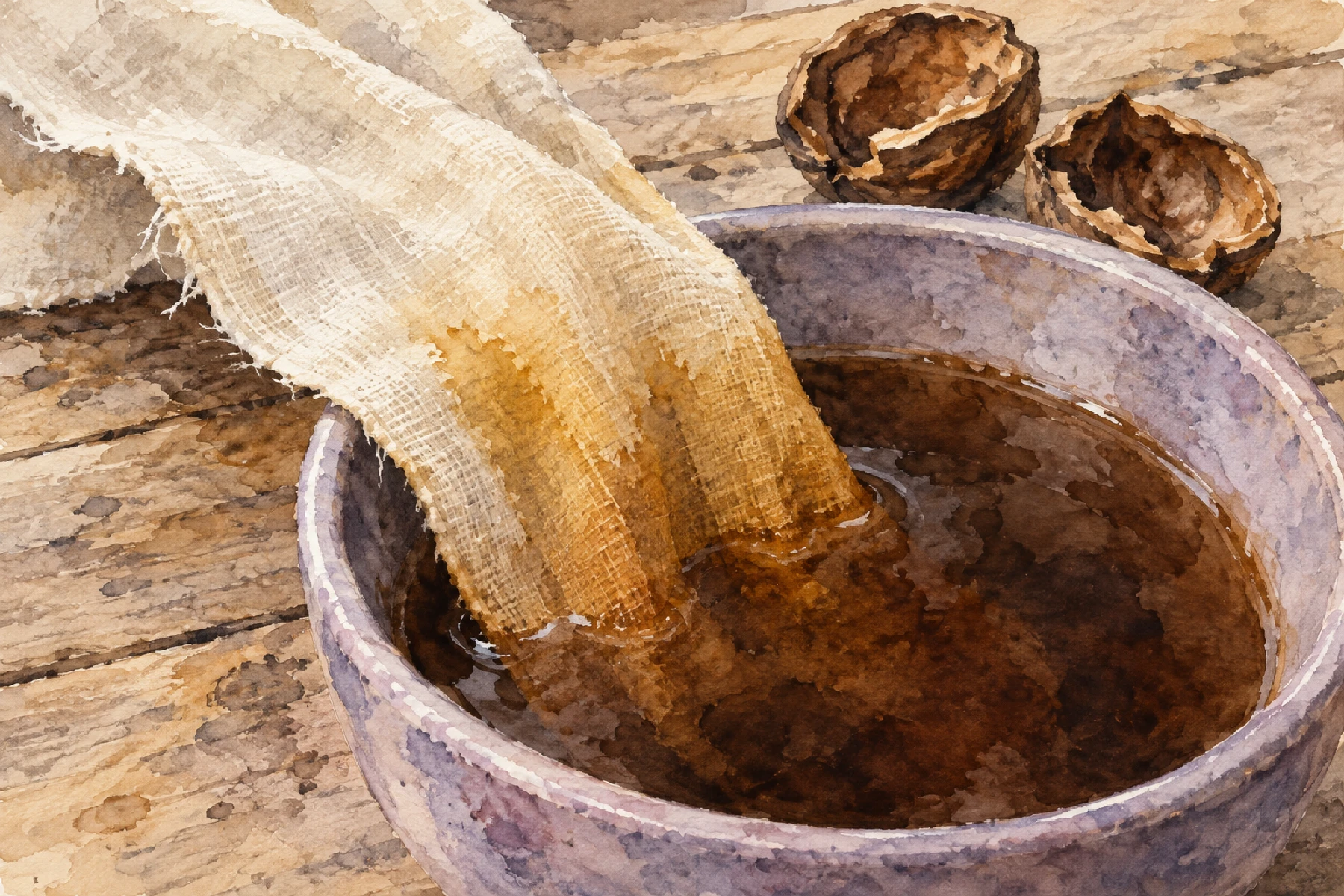
A natural dye atelier brand image where walnut husks and stained linen meet at a dye bowl’s rim. Intimate cropping and blooming watercolor suggest materials soaking into one another.
Remix this referenceCloth Across a Dye Bowl
- Form language
- Reduce forms to broad, slightly uneven masses; preserve useful structural breaks while letting minor shapes vary.
- Contour
- Let wash boundaries carry most contours, alternating dissolved edges with brief dry-brush catches.
- Mark-making
- Lay generous wet strokes beside sparse dragged marks; allow blooms and backruns to interrupt the brush rhythm.
- Surface rendering
- Build transparent watercolor layers with pooled pigment and uneven tonal bridges, retaining visible paper between washes.
Priority
Watercolor blooms and broken edges must visibly shape the finished image.
What to avoid & what to check
Exact prompt for this example
MODULE OWNERSHIP
subject: Subject count, type, stable proportions and landmarks, resting face geometry, hair shape, physical materials, garment construction and permanent marks. No emotion, movement, color assignment or rendering recipe.
expression: Facial soft-tissue displacement and pupil direction, muscle coordination, regional intensity, asymmetry and onset/peak/release. No head/body pose, stable appearance, skin color or rendering.
gesture: Head/neck/body/limb orientation, joint movement, support, contact and pose-caused occlusion using existing anatomy. No eye/pupil movement, emotion, identity, props inventory or camera.
props: Prop count, type, construction, physical material and scale relative to the subject. Holding/contact belongs to gesture, position to composition, color to palette.
scene: Environment elements, terrain, backdrop/floor presence and structural detail. No canvas positions, camera, lighting, assigned colors or render texture.
camera: Projection, focal-length impression, camera elevation/yaw/roll, viewing distance and crop. No actor pose, world placement, lighting or canvas aspect ratio.
composition: Normalized 0-100% canvas positions, scale in frame, depth/overlap, focal hierarchy and margins. No joint pose, camera projection, rendering, subject/prop inventory or emotion.
palette: Color anchors, hue/saturation/value ranges, colors assigned to parts and approximate color coverage. No illumination direction, shading algorithm, physical material or layout.
lighting: Light-source direction/softness/intensity, ambient illumination, physical shadow direction/length and highlight position. Absence of directional illumination is allowed. No shading technique, palette or material changes.
style: Reusable form abstraction, contour weight/taper/edge quality, medium and mark scale/density/direction, surface rendering and tonal transition technique. No fixed subject proportions, anatomy, identity, expression, pose, palette, light-source direction, camera or layout.
output: Image count, aspect ratio, size, file/alpha requirements and global lettering/logo/watermark restrictions. No background scenery, crop, style, identity or pose.

SUBJECT
inventory: One linen strip and two split walnut husks are the featured materials.
geometry: The linen is a broad continuous strip; the husks are irregular hollow cups with thick ragged rims.
resting-face: No faces or facial landmarks apply.
appearance: Use loosely woven linen with an unhemmed end and fibrous walnut husks; minor material irregularities may vary.

PRIORITY


AVOID


CHECK


PROPS
inventory: One dye bowl containing liquid dye, broad enough to accommodate the linen strip.
construction: An open earthenware bowl with a rounded lip and a gently curved interior.

PRIORITY


AVOID


CHECK


SCENE
inventory: A workshop workbench provides the only environment; no wider room is shown.
structure: The bench has broad wooden planks and a worn front edge, with little incidental detail.

PRIORITY


AVOID


CHECK


CAMERA
projection: Natural perspective with a normal-lens impression and restrained depth exaggeration.
viewpoint: Look diagonally down into the bowl from close range, with a level camera roll.
crop: An intimate detail crop cuts through the bowl’s near edge and the continuing length of linen.

PRIORITY


AVOID


CHECK


COMPOSITION
placement: The bowl fills the lower right; linen enters from the upper left, with husks gathered beside the rim.
depth: Linen overlaps the lip and continues into the dye; the husks remain behind this crossing.
spacing: The cloth–liquid boundary leads attention; a quiet wedge of bench offsets the crowded material junction.

PRIORITY


AVOID


CHECK


PALETTE
colors: Walnut umber, toasted ochre, pale lavender and warm ivory form a muted, earthy palette.
assignment: Umber colors the husks and dye; ochre stains the linen; lavender colors the bowl; ivory colors the bench.
balance: Pale ivory and lavender dominate, while concentrated umber gives the dye a compact dark accent.

PRIORITY


AVOID


CHECK


LIGHTING
sources: Broad, soft daylight enters from the upper left, with gentle ambient fill.
shadows: Short diffuse shadows fall toward the lower right, deepening beneath the rim and cloth overlap.
highlights: Soft highlights touch the upper-left lip and the exposed liquid surface.

PRIORITY


AVOID


CHECK


STYLE GUIDE
form-language: Reduce forms to broad, slightly uneven masses; preserve useful structural breaks while letting minor shapes vary.
contour: Let wash boundaries carry most contours, alternating dissolved edges with brief dry-brush catches.
mark-making: Lay generous wet strokes beside sparse dragged marks; allow blooms and backruns to interrupt the brush rhythm.
surface-rendering: Build transparent watercolor layers with pooled pigment and uneven tonal bridges, retaining visible paper between washes.

PRIORITY
Watercolor blooms and broken edges must visibly shape the finished image.

AVOID


CHECK


OUTPUT
format: One finished image, landscape 3:2, 1800 × 1200 pixels, opaque PNG.
restrictions: No lettering, logos or watermarks.

PRIORITY


AVOID


CHECK


FINAL INTEGRATION
composition + style: Keep the material junction legible while allowing watercolor edges to merge around it.
Model information comes from image provenance. The same prompt may produce a different result.