Text to imageCalligraphyStyle guide
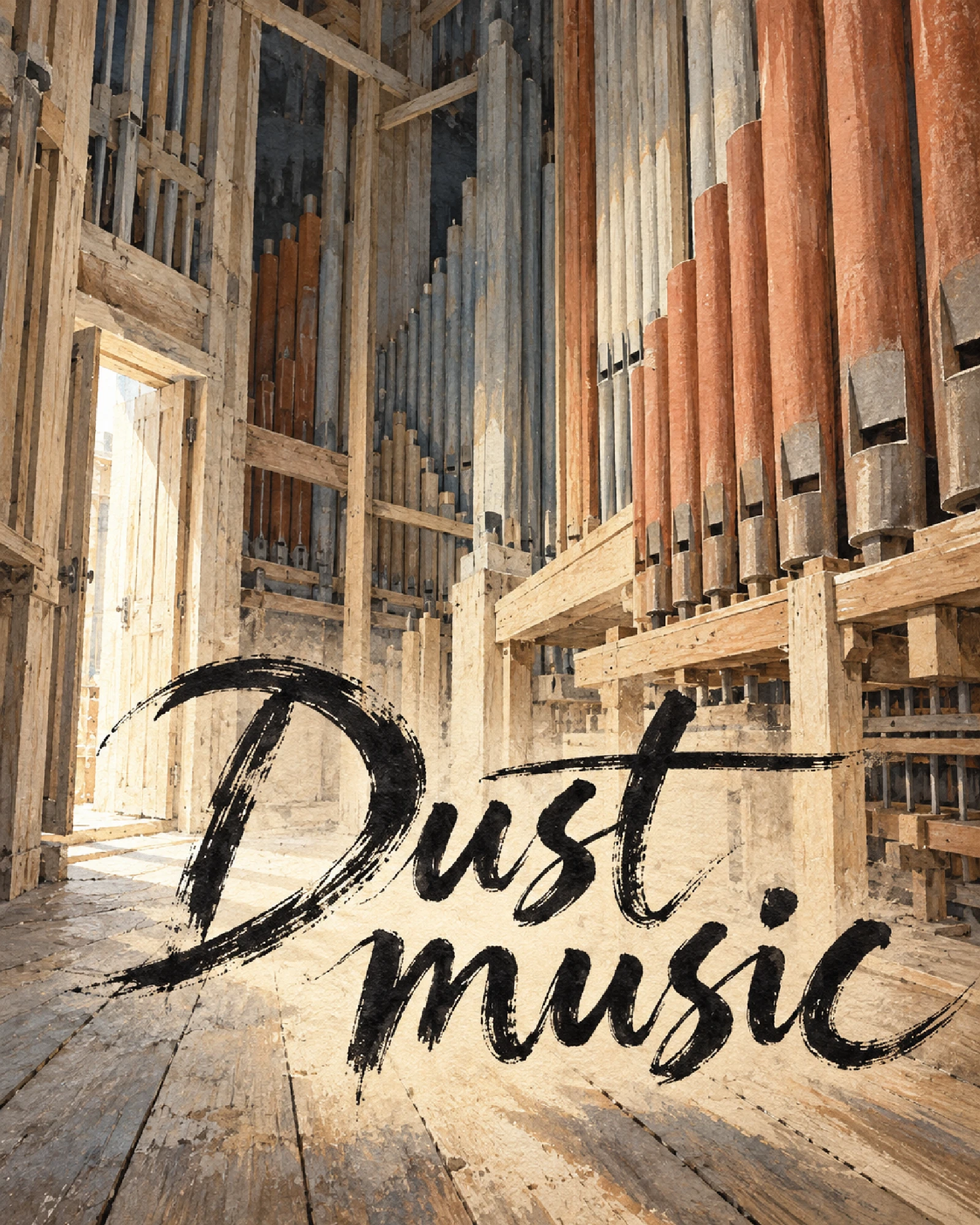
Brush Lettering in an Organ Chamber
Two lines of brush lettering inhabit a towering wooden organ chamber. Broken ink edges and a sweeping crossbar give the quiet interior a forceful rhythm.
Remix this referenceBrush Lettering in an Organ Chamber
- Form language
- Pair elastic calligraphic forms with architecture reduced to long blocks and stepped openings; allow coherent irregularity.
- Contour
- Let broad stroke edges break into bristle traces, while thin connections taper cleanly enough to preserve letter recognition.
- Mark-making
- Drag a nearly dry brush through decisive pressure changes; vary bristle skips naturally and use sparse vertical scumbles for architecture.
- Surface rendering
- Let exposed paper interrupt dense ink, with thin uneven washes building architectural tone and occasional pooled edges.
Priority
Dry-brush calligraphy with broken ink edges must remain the defining visible medium.
What to avoid & what to check
Exact prompt for this example
MODULE OWNERSHIP
subject: Subject count, type, stable proportions and landmarks, resting face geometry, hair shape, physical materials, garment construction and permanent marks. No emotion, movement, color assignment or rendering recipe.
expression: Facial soft-tissue displacement and pupil direction, muscle coordination, regional intensity, asymmetry and onset/peak/release. No head/body pose, stable appearance, skin color or rendering.
gesture: Head/neck/body/limb orientation, joint movement, support, contact and pose-caused occlusion using existing anatomy. No eye/pupil movement, emotion, identity, props inventory or camera.
props: Prop count, type, construction, physical material and scale relative to the subject. Holding/contact belongs to gesture, position to composition, color to palette.
scene: Environment elements, terrain, backdrop/floor presence and structural detail. No canvas positions, camera, lighting, assigned colors or render texture.
camera: Projection, focal-length impression, camera elevation/yaw/roll, viewing distance and crop. No actor pose, world placement, lighting or canvas aspect ratio.
composition: Normalized 0-100% canvas positions, scale in frame, depth/overlap, focal hierarchy and margins. No joint pose, camera projection, rendering, subject/prop inventory or emotion.
palette: Color anchors, hue/saturation/value ranges, colors assigned to parts and approximate color coverage. No illumination direction, shading algorithm, physical material or layout.
lighting: Light-source direction/softness/intensity, ambient illumination, physical shadow direction/length and highlight position. Absence of directional illumination is allowed. No shading technique, palette or material changes.
style: Reusable form abstraction, contour weight/taper/edge quality, medium and mark scale/density/direction, surface rendering and tonal transition technique. No fixed subject proportions, anatomy, identity, expression, pose, palette, light-source direction, camera or layout.
output: Image count, aspect ratio, size, file/alpha requirements and global lettering/logo/watermark restrictions. No background scenery, crop, style, identity or pose.

SUBJECT
inventory: One original two-word English calligraphic inscription; no human or animal subjects.
geometry: Write "Dust music" with an open capital D, distinct lowercase letters, generous counters and an extended t crossbar.
resting-face: No face or resting facial geometry applies.
appearance: The inscription has no physical carrier, modeled thickness or attached ornaments.

PRIORITY


AVOID


CHECK


PROPS
inventory: No separate props.
construction: No prop construction applies.

PRIORITY


AVOID


CHECK


SCENE
inventory: An empty organ chamber contains tall wooden resonator pipes, an exposed windchest and a narrow maintenance floor.
structure: Unequal pipe ranks form successive passages; crossbeams and an open service doorway reveal the chamber's construction.

PRIORITY


AVOID


CHECK


CAMERA
projection: Use moderate wide-angle perspective with restrained convergence.
viewpoint: Look slightly upward from standing height, obliquely along the chamber, with no camera roll.
crop: Frame an immersive interior view, cutting through the nearest architectural edges while retaining the full inscription.

PRIORITY


AVOID


CHECK


COMPOSITION
placement: Set two staggered lines across the lower middle, the second shifted right; the crossbar supplies the dominant sweep.
depth: Keep lettering on the foremost graphic plane, with near forms and successive recesses creating depth behind it.
spacing: Keep clear gaps between words and around counters; leave an airy upper third and quiet intervals behind delicate links.

PRIORITY


AVOID


CHECK


PALETTE
colors: Use soot black, parchment cream, muted terracotta and a cool slate gray, with generally subdued saturation.
assignment: Assign black to lettering, cream to most architecture, terracotta to selected pipe faces and slate to recesses.
balance: Let pale values dominate; reserve the deepest black for the inscription and keep terracotta accents sparse.

PRIORITY


AVOID


CHECK


LIGHTING
sources: Broad soft daylight enters from the service doorway at the left, with gentle ambient illumination.
shadows: Architectural shadows fall softly rightward and merge within the deeper passages.
highlights: Keep highlights broad on left-facing architectural edges; the graphic inscription receives no dimensional highlights.

PRIORITY


AVOID


CHECK


STYLE GUIDE
form-language: Pair elastic calligraphic forms with architecture reduced to long blocks and stepped openings; allow coherent irregularity.
contour: Let broad stroke edges break into bristle traces, while thin connections taper cleanly enough to preserve letter recognition.
mark-making: Drag a nearly dry brush through decisive pressure changes; vary bristle skips naturally and use sparse vertical scumbles for architecture.
surface-rendering: Let exposed paper interrupt dense ink, with thin uneven washes building architectural tone and occasional pooled edges.

PRIORITY
Dry-brush calligraphy with broken ink edges must remain the defining visible medium.

AVOID


CHECK


OUTPUT
format: One finished image, 4:5 portrait, 1600 × 2000 pixels, opaque PNG.
restrictions: Allow primary lettering; forbid additional text, logos and watermarks.

PRIORITY


AVOID


CHECK


FINAL INTEGRATION
subject + output: Carry subject's "Dust music" through as the primary lettering permitted by output.
Model information comes from image provenance. The same prompt may produce a different result.