Text to imageArt stylesStyle guide
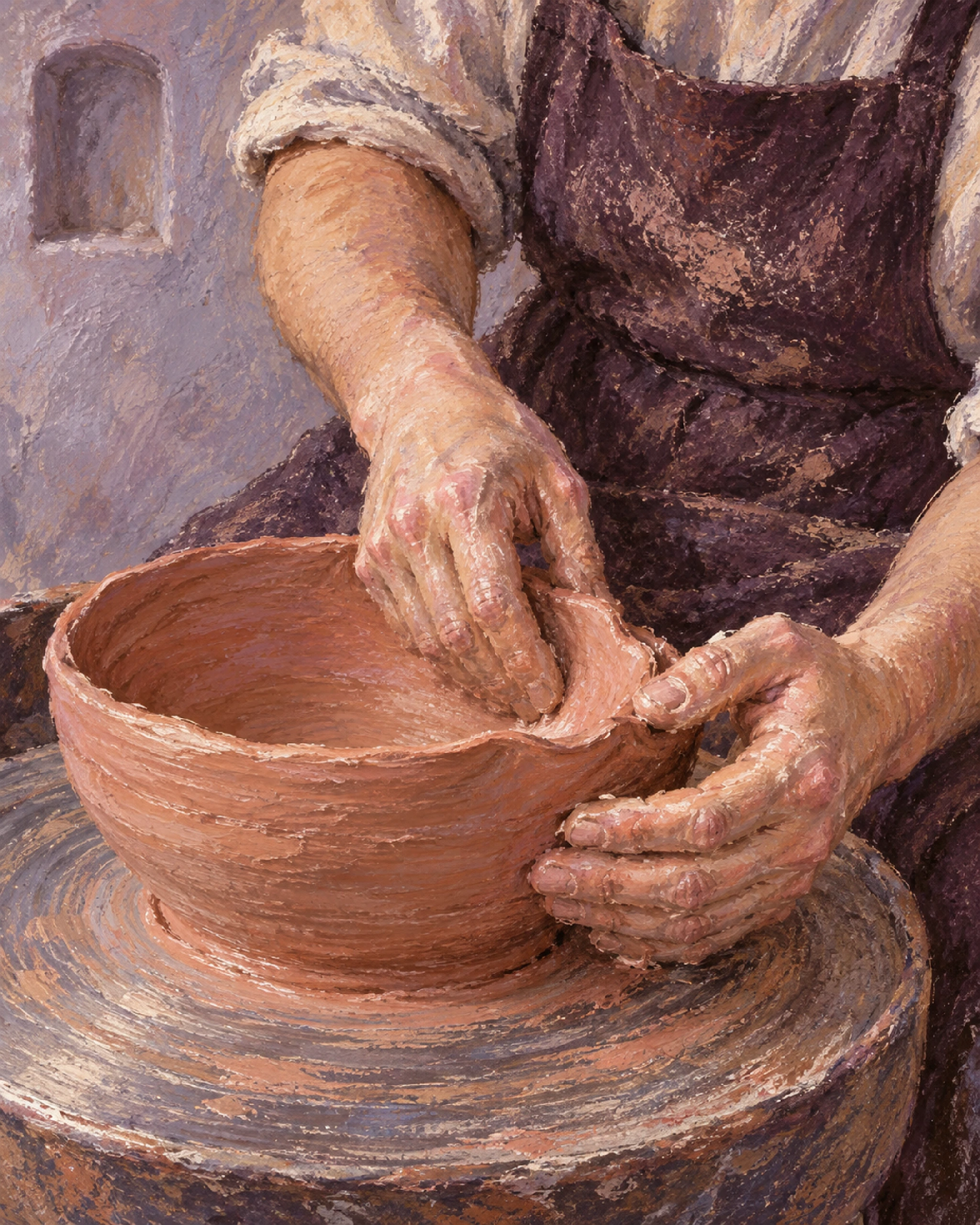
Hands Supporting a Slumping Bowl
Two hands support the yielding wall of a bowl on a pottery wheel. Rubbed oil pastel masses and scratched passages bring the contact between hands and wet clay into intimate view.
Remix this referenceHands Supporting a Slumping Bowl
- Form language
- Reduce forms to softly interlocking masses; let selected boundaries dissolve while retaining a few decisive junctions.
- Contour
- Use broken, blunt pastel edges with occasional narrow scraped accents rather than continuous enclosing outlines.
- Mark-making
- Drag oil pastel in broad curved strokes, rub passages together and scratch through deposits with naturally uneven pressure.
- Surface rendering
- Waxy ridges interrupt rubbed veils; mingled deposits create dreamy tonal transitions with freely varying local texture.
Priority
Keep rubbed and scratched oil pastel visibly present throughout the image.
What to avoid & what to check
Exact prompt for this example
MODULE OWNERSHIP
subject: Subject count, type, stable proportions and landmarks, resting face geometry, hair shape, physical materials, garment construction and permanent marks. No emotion, movement, color assignment or rendering recipe.
expression: Facial soft-tissue displacement and pupil direction, muscle coordination, regional intensity, asymmetry and onset/peak/release. No head/body pose, stable appearance, skin color or rendering.
gesture: Head/neck/body/limb orientation, joint movement, support, contact and pose-caused occlusion using existing anatomy. No eye/pupil movement, emotion, identity, props inventory or camera.
props: Prop count, type, construction, physical material and scale relative to the subject. Holding/contact belongs to gesture, position to composition, color to palette.
scene: Environment elements, terrain, backdrop/floor presence and structural detail. No canvas positions, camera, lighting, assigned colors or render texture.
camera: Projection, focal-length impression, camera elevation/yaw/roll, viewing distance and crop. No actor pose, world placement, lighting or canvas aspect ratio.
composition: Normalized 0-100% canvas positions, scale in frame, depth/overlap, focal hierarchy and margins. No joint pose, camera projection, rendering, subject/prop inventory or emotion.
palette: Color anchors, hue/saturation/value ranges, colors assigned to parts and approximate color coverage. No illumination direction, shading algorithm, physical material or layout.
lighting: Light-source direction/softness/intensity, ambient illumination, physical shadow direction/length and highlight position. Absence of directional illumination is allowed. No shading technique, palette or material changes.
style: Reusable form abstraction, contour weight/taper/edge quality, medium and mark scale/density/direction, surface rendering and tonal transition technique. No fixed subject proportions, anatomy, identity, expression, pose, palette, light-source direction, camera or layout.
output: Image count, aspect ratio, size, file/alpha requirements and global lettering/logo/watermark restrictions. No background scenery, crop, style, identity or pose.

SUBJECT
inventory: One adult potter.
geometry: Broad palms, substantial fingertips and gently prominent knuckles give the hands recognizable construction.
resting-face: Resting facial geometry is unspecified.
appearance: Bare forearms and a heavy woven apron; minor fabric wear may vary naturally.

PRIORITY


AVOID


CHECK


GESTURE
head: No visible head or neck pose is prescribed.
torso: The visible torso leans toward the work.
limbs: Both wrists bend inward; one hand cups the outer wall while the other opens gently inside the bowl.
contact: Opposing fingertips support the yielding section; the nearer hand partly conceals the rim at contact.

PRIORITY


AVOID


CHECK


PROPS
inventory: One unfired clay bowl about two palm-widths across and one pottery wheel with a broad circular wheelhead; no additional tools.
construction: The wet clay bowl has a thin pliable wall, uneven oval mouth and folded rim section; the wheelhead is worn metal.

PRIORITY


AVOID


CHECK


SCENE
inventory: A modest pottery workshop with a plain plaster wall and no additional furnishings.
structure: A shallow wall recess supplies the only architectural detail.

PRIORITY


AVOID


CHECK


CAMERA
projection: Natural perspective with a normal-lens impression and little wide-angle expansion.
viewpoint: Look closely downward from just above the bowl rim, oblique to the potter's working position.
crop: Frame the hands, partial forearms and apron-covered torso; crop through forearms and wheelhead, keeping contact intact and head and floor out.

PRIORITY


AVOID


CHECK


COMPOSITION
placement: Place the hand-and-rim contact near 65% across and 60% down; it leads before the broader bowl mass.
depth: Layer the hands and bowl before the apron, with the wall receding behind the compact working group.
spacing: Use unequal diagonal passages around the bowl and leave a quiet opening above the smaller hand shape.

PRIORITY


AVOID


CHECK


PALETTE
colors: Smoky lilac, clay rose, warm cream and a small amount of deep plum.
assignment: Clay rose for the bowl, cream with rose accents for hands, lilac for the wall and plum for the apron.
balance: Muted middle values dominate; hands form the largest pale area and plum supplies a restrained dark anchor.

PRIORITY


AVOID


CHECK


LIGHTING
sources: Broad, soft window light enters from the upper left, supported by gentle ambient illumination.
shadows: Short, soft shadows fall lower right, deepening inside the bowl and beneath the supporting fingers.
highlights: Broad highlights gather on upper knuckles and the exposed rim, with small glints on wet clay.

PRIORITY


AVOID


CHECK


STYLE GUIDE
form-language: Reduce forms to softly interlocking masses; let selected boundaries dissolve while retaining a few decisive junctions.
contour: Use broken, blunt pastel edges with occasional narrow scraped accents rather than continuous enclosing outlines.
mark-making: Drag oil pastel in broad curved strokes, rub passages together and scratch through deposits with naturally uneven pressure.
surface-rendering: Waxy ridges interrupt rubbed veils; mingled deposits create dreamy tonal transitions with freely varying local texture.

PRIORITY
Keep rubbed and scratched oil pastel visibly present throughout the image.

AVOID


CHECK


OUTPUT
format: One finished image, portrait 4:5, 2048 × 2560 pixels, opaque PNG.
restrictions: No lettering, logos or watermarks.

PRIORITY


AVOID


CHECK
Model information comes from image provenance. The same prompt may produce a different result.