Text to imageCharacterStyle guide
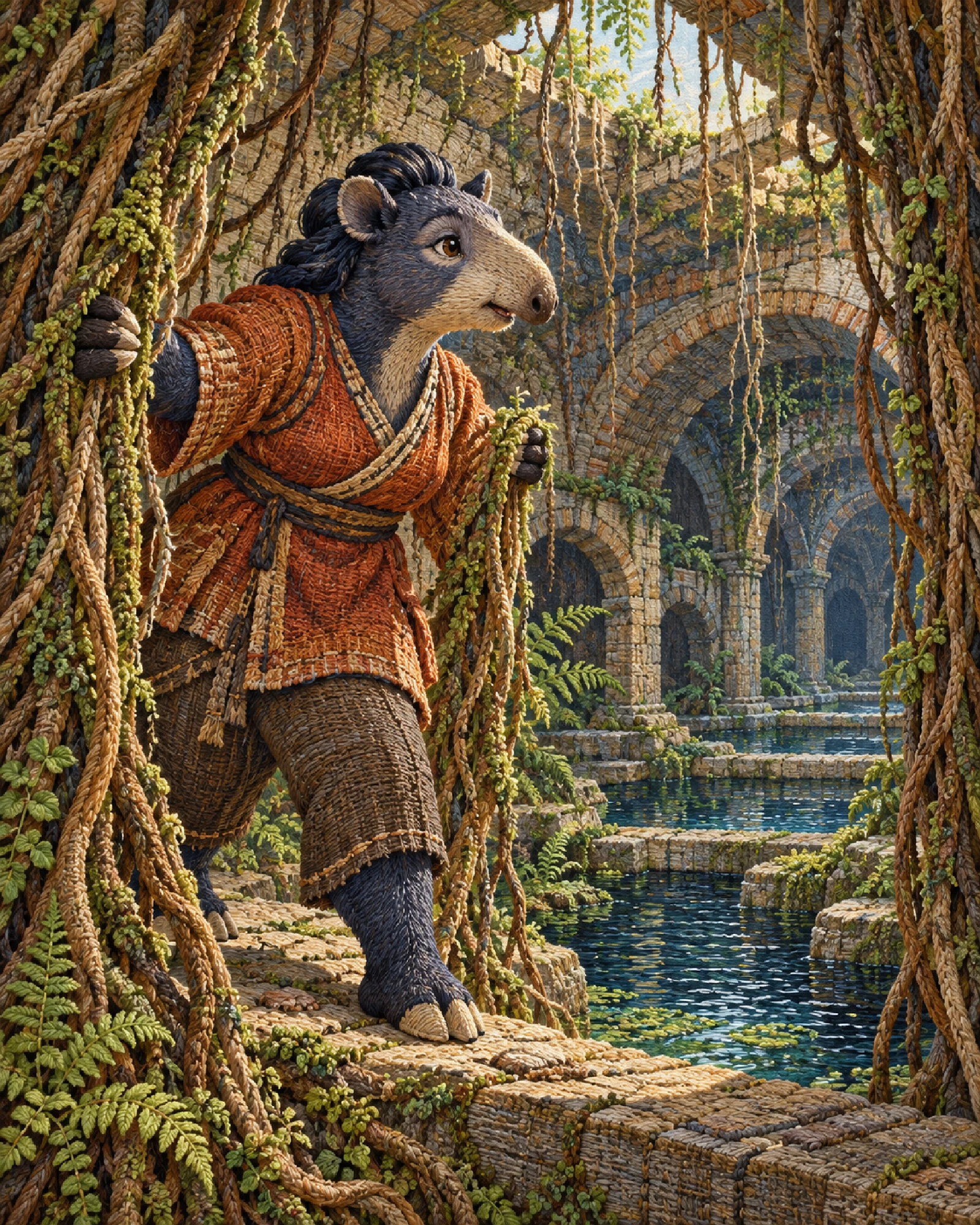
Tapir Woman Parting the Roots
A tapir woman parts hanging roots with both hands, revealing fern-filled pools beneath brick arches. Raised embroidery and open ground weave give the secluded chamber tactile depth.
Remix this referenceTapir Woman Parting the Roots
- Form language
- Translate forms into nested stitched lobes and broad fabric-like planes; simplify small details while retaining irregular silhouettes.
- Contour
- Use couched cords for selected edges, varying their thickness and letting other boundaries break into loose stitches.
- Mark-making
- Alternate long directional stitches, small knots and occasional open loops; let stitch length and spacing vary naturally.
- Surface rendering
- Build visible thread relief over woven ground; interleave strands for tonal transitions and leave quieter passages sparsely stitched.
Priority
The finished illustration must visibly read as embroidered textile with raised thread relief.
What to avoid & what to check
Exact prompt for this example
MODULE OWNERSHIP
subject: Subject count, type, stable proportions and landmarks, resting face geometry, hair shape, physical materials, garment construction and permanent marks. No emotion, movement, color assignment or rendering recipe.
expression: Facial soft-tissue displacement and pupil direction, muscle coordination, regional intensity, asymmetry and onset/peak/release. No head/body pose, stable appearance, skin color or rendering.
gesture: Head/neck/body/limb orientation, joint movement, support, contact and pose-caused occlusion using existing anatomy. No eye/pupil movement, emotion, identity, props inventory or camera.
props: Prop count, type, construction, physical material and scale relative to the subject. Holding/contact belongs to gesture, position to composition, color to palette.
scene: Environment elements, terrain, backdrop/floor presence and structural detail. No canvas positions, camera, lighting, assigned colors or render texture.
camera: Projection, focal-length impression, camera elevation/yaw/roll, viewing distance and crop. No actor pose, world placement, lighting or canvas aspect ratio.
composition: Normalized 0-100% canvas positions, scale in frame, depth/overlap, focal hierarchy and margins. No joint pose, camera projection, rendering, subject/prop inventory or emotion.
palette: Color anchors, hue/saturation/value ranges, colors assigned to parts and approximate color coverage. No illumination direction, shading algorithm, physical material or layout.
lighting: Light-source direction/softness/intensity, ambient illumination, physical shadow direction/length and highlight position. Absence of directional illumination is allowed. No shading technique, palette or material changes.
style: Reusable form abstraction, contour weight/taper/edge quality, medium and mark scale/density/direction, surface rendering and tonal transition technique. No fixed subject proportions, anatomy, identity, expression, pose, palette, light-source direction, camera or layout.
output: Image count, aspect ratio, size, file/alpha requirements and global lettering/logo/watermark restrictions. No background scenery, crop, style, identity or pose.

SUBJECT
inventory: A is one original adult anthropomorphic tapir woman.
geometry: A has a sturdy pear-shaped torso, short neck, rounded ears, a short flexible snout, broad hands and hoof-shaped feet.
resting-face: At rest, the eyes are small ovals, the brow ridges shallow, and the broad mouth sits beneath a rounded muzzle.
appearance: Close fur and a swept-back crown mane accompany a wrap-front woven tunic with wide sleeves and cropped trousers.

PRIORITY


AVOID


CHECK


EXPRESSION — ACTOR A
brows: Both brow ridges lift slightly, the nearer one a little higher.
lids: Upper lids open gently; lower lids remain relaxed.
cheeks: Cheeks stay loose with a small lift beside the muzzle.
nose: The fleshy snout tip lifts subtly and the nostrils open slightly.
mouth: The lips part narrowly without lifting the corners into a smile.
jaw: The jaw releases just enough to leave a small mouth opening.
gaze: Pupils turn toward the newly revealed pool beyond the roots.
coordination: The lifted brows and softly parted mouth share restrained, attentive curiosity.
timing: Capture curiosity at onset, before the eyes and mouth open further.

PRIORITY


AVOID


CHECK


GESTURE
head: A extends her neck through the opening and turns her head gently toward the chamber.
torso: Her torso leans forward from a staggered stance, with the rear leg bearing most of her weight.
limbs: Both arms spread apart with bent elbows; one knee advances while the rear leg stays braced.
contact: Her hands gather separate root bundles and draw them aside; both feet stay planted on the stone threshold.

PRIORITY


AVOID


CHECK


PROPS
inventory: No separate props.
construction: No prop construction applies.

PRIORITY


AVOID


CHECK


SCENE
inventory: A disused forest cistern contains shallow pools, hanging roots, fern-filled niches and a stone threshold.
structure: Successive brick vaults connect the chambers; a broken roof admits roots, and narrow stone ledges divide the pools.

PRIORITY


AVOID


CHECK


CAMERA
projection: Use a natural perspective with a moderately wide focal-length impression.
viewpoint: View from just below A's shoulder height, obliquely across the threshold, with no camera roll.
crop: Show the complete figure at an environmental viewing distance; let nearby architecture continue beyond the crop.

PRIORITY


AVOID


CHECK


COMPOSITION
placement: A fills the left-middle, her face near 40% across and the upper third; the pool opening expands into the right half.
depth: Foreground roots overlap the outer silhouette; successive arches and pools recede behind her into the chamber.
spacing: Read the hands and face first, then the revealed pools; leave a generous opening between the root bundles.

PRIORITY


AVOID


CHECK


PALETTE
colors: Use moss green, ink indigo, rust orange and warm flax, with muted saturation and a broad value range.
assignment: Assign indigo to fur and water, flax to the muzzle and masonry, rust to the tunic, and moss to roots and ferns.
balance: Moss and indigo occupy broad areas; flax provides pale intervals and rust remains a concentrated garment accent.

PRIORITY


AVOID


CHECK


LIGHTING
sources: Soft daylight enters from the upper left through the broken roof, with subdued ambient illumination deeper inside.
shadows: Broad shadows fall toward the lower right.
highlights: Gentle highlights catch upper-left-facing surfaces, the muzzle bridge and exposed root ridges.

PRIORITY


AVOID


CHECK


STYLE GUIDE
form-language: Translate forms into nested stitched lobes and broad fabric-like planes; simplify small details while retaining irregular silhouettes.
contour: Use couched cords for selected edges, varying their thickness and letting other boundaries break into loose stitches.
mark-making: Alternate long directional stitches, small knots and occasional open loops; let stitch length and spacing vary naturally.
surface-rendering: Build visible thread relief over woven ground; interleave strands for tonal transitions and leave quieter passages sparsely stitched.

PRIORITY
The finished illustration must visibly read as embroidered textile with raised thread relief.

AVOID


CHECK


OUTPUT
format: One finished image, portrait 4:5, 1600 × 2000 pixels, opaque PNG.
restrictions: No lettering, logos or watermarks.

PRIORITY


AVOID


CHECK


FINAL INTEGRATION
gesture + composition + scene: The root contact and layered chamber arrangement cooperate to make the act of opening the passage immediately legible.
style + lighting: The daylight reveals the stitched relief through tiny lower-right shadows and gentle highlights on upper-left-facing thread crests; varied stitch density supports the chamber depth
Model information comes from image provenance. The same prompt may produce a different result.