Text to imageAnimationStyle guide
Dunes in the Seaside Ballroom
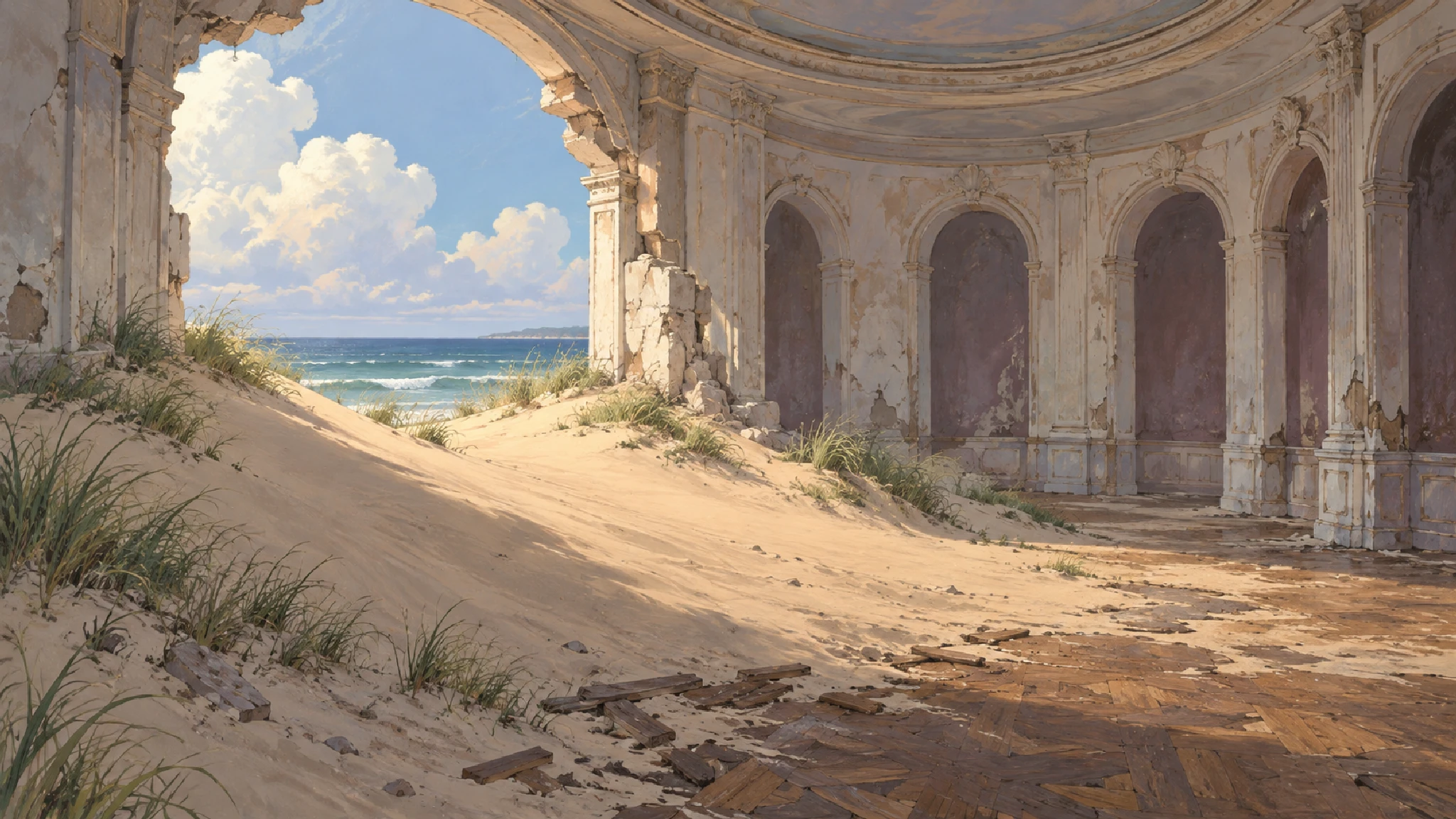
A dune has entered an empty ballroom through a broken arch. Beyond the spacious, quiet sand floor lies the sea, its curves echoed by the surviving ceiling.
Remix this referenceDunes in the Seaside Ballroom
- Form language
- Establish broad connected planes first; suggest smaller irregularities with painted patches. Minor details may vary within this shared abstraction.
- Contour
- Use firm painted edges at structural breaks and softened, occasionally lost edges elsewhere; avoid a continuous enclosing outline.
- Mark-making
- Overlap broad brush traces along each plane, letting occasional dry-brush skips interrupt the strokes with natural variation.
- Surface rendering
- Retain shallow paper-and-pigment grain beneath uneven opaque paint; blend tonal transitions while leaving selected patch boundaries visible.
Priority
Rendering medium: 2D hand-painted animated-film background illustration; formal rendering reference: Studio Ghibli · 2020s · The Boy and the Heron (2023), background art
What to avoid & what to check
Exact prompt for this example
MODULE OWNERSHIP
subject: Subject count, type, stable proportions and landmarks, resting face geometry, hair shape, physical materials, garment construction and permanent marks. No emotion, movement, color assignment or rendering recipe.
expression: Facial soft-tissue displacement and pupil direction, muscle coordination, regional intensity, asymmetry and onset/peak/release. No head/body pose, stable appearance, skin color or rendering.
gesture: Head/neck/body/limb orientation, joint movement, support, contact and pose-caused occlusion using existing anatomy. No eye/pupil movement, emotion, identity, props inventory or camera.
props: Prop count, type, construction, physical material and scale relative to the subject. Holding/contact belongs to gesture, position to composition, color to palette.
scene: Environment elements, terrain, backdrop/floor presence and structural detail. No canvas positions, camera, lighting, assigned colors or render texture.
camera: Projection, focal-length impression, camera elevation/yaw/roll, viewing distance and crop. No actor pose, world placement, lighting or canvas aspect ratio.
composition: Normalized 0-100% canvas positions, scale in frame, depth/overlap, focal hierarchy and margins. No joint pose, camera projection, rendering, subject/prop inventory or emotion.
palette: Color anchors, hue/saturation/value ranges, colors assigned to parts and approximate color coverage. No illumination direction, shading algorithm, physical material or layout.
lighting: Light-source direction/softness/intensity, ambient illumination, physical shadow direction/length and highlight position. Absence of directional illumination is allowed. No shading technique, palette or material changes.
style: Reusable form abstraction, contour weight/taper/edge quality, medium and mark scale/density/direction, surface rendering and tonal transition technique. No fixed subject proportions, anatomy, identity, expression, pose, palette, light-source direction, camera or layout.
output: Image count, aspect ratio, size, file/alpha requirements and global lettering/logo/watermark restrictions. No background scenery, crop, style, identity or pose.

SUBJECT
inventory: No people or animals are present.
geometry: No independent subject proportions or anatomical landmarks apply.
resting-face: No faces are present.
appearance: No character appearance, garments or permanent marks apply.

PRIORITY


AVOID


CHECK


PROPS
inventory: No separate props.
construction: No prop construction applies.

PRIORITY


AVOID


CHECK


SCENE
inventory: A seaside ballroom contains a dune, remnants of parquet, beach grass and a broken arch opening onto sea and clouds.
structure: The dune spills through the breached seaward wall. Coved plaster survives above recessed bays; exposed parquet emerges along the dune's edge.

PRIORITY


AVOID


CHECK


CAMERA
projection: Use natural perspective with a moderately wide focal-length impression and restrained edge expansion.
viewpoint: View diagonally across the hall from standing eye height, looking slightly downward with a level roll.
crop: Show a broad interior view; crop the nearest wall and ceiling while retaining the full dune crest and distant opening.

PRIORITY


AVOID


CHECK


COMPOSITION
placement: Keep the opening within the left 20–40% of the canvas and the surviving architecture mainly within the right 45–100%.
depth: The foreground dune overlaps the floor remnants; repeated wall bays lead behind it toward the sea opening.
spacing: Leave most of the lower half spacious. The dune crest meeting the opening is primary; ceiling curves form a quieter secondary rhythm.

PRIORITY


AVOID


CHECK


PALETTE
colors: Anchor the image in pale apricot, chalk ivory, smoky blue and muted plum, with a small sage accent.
assignment: Assign apricot to sand, ivory to plaster, smoky blue to sea and clouds, plum to deep recesses, and sage to grass.
balance: Let pale sand and plaster occupy most of the color area; reserve darker values for recesses and keep accent saturation low.

PRIORITY


AVOID


CHECK


LIGHTING
sources: Broad daylight enters from the upper left through the breach, with gentle ambient fill throughout the hall.
shadows: Architectural shadows extend softly toward the right rear; the dune casts a shallow shadow onto the exposed floor.
highlights: Place broad highlights on the dune's left-facing slope and the arch edges facing the opening.

PRIORITY


AVOID


CHECK


STYLE GUIDE
form-language: Establish broad connected planes first; suggest smaller irregularities with painted patches. Minor details may vary within this shared abstraction.
contour: Use firm painted edges at structural breaks and softened, occasionally lost edges elsewhere; avoid a continuous enclosing outline.
mark-making: Overlap broad brush traces along each plane, letting occasional dry-brush skips interrupt the strokes with natural variation.
surface-rendering: Retain shallow paper-and-pigment grain beneath uneven opaque paint; blend tonal transitions while leaving selected patch boundaries visible.

PRIORITY
Rendering medium: 2D hand-painted animated-film background illustration; formal rendering reference: Studio Ghibli · 2020s · The Boy and the Heron (2023), background art

AVOID


CHECK


OUTPUT
format: Produce one finished 16:9 image at 2048 × 1152 pixels as an opaque PNG.
restrictions: Include no lettering, logos or watermarks.

PRIORITY


AVOID


CHECK


FINAL INTEGRATION
scene + composition + camera: Let the architectural sequence establish depth while the spacious arrangement preserves the dune's uninterrupted sweep.
palette + lighting + style: Keep the assigned colors legible under the physical illumination, using brush variation to give the broad planes a lived-in presence.
Art direction
스튜디오 지브리 / Studio Ghibli · 2020s · 그대들은 어떻게 살 것인가(2023)의 배경 미술 / The Boy and the Heron (2023), background art ↗- Establish broad form planes before describing smaller surface variations with painted patches
- Use hard and soft painted boundaries rather than strong continuous outlines
- Overlapping brush traces following the plane direction with sparse dry-brush marks
- Shallow paper-and-pigment texture, uneven painted planes and blended tonal transitions
Model information comes from image provenance. The same prompt may produce a different result.