Text to imageArt stylesStyle guide
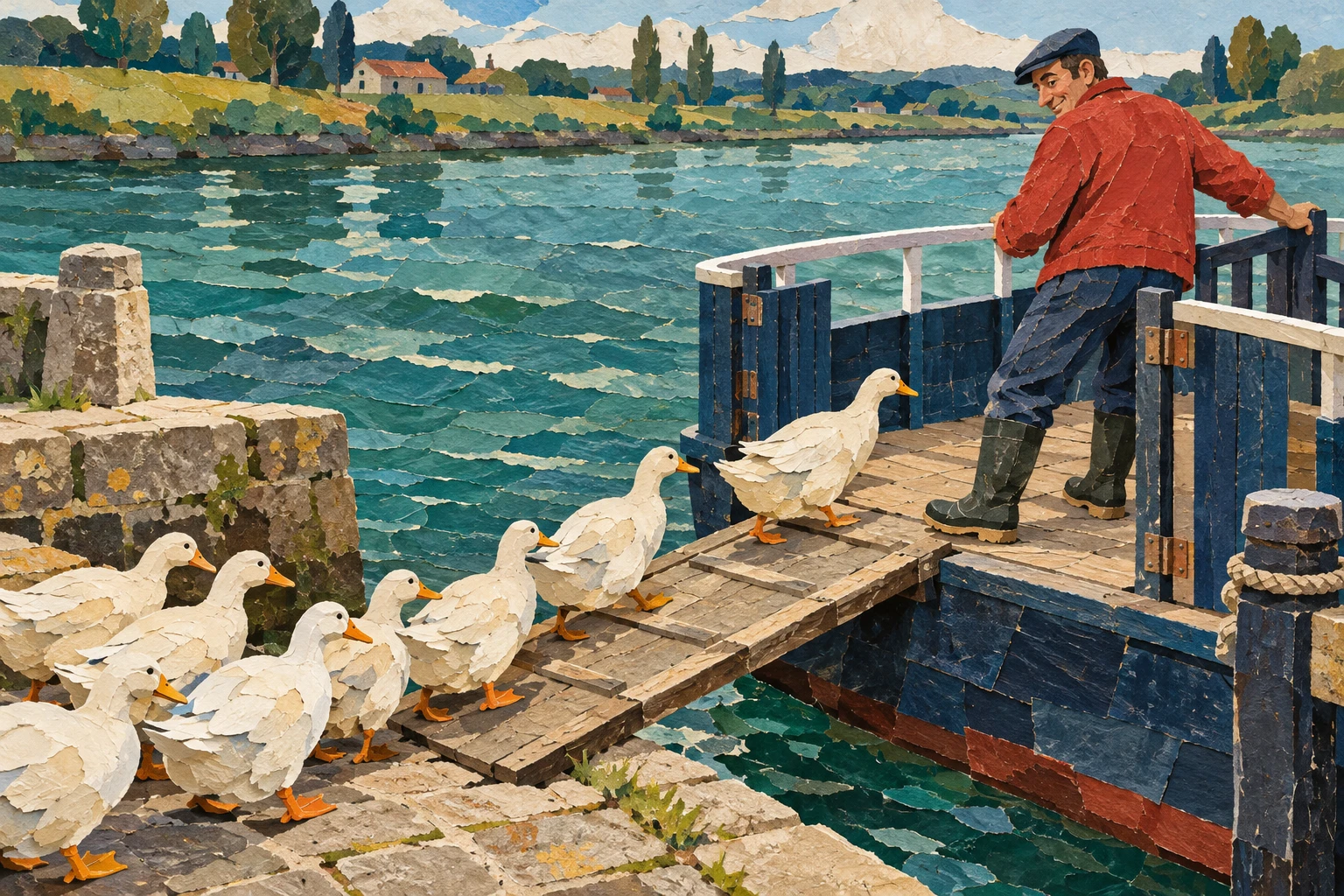
Ducks Boarding the Ferry
Ducks crowd across a narrow boarding ramp while a deckhand holds the gate, assembled from tactile paper layers with lively brushed marks.
Remix this referenceDucks Boarding the Ferry
- Form language
- Build broad, interlocking cut-paper shapes with small inset fragments for detail; allow irregular shapes to vary naturally.
- Contour
- Mix decisive scissor-cut edges with occasional fibrous tears; exposed sheet thickness supplies contours without continuous drawn outlines.
- Mark-making
- Brush and rub pigment onto paper before assembly, leaving broad dry streaks and loose scratches with naturally varied pressure and direction.
- Surface rendering
- Keep matte sheet faces and palpable overlaps; build tonal changes with nested paper patches and uneven rubbed pigment rather than smooth modeling.
Priority
Make assembled paper edges and tactile overlaps visibly integral to the image.
What to avoid & what to check
Exact prompt for this example
MODULE OWNERSHIP
subject: Subject count, type, stable proportions and landmarks, resting face geometry, hair shape, physical materials, garment construction and permanent marks. No emotion, movement, color assignment or rendering recipe.
expression: Facial soft-tissue displacement and pupil direction, muscle coordination, regional intensity, asymmetry and onset/peak/release. No head/body pose, stable appearance, skin color or rendering.
gesture: Head/neck/body/limb orientation, joint movement, support, contact and pose-caused occlusion using existing anatomy. No eye/pupil movement, emotion, identity, props inventory or camera.
props: Prop count, type, construction, physical material and scale relative to the subject. Holding/contact belongs to gesture, position to composition, color to palette.
scene: Environment elements, terrain, backdrop/floor presence and structural detail. No canvas positions, camera, lighting, assigned colors or render texture.
camera: Projection, focal-length impression, camera elevation/yaw/roll, viewing distance and crop. No actor pose, world placement, lighting or canvas aspect ratio.
composition: Normalized 0-100% canvas positions, scale in frame, depth/overlap, focal hierarchy and margins. No joint pose, camera projection, rendering, subject/prop inventory or emotion.
palette: Color anchors, hue/saturation/value ranges, colors assigned to parts and approximate color coverage. No illumination direction, shading algorithm, physical material or layout.
lighting: Light-source direction/softness/intensity, ambient illumination, physical shadow direction/length and highlight position. Absence of directional illumination is allowed. No shading technique, palette or material changes.
style: Reusable form abstraction, contour weight/taper/edge quality, medium and mark scale/density/direction, surface rendering and tonal transition technique. No fixed subject proportions, anatomy, identity, expression, pose, palette, light-source direction, camera or layout.
output: Image count, aspect ratio, size, file/alpha requirements and global lettering/logo/watermark restrictions. No background scenery, crop, style, identity or pose.

SUBJECT
inventory: One adult deckhand, actor A, and a small flock of domestic ducks; no other figures.
geometry: A has a broad torso and sturdy limbs; the ducks have plump bodies, short necks, flat bills and webbed feet.
resting-face: A has level brows, a broad nose and a short chin; the ducks have small, simply shaped eyes.
appearance: A wears a soft cap, cotton work jacket, straight trousers and rubber boots; ducks have smooth feather masses.

PRIORITY


AVOID


CHECK


EXPRESSION — ACTOR A
brows: Lift the visible outer brow slightly; leave the inner brow relaxed.
lids: Narrow the visible lids gently without squeezing them shut.
cheeks: Raise the visible cheek slightly beneath the eye.
nose: Keep the nose relaxed, without wrinkling or nostril flare.
mouth: Keep the lips together, lifting the visible corner into a small uneven smile.
jaw: Keep the jaw loosely closed without clenching.
gaze: Direct the visible pupil toward the leading duck on the ramp.
coordination: Let the mouth carry the amusement, supported by a quieter cheek and lid response.
timing: Hold the mild amusement at its apex, without building into laughter.

PRIORITY


AVOID


CHECK


GESTURE
head: A turns the head back toward the boarding ducks; the ducks extend their necks along their route.
torso: A leans back against the gate's pull; the ducks pitch slightly forward as they waddle aboard.
limbs: A reaches one arm outward and staggers the boots for balance; ducks take uneven steps with wings tucked.
contact: A grips the open gate with one hand and plants both boots on deck; the ducks' feet meet the boarding ramp.

PRIORITY


AVOID


CHECK


PROPS
inventory: No separate props.
construction: No prop construction applies.

PRIORITY


AVOID


CHECK


SCENE
inventory: A modest canal ferry beside a masonry landing, with canal water and a low opposite bank.
structure: The ferry has a plank deck, low railing, hinged boarding gate and narrow ramp with simple cross battens.

PRIORITY


AVOID


CHECK


CAMERA
projection: Use mild perspective with a natural, moderately wide lens impression.
viewpoint: Look slightly downward from the quay at A's rear three-quarter side, with no roll.
crop: Show A in full and enough landing and ferry to explain the crossing; crop the far end of the boat.

PRIORITY


AVOID


CHECK


COMPOSITION
placement: Lead from the crowded lower-left landing across the diagonal ramp to A at the right; leave open water above.
depth: Overlap the nearest ducks generously; separate the leading duck against the deck, with A behind the gate.
spacing: Make the congested ramp the first read, then A's silhouette; keep breathing room around the entrance.

PRIORITY


AVOID


CHECK


PALETTE
colors: Use warm ivory, canal teal, ochre, vermilion and ink blue, with mostly muted saturation.
assignment: Give ducks ivory bodies and ochre bills; use teal water, an ink-blue ferry and vermilion on A's jacket.
balance: Let teal and ivory dominate, ink blue anchor the structure and vermilion remain a compact accent.

PRIORITY


AVOID


CHECK


LIGHTING
sources: Broad, soft daylight arrives from the upper left with generous ambient fill.
shadows: Cast short, soft shadows toward the lower right beneath feet and railings.
highlights: Keep highlights subdued, with faint catches along upper-left edges.

PRIORITY


AVOID


CHECK


STYLE GUIDE
form-language: Build broad, interlocking cut-paper shapes with small inset fragments for detail; allow irregular shapes to vary naturally.
contour: Mix decisive scissor-cut edges with occasional fibrous tears; exposed sheet thickness supplies contours without continuous drawn outlines.
mark-making: Brush and rub pigment onto paper before assembly, leaving broad dry streaks and loose scratches with naturally varied pressure and direction.
surface-rendering: Keep matte sheet faces and palpable overlaps; build tonal changes with nested paper patches and uneven rubbed pigment rather than smooth modeling.

PRIORITY
Make assembled paper edges and tactile overlaps visibly integral to the image.

AVOID


CHECK


OUTPUT
format: One finished image, landscape 3:2, 1536 × 1024 pixels, opaque PNG.
restrictions: No lettering, logos, signatures or watermarks.

PRIORITY


AVOID


CHECK


FINAL INTEGRATION
lighting + style: Apply the established shadow behavior to lifted collage overlaps as well as depicted scene surfaces.
Model information comes from image provenance. The same prompt may produce a different result.