Text to imageCharacterStyle guide
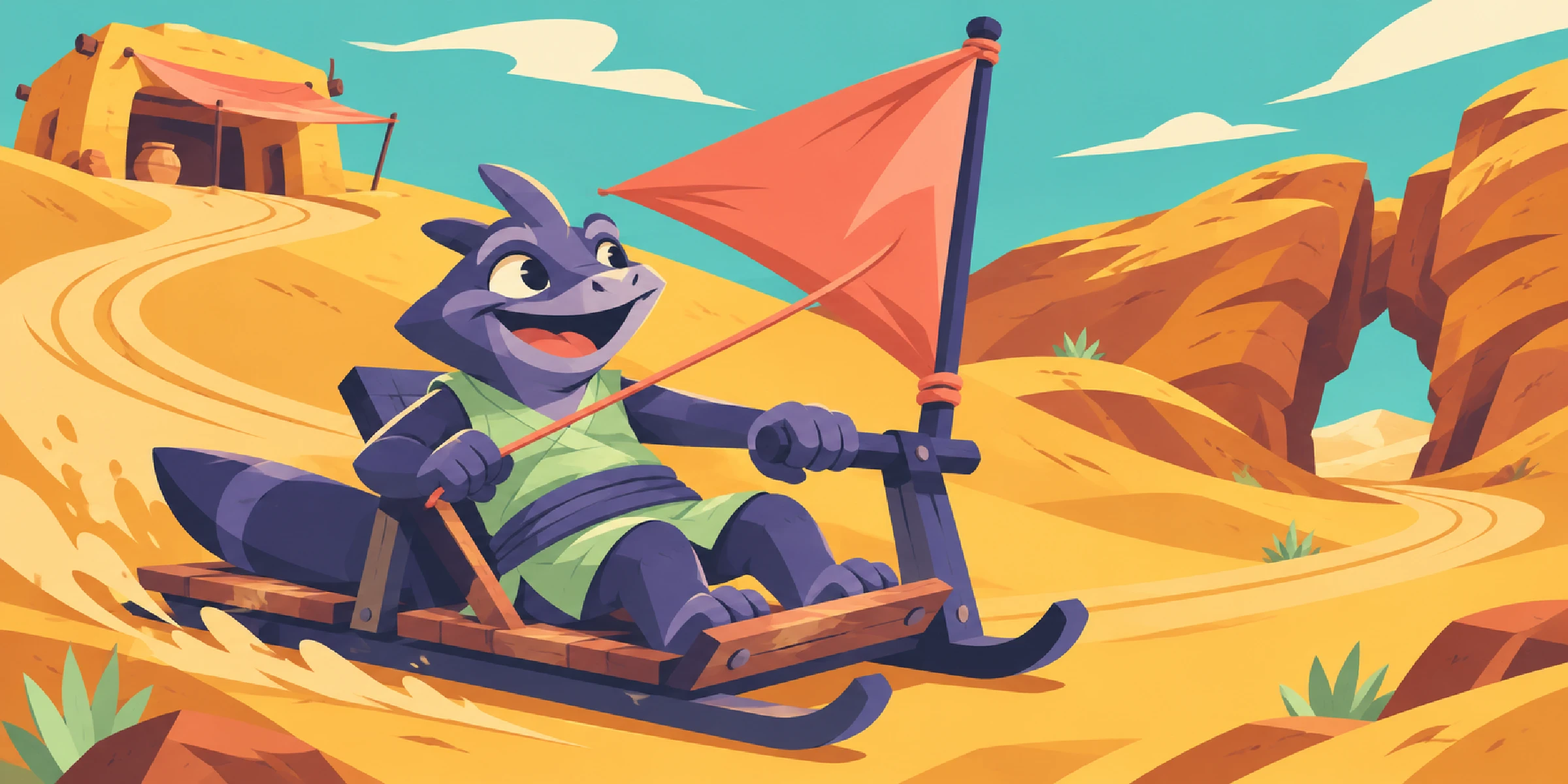
A Split-Crested Creature on a Sand Sled
A split-crested creature sails a sled down a curving sand chute. Crisp vector shapes and playful asymmetry carry a panoramic journey from a launch shelter toward a gap in the rocks.
Remix this referenceA Split-Crested Creature on a Sand Sled
- Form language
- Abstract forms into unequal wedges, bent capsules, and broad scooped curves; permit small variations within this playful geometric family.
- Contour
- Use crisp vector boundaries with occasional short tapered interior lines; vary corner sharpness instead of outlining every shape.
- Mark-making
- Add sparse curved cuts and tapered dash clusters, changing their scale and rhythm naturally across otherwise open shapes.
- Surface rendering
- Build surfaces from interlocking flat color planes and a few hard-edged tonal steps; use selective inset gaps for lively graphic separation.
Priority
Preserve crisp vector abstraction and playful asymmetry throughout the finished illustration.
What to avoid & what to check
Exact prompt for this example
MODULE OWNERSHIP
subject: Subject count, type, stable proportions and landmarks, resting face geometry, hair shape, physical materials, garment construction and permanent marks. No emotion, movement, color assignment or rendering recipe.
expression: Facial soft-tissue displacement and pupil direction, muscle coordination, regional intensity, asymmetry and onset/peak/release. No head/body pose, stable appearance, skin color or rendering.
gesture: Head/neck/body/limb orientation, joint movement, support, contact and pose-caused occlusion using existing anatomy. No eye/pupil movement, emotion, identity, props inventory or camera.
props: Prop count, type, construction, physical material and scale relative to the subject. Holding/contact belongs to gesture, position to composition, color to palette.
scene: Environment elements, terrain, backdrop/floor presence and structural detail. No canvas positions, camera, lighting, assigned colors or render texture.
camera: Projection, focal-length impression, camera elevation/yaw/roll, viewing distance and crop. No actor pose, world placement, lighting or canvas aspect ratio.
composition: Normalized 0-100% canvas positions, scale in frame, depth/overlap, focal hierarchy and margins. No joint pose, camera projection, rendering, subject/prop inventory or emotion.
palette: Color anchors, hue/saturation/value ranges, colors assigned to parts and approximate color coverage. No illumination direction, shading algorithm, physical material or layout.
lighting: Light-source direction/softness/intensity, ambient illumination, physical shadow direction/length and highlight position. Absence of directional illumination is allowed. No shading technique, palette or material changes.
style: Reusable form abstraction, contour weight/taper/edge quality, medium and mark scale/density/direction, surface rendering and tonal transition technique. No fixed subject proportions, anatomy, identity, expression, pose, palette, light-source direction, camera or layout.
output: Image count, aspect ratio, size, file/alpha requirements and global lettering/logo/watermark restrictions. No background scenery, crop, style, identity or pose.

SUBJECT
inventory: One original bipedal desert creature, actor A; no additional characters.
geometry: A compact barrel torso, short sturdy legs, long forearms, a wedge muzzle, and two unequal blunt crest prongs.
resting-face: Widely spaced oval eyes, low brow pads, small nostril slits, and a broad mouth beneath the projecting muzzle.
appearance: Smooth hide, a thick tapering tail, three-digit hands, and a wrap tunic secured by a broad cloth waistband.

PRIORITY


AVOID


CHECK


EXPRESSION — ACTOR A
brows: Both brow pads rise into shallow arcs, one slightly higher.
lids: Lower lids lift with the cheeks; upper lids remain comfortably open.
cheeks: Cheek pads bunch upward beside the mouth.
nose: Nostril slits remain relaxed without a muzzle wrinkle.
mouth: The broad mouth opens into a smile with unevenly lifted corners.
jaw: The jaw drops freely, leaving a clear opening beneath the muzzle.
gaze: Pupils look ahead toward the approaching rock passage.
coordination: Raised cheeks and mouth corners lead; the eyes share the smile without squeezing shut.
timing: Hold the apex of a sustained delighted reaction.

PRIORITY


AVOID


CHECK


GESTURE
head: The neck reaches forward and the muzzle lifts slightly along the direction of travel.
torso: The seated torso leans back against the pull, with a small twist toward the steering hand.
limbs: Feet brace forward, one hand grips the steering bar, and the other draws the sail line inward.
contact: The seat supports the hips and the footboard supports the soles; the tail rests along the rear deck.

PRIORITY


AVOID


CHECK


PROPS
inventory: One sail sled, large enough to seat the creature with room for its tail.
construction: A wooden deck on paired runners, with a footboard, steering bar, short mast, triangular cloth sail, and control rope.

PRIORITY


AVOID


CHECK


SCENE
inventory: An open dune basin with a sand chute, a rammed-earth launch shelter, and a cleft sandstone ridge.
structure: The chute descends between low dunes toward a natural rock passage; shallow runner tracks connect its bends.

PRIORITY


AVOID


CHECK


CAMERA
projection: Broad natural perspective with a mild wide-lens impression and restrained depth exaggeration.
viewpoint: A slightly elevated three-quarter side view, level with the broad descent rather than the basin floor.
crop: A panoramic long shot includes the entire creature and sled, the launch shelter, and the rock passage.

PRIORITY


AVOID


CHECK


COMPOSITION
placement: Place the creature just left of center, the small shelter high at left, and the rock opening near the right edge.
depth: Overlapping dune shoulders frame the route; the sled crosses in front of the middle-distance chute.
spacing: Make the creature the main focal point; a spacious S-curve links departure, rider, and destination without covering the face.

PRIORITY


AVOID


CHECK


PALETTE
colors: Saffron, coral, deep indigo, pale mint, and dusty turquoise form a compact expressive palette.
assignment: Saffron colors dunes and masonry, coral the sail, indigo the creature and sled, mint the tunic, turquoise the sky.
balance: Broad saffron and turquoise fields support a concentrated coral accent and a smaller, strongly separated indigo mass.

PRIORITY


AVOID


CHECK


LIGHTING
sources: A broad sun source from the upper right supplies clear illumination with gentle ambient fill.
shadows: Short shadows fall leftward beneath the runners and dune lips, with slightly softened outer edges.
highlights: Highlights occupy upper-right-facing crest edges, the muzzle ridge, and the sail's outward bulge.

PRIORITY


AVOID


CHECK


STYLE GUIDE
form-language: Abstract forms into unequal wedges, bent capsules, and broad scooped curves; permit small variations within this playful geometric family.
contour: Use crisp vector boundaries with occasional short tapered interior lines; vary corner sharpness instead of outlining every shape.
mark-making: Add sparse curved cuts and tapered dash clusters, changing their scale and rhythm naturally across otherwise open shapes.
surface-rendering: Build surfaces from interlocking flat color planes and a few hard-edged tonal steps; use selective inset gaps for lively graphic separation.

PRIORITY
Preserve crisp vector abstraction and playful asymmetry throughout the finished illustration.

AVOID


CHECK


OUTPUT
format: One finished image, panoramic 2:1, 2400 × 1200 pixels, opaque PNG.
restrictions: No lettering, logos, signatures, or watermarks.

PRIORITY


AVOID


CHECK


FINAL INTEGRATION
expression + camera + style: Keep facial acting readable at the selected viewing distance through economical vector shapes.
gesture + props + composition: Maintain clear working contacts while the broader arrangement carries the journey through the environment.
Model information comes from image provenance. The same prompt may produce a different result.