Text to imagePortraitStyle guide
White-Haired Adult · High-Key Value Compression
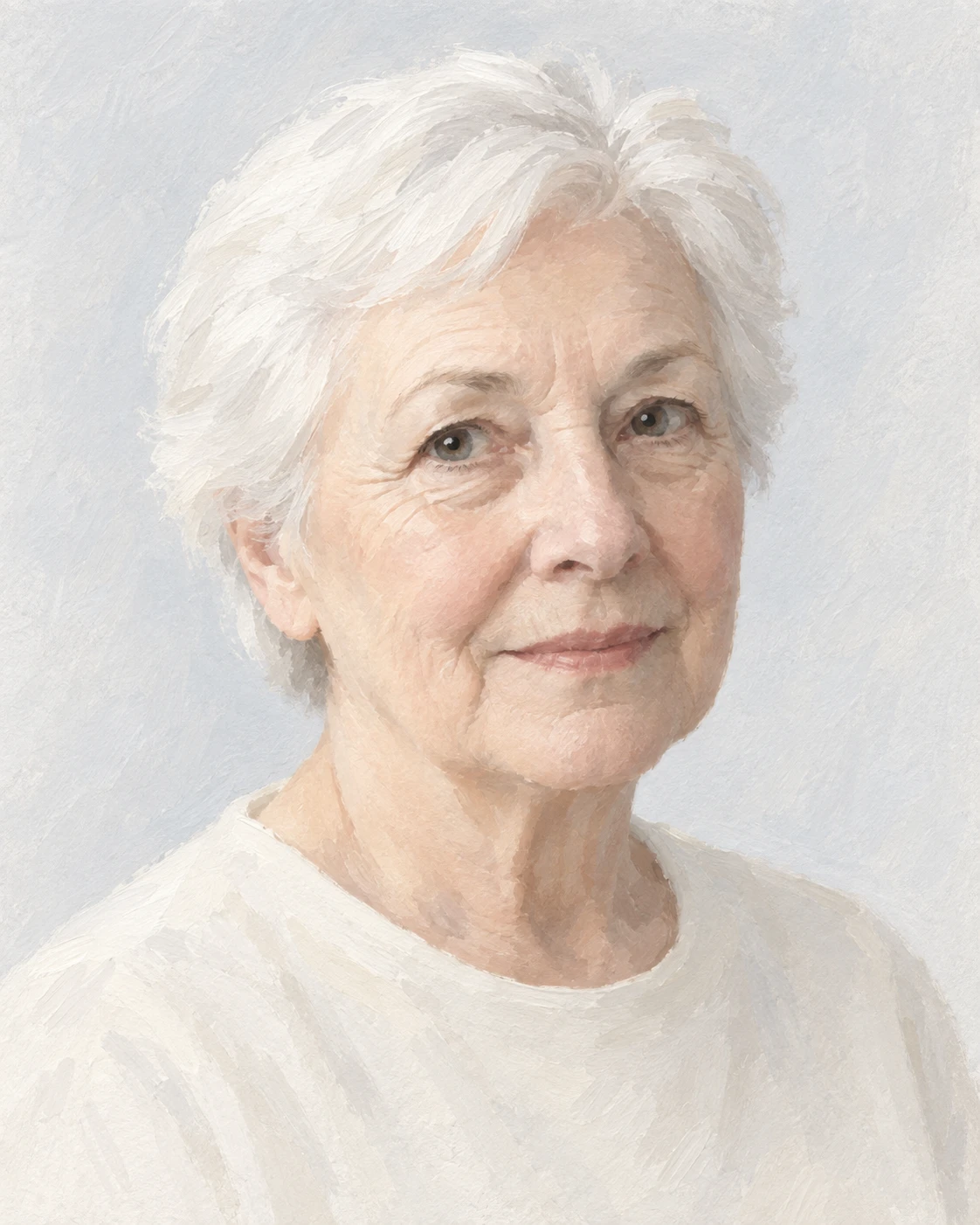
A portrait that models the face within a narrow range of pale values, reserving small dark accents for the eyes and nostrils.
White-Haired Adult · High-Key Value Compression
- Shape & line
- Construct the head with rounded forehead, cheek, and jaw shapes; describe the eyelids and mouth with short restrained strokes, and let gentle value transitions define the nose instead of outlining it.
- Color & light
- Place a large soft light above image-left so the image-left forehead and cheek are brightest and the image-right cheek carries a pale warm-gray shadow. Keep hair, skin, shirt, and background within white-to-light-gray values; reserve the deepest tones for tiny pupil, nostril, and mouth-corner accents.
- Texture & material
- Use opaque gouache on lightly textured paper, laying broad matte strokes across the skin and a few curved strokes through the white hair. Suggest age with sparse soft creases around the eyes, allowing paper grain to remain visible without speckling every surface.
- Composition
- Keep the small dark facial accents clustered near the center of the head, with the eyes forming the strongest focal pair. Separate the white hair from the pale background using a slightly cooler background value, and simplify the shirt into broad light shapes below the face.
Priority
Preserve readable facial volume while keeping almost the entire image in pale values.
What to avoid & what to check
Avoid clipped white facial areas, large dark shadows, and uniformly dark outlines.
Check that the face remains dimensional at thumbnail size and that dark accents occupy only small areas.
Exact prompt for this example
SUBJECT
One older adult with short white hair, a relaxed closed mouth, and a plain cream shirt; the head turns slightly toward image-right while the eyes look toward the viewer.

COMPOSITION
A vertical head-and-shoulders portrait at eye level, with the face just above center, both shoulders visible, and generous pale background around the hair.

STYLE GUIDE
1. Shape & line
Construct the head with rounded forehead, cheek, and jaw shapes; describe the eyelids and mouth with short restrained strokes, and let gentle value transitions define the nose instead of outlining it.

2. Color & light
Place a large soft light above image-left so the image-left forehead and cheek are brightest and the image-right cheek carries a pale warm-gray shadow. Keep hair, skin, shirt, and background within white-to-light-gray values; reserve the deepest tones for tiny pupil, nostril, and mouth-corner accents.

3. Texture & material
Use opaque gouache on lightly textured paper, laying broad matte strokes across the skin and a few curved strokes through the white hair. Suggest age with sparse soft creases around the eyes, allowing paper grain to remain visible without speckling every surface.

4. Composition
Keep the small dark facial accents clustered near the center of the head, with the eyes forming the strongest focal pair. Separate the white hair from the pale background using a slightly cooler background value, and simplify the shirt into broad light shapes below the face.

PRIORITY
Preserve the requested identity, count, action, composition and output settings. Apply the style rules within those constraints; a style reference must not replace the subject or layout. Within the style: Preserve readable facial volume while keeping almost the entire image in pale values.

AVOID
Avoid clipped white facial areas, large dark shadows, and uniformly dark outlines.

OUTPUT
One finished portrait painting in a 4:5 vertical aspect ratio, without lettering, captions, logos, or watermarks.

SELF-CHECK
Check that the face remains dimensional at thumbnail size and that dark accents occupy only small areas.
Model information comes from image provenance. The same prompt may produce a different result.