Text to imageProductStyle guide
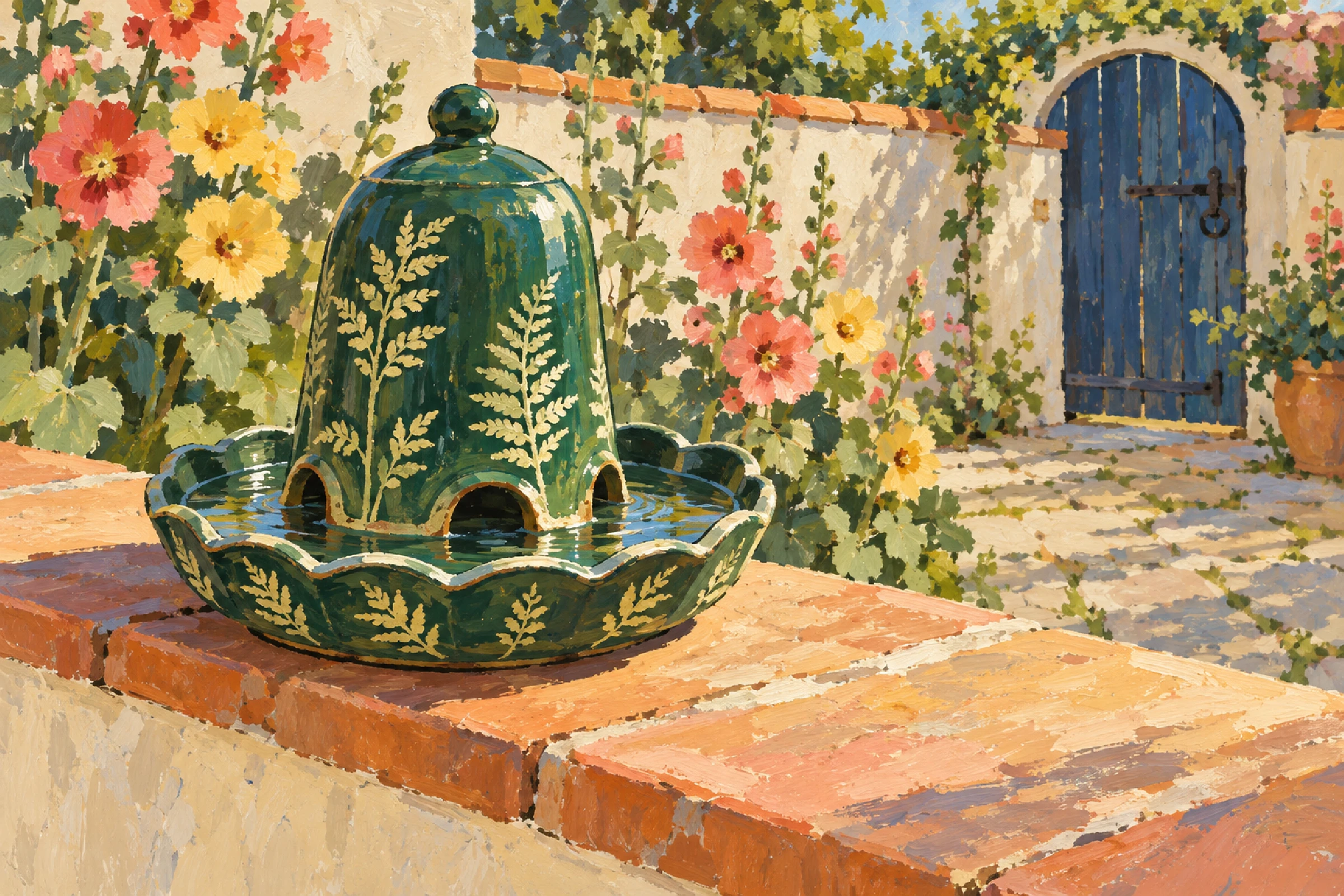
Ceramic Bird Waterer on a Wall
A folk-painted product scene pairing a green ceramic bird waterer with courtyard hollyhocks, using uneven silhouettes and lively brushwork across generous wall space.
Remix this referenceCeramic Bird Waterer on a Wall
- Form language
- Simplify forms into broad, slightly uneven silhouettes; translate secondary detail into freely repeated decorative emblems.
- Contour
- Let edges wander through blunt brush turns, adding selective thin outlines without enclosing every shape.
- Mark-making
- Use loaded short strokes, occasional dry skips and freehand decorative dabs; allow related marks to vary naturally.
- Surface rendering
- Layer opaque tempera patches with visible brush overlaps and simple stepped tones, leaving small underpaint glimpses.
Priority
Preserve the lively decorative simplification and handmade brush character of naive folk painting.
What to avoid & what to check
Exact prompt for this example
MODULE OWNERSHIP
subject: Subject count, type, stable proportions and landmarks, resting face geometry, hair shape, physical materials, garment construction and permanent marks. No emotion, movement, color assignment or rendering recipe.
expression: Facial soft-tissue displacement and pupil direction, muscle coordination, regional intensity, asymmetry and onset/peak/release. No head/body pose, stable appearance, skin color or rendering.
gesture: Head/neck/body/limb orientation, joint movement, support, contact and pose-caused occlusion using existing anatomy. No eye/pupil movement, emotion, identity, props inventory or camera.
props: Prop count, type, construction, physical material and scale relative to the subject. Holding/contact belongs to gesture, position to composition, color to palette.
scene: Environment elements, terrain, backdrop/floor presence and structural detail. No canvas positions, camera, lighting, assigned colors or render texture.
camera: Projection, focal-length impression, camera elevation/yaw/roll, viewing distance and crop. No actor pose, world placement, lighting or canvas aspect ratio.
composition: Normalized 0-100% canvas positions, scale in frame, depth/overlap, focal hierarchy and margins. No joint pose, camera projection, rendering, subject/prop inventory or emotion.
palette: Color anchors, hue/saturation/value ranges, colors assigned to parts and approximate color coverage. No illumination direction, shading algorithm, physical material or layout.
lighting: Light-source direction/softness/intensity, ambient illumination, physical shadow direction/length and highlight position. Absence of directional illumination is allowed. No shading technique, palette or material changes.
style: Reusable form abstraction, contour weight/taper/edge quality, medium and mark scale/density/direction, surface rendering and tonal transition technique. No fixed subject proportions, anatomy, identity, expression, pose, palette, light-source direction, camera or layout.
output: Image count, aspect ratio, size, file/alpha requirements and global lettering/logo/watermark restrictions. No background scenery, crop, style, identity or pose.

SUBJECT
inventory: One original ceramic garden bird waterer, roughly the size of a small flowerpot.
geometry: A removable bell-shaped reservoir fits within a broad scalloped drinking saucer, with arched skirt openings.
resting-face: No face or facial geometry applies.
appearance: Glazed earthenware with impressed fern sprigs and handmade irregularities; water remains visible in the saucer.

PRIORITY


AVOID


CHECK


PROPS
inventory: No separate props.
construction: No prop construction applies.

PRIORITY


AVOID


CHECK


SCENE
inventory: A small courtyard with a low plastered wall, hollyhocks, an arched wooden gate and stone paving.
structure: Fired-clay coping caps the wall; uneven paving joints and a simple gate latch suggest a lived-in garden.

PRIORITY


AVOID


CHECK


CAMERA
projection: Gentle natural perspective with a normal-lens impression.
viewpoint: View from slightly above the wall, with a mild three-quarter yaw and no roll.
crop: Show the entire waterer within a medium-wide courtyard fragment, including a clear view into its saucer.

PRIORITY


AVOID


CHECK


COMPOSITION
placement: Set the waterer on the coping left of center, large enough to lead the image.
depth: The waterer leads, flowering stems form a secondary rhythm, and the gate recedes beyond the wall.
spacing: Keep generous open wall to the right, interrupted by loose flower intervals; let the coping cross the lower frame.

PRIORITY


AVOID


CHECK


PALETTE
colors: Use bottle green, butter yellow, faded coral and chalk cream, with restrained deep blue accents.
assignment: Give the waterer bottle green, wall cream, flowers coral and yellow, foliage muted green, and gate deep blue.
balance: Let cream dominate the field, with green as the main color mass and scattered warm floral accents.

PRIORITY


AVOID


CHECK


LIGHTING
sources: Broad afternoon sunlight arrives from upper right with ample ambient fill.
shadows: Short, softly edged shadows fall leftward across the coping and beneath the saucer.
highlights: A broad highlight follows the reservoir's right shoulder, with a small light catch on the water.

PRIORITY


AVOID


CHECK


STYLE GUIDE
form-language: Simplify forms into broad, slightly uneven silhouettes; translate secondary detail into freely repeated decorative emblems.
contour: Let edges wander through blunt brush turns, adding selective thin outlines without enclosing every shape.
mark-making: Use loaded short strokes, occasional dry skips and freehand decorative dabs; allow related marks to vary naturally.
surface-rendering: Layer opaque tempera patches with visible brush overlaps and simple stepped tones, leaving small underpaint glimpses.

PRIORITY
Preserve the lively decorative simplification and handmade brush character of naive folk painting.

AVOID


CHECK


OUTPUT
format: Produce one opaque PNG, 3:2 landscape, 2400 × 1600 pixels.
restrictions: No lettering, logos or watermarks.

PRIORITY


AVOID


CHECK


FINAL INTEGRATION
subject + style: Keep the waterer's functional construction understandable through the decorative simplification.
Model information comes from image provenance. The same prompt may produce a different result.