Text to imageCafe & brandStyle guide
A Boot Under Repair
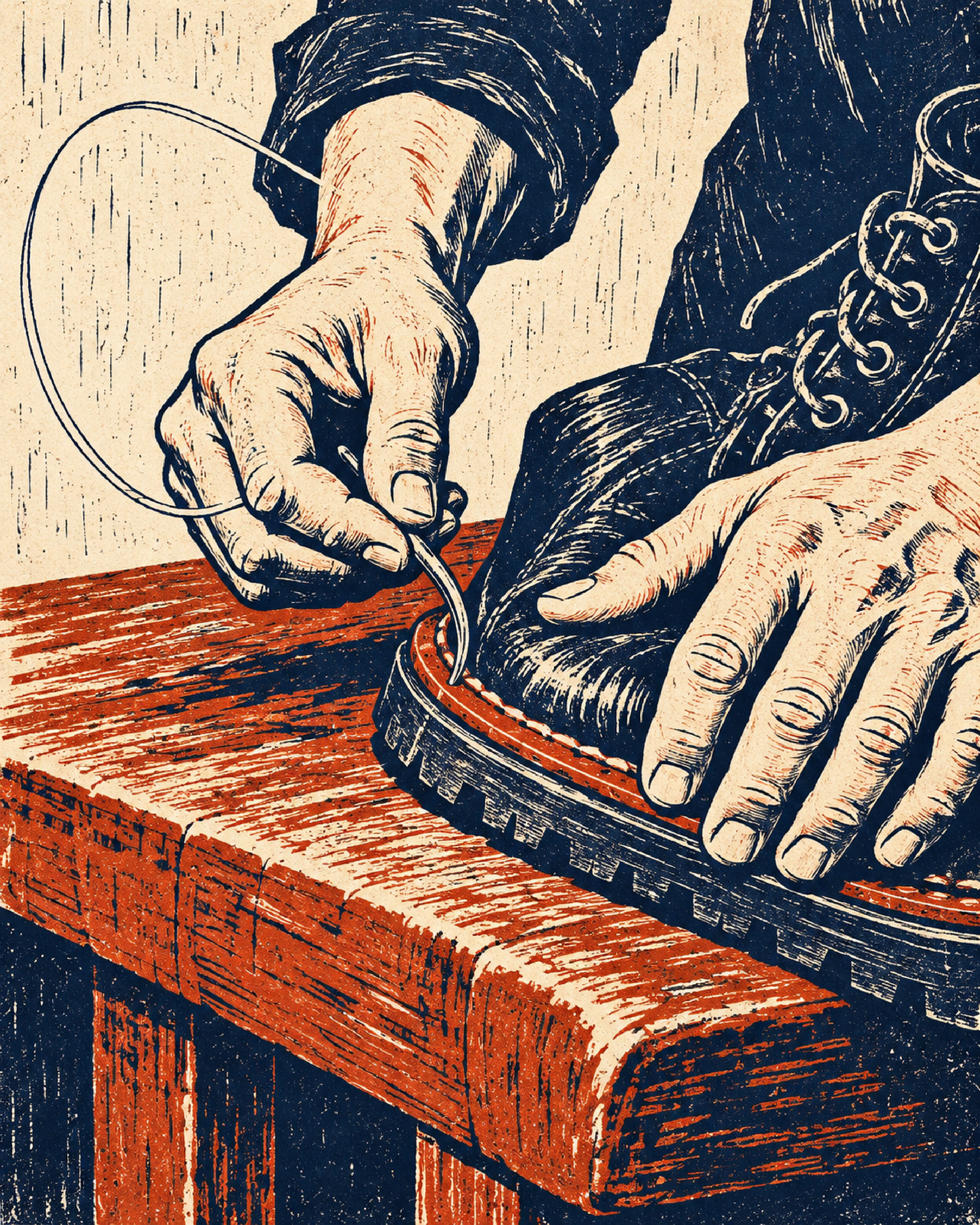
An intimate repair-brand image of hands stitching a worn boot. Bold linocut masses and rhythmic carved marks give continued use a tangible, expressive presence.
Remix this referenceA Boot Under Repair
- Form language
- Reduce forms to interlocking, weighty silhouettes with a few decisive interior divisions; small irregularities may vary.
- Contour
- Use blunt, slightly bitten edges with occasional tapered gouge notches, letting boundaries emerge without uniform enclosing outlines.
- Mark-making
- Carve rhythmic curved cuts and short wedge strokes in changing groups, allowing pauses between energetic passages.
- Surface rendering
- Build tone through relief-printed ink masses and exposed paper cuts; uneven ink pressure lightly interrupts broad areas.
Priority
Make bold linocut relief and rhythmic carved marks unmistakable.
What to avoid & what to check
Exact prompt for this example
MODULE OWNERSHIP
subject: Subject count, type, stable proportions and landmarks, resting face geometry, hair shape, physical materials, garment construction and permanent marks. No emotion, movement, color assignment or rendering recipe.
expression: Facial soft-tissue displacement and pupil direction, muscle coordination, regional intensity, asymmetry and onset/peak/release. No head/body pose, stable appearance, skin color or rendering.
gesture: Head/neck/body/limb orientation, joint movement, support, contact and pose-caused occlusion using existing anatomy. No eye/pupil movement, emotion, identity, props inventory or camera.
props: Prop count, type, construction, physical material and scale relative to the subject. Holding/contact belongs to gesture, position to composition, color to palette.
scene: Environment elements, terrain, backdrop/floor presence and structural detail. No canvas positions, camera, lighting, assigned colors or render texture.
camera: Projection, focal-length impression, camera elevation/yaw/roll, viewing distance and crop. No actor pose, world placement, lighting or canvas aspect ratio.
composition: Normalized 0-100% canvas positions, scale in frame, depth/overlap, focal hierarchy and margins. No joint pose, camera projection, rendering, subject/prop inventory or emotion.
palette: Color anchors, hue/saturation/value ranges, colors assigned to parts and approximate color coverage. No illumination direction, shading algorithm, physical material or layout.
lighting: Light-source direction/softness/intensity, ambient illumination, physical shadow direction/length and highlight position. Absence of directional illumination is allowed. No shading technique, palette or material changes.
style: Reusable form abstraction, contour weight/taper/edge quality, medium and mark scale/density/direction, surface rendering and tonal transition technique. No fixed subject proportions, anatomy, identity, expression, pose, palette, light-source direction, camera or layout.
output: Image count, aspect ratio, size, file/alpha requirements and global lettering/logo/watermark restrictions. No background scenery, crop, style, identity or pose.

SUBJECT
inventory: One adult human repairer.
geometry: Broad palms, sturdy fingers and short nails; individual hand details may vary naturally.
resting-face: No facial geometry is prescribed.
appearance: Bare hands and cotton work sleeves with folded cuffs; no permanent decorative marks.

PRIORITY


AVOID


CHECK


GESTURE
head: No head or neck pose is prescribed.
torso: No torso pose is prescribed.
limbs: The right hand draws the curved needle outward while the left fingers spread over the boot.
contact: The left palm braces the boot on the bench; right thumb and forefinger pinch the needle beyond the welt.

PRIORITY


AVOID


CHECK


PROPS
inventory: One adult ankle boot, one curved stitching needle and one continuous length of waxed thread.
construction: The worn boot has a leather upper, thick rubber sole and exposed welt; the steel needle is finger-length.

PRIORITY


AVOID


CHECK


SCENE
inventory: A timber repair bench and a plain workshop wall; no floor is visible.
structure: The bench has a substantial rounded front edge; the wall has no shelves or architectural ornament.

PRIORITY


AVOID


CHECK


CAMERA
projection: Natural perspective with a normal-lens impression and restrained depth exaggeration.
viewpoint: Look closely down from a modest elevation at an oblique side angle, without roll.
crop: Crop through both forearms and the boot shaft, retaining the repair junction; exclude head, neck and torso.

PRIORITY


AVOID


CHECK


COMPOSITION
placement: The repair junction leads below center; the boot fills the right side and the thread loop opens upper left.
depth: Hands overlap the boot around the welt; the boot overlaps the bench edge, with the wall behind.
spacing: Keep generous space inside the thread loop and a small clear interval around the needle tip.

PRIORITY


AVOID


CHECK


PALETTE
colors: Midnight indigo, rusty vermilion and warm ivory, with strong dark-to-light separation.
assignment: Indigo anchors boot and sleeves; vermilion accents welt and bench; ivory carries hands, thread and wall.
balance: Indigo and ivory dominate; vermilion remains a concentrated accent with minimal hue variation.

PRIORITY


AVOID


CHECK


LIGHTING
sources: Broad workshop daylight arrives from the upper left, supported by gentle ambient illumination.
shadows: Short shadows fall lower right, deepening beneath the fingers and boot sole.
highlights: Light catches the upper knuckles, curved needle and raised welt edge.

PRIORITY


AVOID


CHECK


STYLE GUIDE
form-language: Reduce forms to interlocking, weighty silhouettes with a few decisive interior divisions; small irregularities may vary.
contour: Use blunt, slightly bitten edges with occasional tapered gouge notches, letting boundaries emerge without uniform enclosing outlines.
mark-making: Carve rhythmic curved cuts and short wedge strokes in changing groups, allowing pauses between energetic passages.
surface-rendering: Build tone through relief-printed ink masses and exposed paper cuts; uneven ink pressure lightly interrupts broad areas.

PRIORITY
Make bold linocut relief and rhythmic carved marks unmistakable.

AVOID


CHECK


OUTPUT
format: One finished image, portrait 4:5, 2400 × 3000 pixels, opaque PNG.
restrictions: No lettering, logos or watermarks.

PRIORITY


AVOID


CHECK
Model information comes from image provenance. The same prompt may produce a different result.