Text to imageCharacterStyle guide
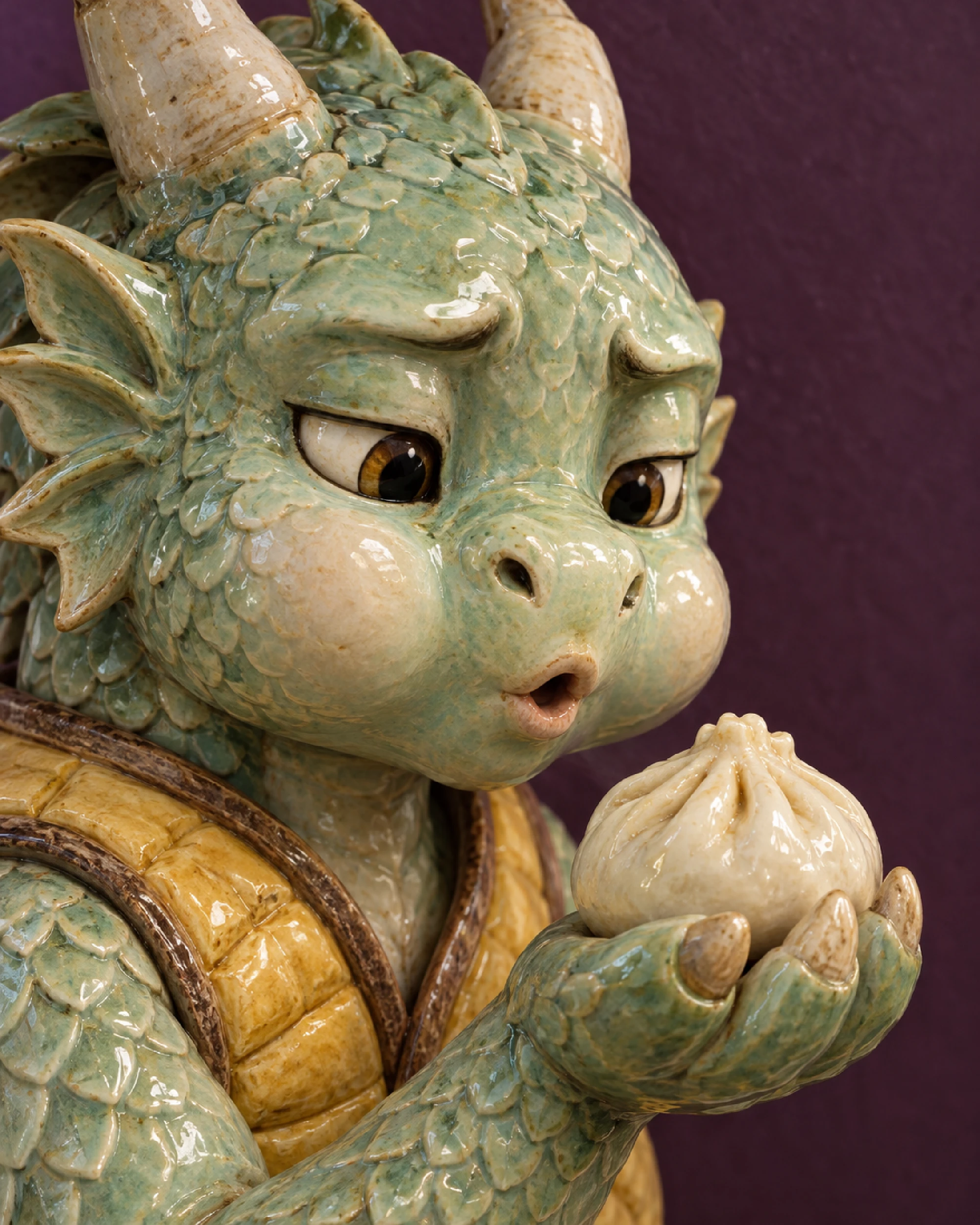
Dragon Cooling a Dumpling
A small dragon puffs its cheeks to cool a dumpling balanced on its forepaw. An intimate crop, substantial ceramic relief and pooled glaze give this earnest little moment a tactile presence.
Remix this referenceDragon Cooling a Dumpling
- Form language
- Build ceramic relief from broad modeled masses, with shallow incisions for secondary detail and generous transitions between raised forms.
- Contour
- Use rounded, slightly uneven relief edges and occasional compressed rims; let incised lines taper instead of outlining every form.
- Mark-making
- Retain selective thumb smoothing and short carving strokes, allowing their spacing and depth to vary naturally.
- Surface rendering
- Render glaze as translucent pools in recesses and thin veils across raised areas, with soft mottling and uneven glossy patches.
Priority
Make modeled ceramic relief and glaze depth unmistakable while preserving handmade irregularity.
What to avoid & what to check
Exact prompt for this example
MODULE OWNERSHIP
subject: Subject count, type, stable proportions and landmarks, resting face geometry, hair shape, physical materials, garment construction and permanent marks. No emotion, movement, color assignment or rendering recipe.
expression: Facial soft-tissue displacement and pupil direction, muscle coordination, regional intensity, asymmetry and onset/peak/release. No head/body pose, stable appearance, skin color or rendering.
gesture: Head/neck/body/limb orientation, joint movement, support, contact and pose-caused occlusion using existing anatomy. No eye/pupil movement, emotion, identity, props inventory or camera.
props: Prop count, type, construction, physical material and scale relative to the subject. Holding/contact belongs to gesture, position to composition, color to palette.
scene: Environment elements, terrain, backdrop/floor presence and structural detail. No canvas positions, camera, lighting, assigned colors or render texture.
camera: Projection, focal-length impression, camera elevation/yaw/roll, viewing distance and crop. No actor pose, world placement, lighting or canvas aspect ratio.
composition: Normalized 0-100% canvas positions, scale in frame, depth/overlap, focal hierarchy and margins. No joint pose, camera projection, rendering, subject/prop inventory or emotion.
palette: Color anchors, hue/saturation/value ranges, colors assigned to parts and approximate color coverage. No illumination direction, shading algorithm, physical material or layout.
lighting: Light-source direction/softness/intensity, ambient illumination, physical shadow direction/length and highlight position. Absence of directional illumination is allowed. No shading technique, palette or material changes.
style: Reusable form abstraction, contour weight/taper/edge quality, medium and mark scale/density/direction, surface rendering and tonal transition technique. No fixed subject proportions, anatomy, identity, expression, pose, palette, light-source direction, camera or layout.
output: Image count, aspect ratio, size, file/alpha requirements and global lettering/logo/watermark restrictions. No background scenery, crop, style, identity or pose.

SUBJECT
inventory: A is one original small anthropomorphic dragon wearing a sleeveless padded vest.
geometry: A compact chest, short broad muzzle, blunt paired horns and rounded forepaws define its construction.
resting-face: Wide-set eyes sit beneath soft brow ridges; a broad mouth seam rests below rounded nostrils.
appearance: Fine overlapping scales, leaflike cheek fins and a bound-edge quilted vest provide stable landmarks.

PRIORITY


AVOID


CHECK


EXPRESSION — ACTOR A
brows: Inner brow ridges draw gently down, slightly unevenly between sides.
lids: Upper lids lower slightly; lower lids remain loose.
cheeks: Both cheeks bulge softly with held air.
nose: Nostrils remain relaxed, without wrinkling the muzzle.
mouth: Lips project into a small rounded opening for a careful outward breath.
jaw: The jaw opens only enough to sustain the rounded mouth.
gaze: Both pupils aim downward toward the dumpling.
coordination: Cheek and lip effort leads; the nose stays relaxed beneath lightly engaged brows.
timing: Hold the apex of a steady cooling breath before the cheeks release.

PRIORITY


AVOID


CHECK


GESTURE
head: The neck bends forward slightly, bringing the muzzle toward the supported dumpling.
torso: The upper torso inclines forward with one shoulder subtly advanced.
limbs: The visible forearm folds upward, its paw cupped beneath the mouth; other limbs stay unprescribed.
contact: The dumpling rests on the cupped paw, with curled digits supporting it without squeezing.

PRIORITY


AVOID


CHECK


PROPS
inventory: One steamed dumpling, small enough to fit comfortably within the dragon's forepaw.
construction: A soft dough wrapper forms a plump pouch with a gathered pleated crown.

PRIORITY


AVOID


CHECK


SCENE
inventory: A continuous shallow backing plane is present; no floor or additional environment is visible.
structure: The backing remains uninterrupted, without a niche, border or architectural ornament.

PRIORITY


AVOID


CHECK


CAMERA
projection: Use restrained perspective with the compressed impression of an approximately 85 mm portrait lens.
viewpoint: View at muzzle height from a gentle three-quarter angle, with no camera roll.
crop: Use an intimate head-and-upper-chest crop, cutting one horn tip while retaining the paw and dumpling.

PRIORITY


AVOID


CHECK


COMPOSITION
placement: The face fills the upper-left field; the paw and dumpling occupy the lower right.
depth: The near cheek overlaps the vest; the paw projects ahead of the chest without obscuring the mouth.
spacing: Let the face lead and the dumpling answer it, separated by a small clear pocket of space.

PRIORITY


AVOID


CHECK


PALETTE
colors: Use soft celadon, deep aubergine, butter yellow and warm porcelain white.
assignment: Celadon belongs to the dragon, yellow to the vest, white to the dumpling and aubergine to the backing.
balance: Celadon dominates; the dark backing supports a restrained yellow accent and the pale dumpling.

PRIORITY


AVOID


CHECK


LIGHTING
sources: A broad upper-right light grazes the relief, supported by low, soft ambient illumination.
shadows: Short soft shadows fall down-left beneath the muzzle, paw and raised folds.
highlights: Small bright highlights sit on the upper-right cheeks, lip rim and dumpling pleats.

PRIORITY


AVOID


CHECK


STYLE GUIDE
form-language: Build ceramic relief from broad modeled masses, with shallow incisions for secondary detail and generous transitions between raised forms.
contour: Use rounded, slightly uneven relief edges and occasional compressed rims; let incised lines taper instead of outlining every form.
mark-making: Retain selective thumb smoothing and short carving strokes, allowing their spacing and depth to vary naturally.
surface-rendering: Render glaze as translucent pools in recesses and thin veils across raised areas, with soft mottling and uneven glossy patches.

PRIORITY
Make modeled ceramic relief and glaze depth unmistakable while preserving handmade irregularity.

AVOID


CHECK


OUTPUT
format: One finished image, portrait 4:5, 2000 × 2500 pixels, opaque PNG.
restrictions: No lettering, logos or watermarks.

PRIORITY


AVOID


CHECK


FINAL INTEGRATION
expression + gesture + composition: Coordinate facial acting and support so their relationship remains readable within the close arrangement.
style + lighting + palette: Let illumination reveal the modeled surface while assigned colors remain recognizable through glaze variation.
Model information comes from image provenance. The same prompt may produce a different result.