Text to imagePortraitStyle guide
Potter Catching Slipping Bowls
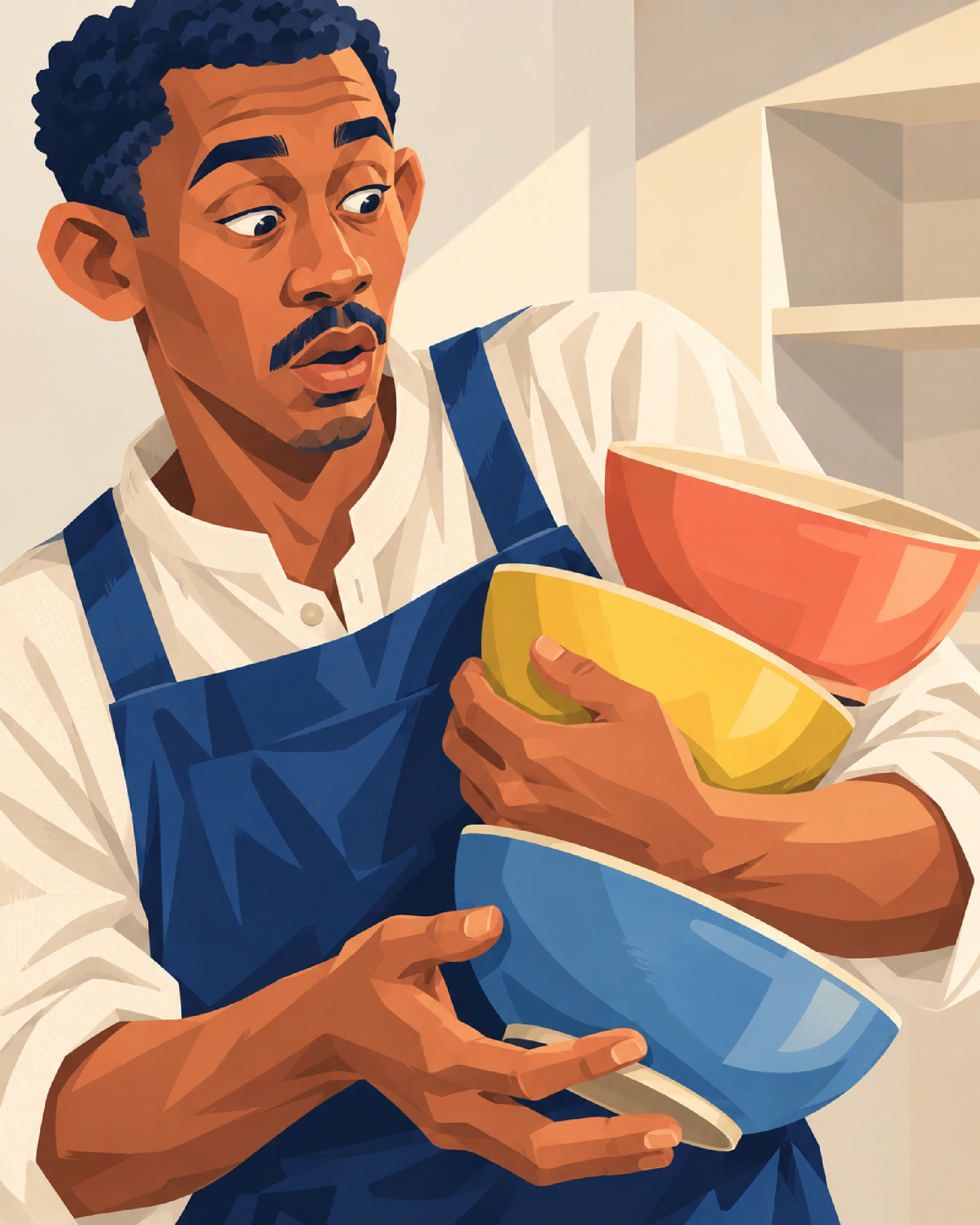
A potter's eyes widen as he catches three bowls slipping in front of his chest. Face, hands, and bowl rims overlap in a lively portrait, with crisp vector planes and mismatched curves holding the moment in balance.
Remix this referencePotter Catching Slipping Bowls
- Form language
- Reduce forms to interlocking curved polygons and offbeat arcs; let paired shapes differ deliberately while preserving clear recognition.
- Contour
- Use crisp vector boundaries without a continuous outer stroke; add a few tapered internal lines where adjacent planes need separation.
- Mark-making
- Use sparse wedges, short curved strokes, and irregularly spaced notches as graphic accents; vary their length instead of applying a pattern.
- Surface rendering
- Construct tone with two or three hard-edged nested planes per major form; keep fills smooth and transitions decisively stepped.
Priority
Make crisp vector abstraction and playful formal asymmetry the defining treatment.
What to avoid & what to check
Exact prompt for this example
MODULE OWNERSHIP
subject: Subject count, type, stable proportions and landmarks, resting face geometry, hair shape, physical materials, garment construction and permanent marks. No emotion, movement, color assignment or rendering recipe.
expression: Facial soft-tissue displacement and pupil direction, muscle coordination, regional intensity, asymmetry and onset/peak/release. No head/body pose, stable appearance, skin color or rendering.
gesture: Head/neck/body/limb orientation, joint movement, support, contact and pose-caused occlusion using existing anatomy. No eye/pupil movement, emotion, identity, props inventory or camera.
props: Prop count, type, construction, physical material and scale relative to the subject. Holding/contact belongs to gesture, position to composition, color to palette.
scene: Environment elements, terrain, backdrop/floor presence and structural detail. No canvas positions, camera, lighting, assigned colors or render texture.
camera: Projection, focal-length impression, camera elevation/yaw/roll, viewing distance and crop. No actor pose, world placement, lighting or canvas aspect ratio.
composition: Normalized 0-100% canvas positions, scale in frame, depth/overlap, focal hierarchy and margins. No joint pose, camera projection, rendering, subject/prop inventory or emotion.
palette: Color anchors, hue/saturation/value ranges, colors assigned to parts and approximate color coverage. No illumination direction, shading algorithm, physical material or layout.
lighting: Light-source direction/softness/intensity, ambient illumination, physical shadow direction/length and highlight position. Absence of directional illumination is allowed. No shading technique, palette or material changes.
style: Reusable form abstraction, contour weight/taper/edge quality, medium and mark scale/density/direction, surface rendering and tonal transition technique. No fixed subject proportions, anatomy, identity, expression, pose, palette, light-source direction, camera or layout.
output: Image count, aspect ratio, size, file/alpha requirements and global lettering/logo/watermark restrictions. No background scenery, crop, style, identity or pose.

SUBJECT
inventory: A is one original adult male potter; no other people appear.
geometry: A has a long face, broad ears, a narrow neck, and substantial hands with blunt fingertips.
resting-face: His resting features include straight brows, deep upper-lid folds, a broad nasal tip, and a full lower lip.
appearance: He has close-cropped curls, a short mustache, and a woven work shirt beneath a canvas bib apron with broad straps.

PRIORITY


AVOID


CHECK


EXPRESSION — ACTOR A
brows: Both brows lift, with the nearer brow rising slightly higher.
lids: The upper lids lift abruptly; the lower lids remain lightly engaged.
cheeks: The cheeks flatten slightly as the mouth begins to open.
nose: The nostrils stay relaxed and the nose bridge remains smooth.
mouth: The lips part into a small uneven oval, with neither corner lifted.
jaw: The jaw releases only a little, leaving the teeth mostly concealed.
gaze: Both pupils look down and right toward the lowest slipping bowl.
coordination: The eyes react ahead of the mouth, producing quick alertness without a full gasp.
timing: Capture the onset of surprise, just as the lips separate.

PRIORITY


AVOID


CHECK


GESTURE
head: A draws his chin back slightly and tips his head toward the slipping stack.
torso: His upper body twists toward the bowls, with one shoulder rising in the catch.
limbs: One bent arm cradles the upper pair while the opposite hand sweeps beneath the lowest bowl.
contact: The upper bowls touch the supporting forearm; the other palm meets the lowest bowl's base with fingers spread.

PRIORITY


AVOID


CHECK


PROPS
inventory: Three ceramic serving bowls, each roughly as wide as A's face, form the only separate props.
construction: The bowls have open rounded bodies, thick rolled rims, and small foot rings; their profiles may vary naturally.

PRIORITY


AVOID


CHECK


SCENE
inventory: The setting is a pottery studio with a plain wall and one shallow built-in drying shelf; no floor is visible.
structure: The shelf is a simple recessed ledge without stored objects; the wall has no decorative fittings.

PRIORITY


AVOID


CHECK


CAMERA
projection: Use restrained perspective with a short-telephoto portrait impression and little depth distortion.
viewpoint: View near eye level from a slight three-quarter angle, with the camera level.
crop: Frame a close bust portrait including both hands; let the lower apron continue beyond the bottom edge.

PRIORITY


AVOID


CHECK


COMPOSITION
placement: Place the face in the upper left and let the staggered bowls sweep diagonally through the lower right.
depth: Keep the face dominant; hands and rims overlap the apron and one shoulder while leaving the mouth readable.
spacing: Use tight overlap around the catch and an open pocket beside the head; allow one bowl edge to leave the frame.

PRIORITY


AVOID


CHECK


PALETTE
colors: Use ink blue, warm coral, pale cream, citron yellow, and a restrained terracotta skin range.
assignment: Assign terracotta to skin, ink blue to hair and apron, cream to shirt and wall, and coral, citron, and blue to the bowls.
balance: Let cream and blue carry the large areas; reserve the most saturated coral and citron for the bowls.

PRIORITY


AVOID


CHECK


LIGHTING
sources: A broad studio window lights the scene from the upper right, with ample ambient fill.
shadows: Soft shadows fall leftward beneath the nose, hands, and bowl rims; cast shadows remain short.
highlights: Place broad highlights on the right cheek and upper-right arcs of the bowls, without sharp glare.

PRIORITY


AVOID


CHECK


STYLE GUIDE
form-language: Reduce forms to interlocking curved polygons and offbeat arcs; let paired shapes differ deliberately while preserving clear recognition.
contour: Use crisp vector boundaries without a continuous outer stroke; add a few tapered internal lines where adjacent planes need separation.
mark-making: Use sparse wedges, short curved strokes, and irregularly spaced notches as graphic accents; vary their length instead of applying a pattern.
surface-rendering: Construct tone with two or three hard-edged nested planes per major form; keep fills smooth and transitions decisively stepped.

PRIORITY
Make crisp vector abstraction and playful formal asymmetry the defining treatment.

AVOID


CHECK


OUTPUT
format: Deliver one image, portrait 4:5, 1920 × 2400 pixels, as an opaque PNG.
restrictions: Include no lettering, logos, signatures, or watermarks.

PRIORITY


AVOID


CHECK


FINAL INTEGRATION
expression + gesture + composition: Coordinate the emerging facial reaction with the catch so the overlapping action supports a readable portrait.
Model information comes from image provenance. The same prompt may produce a different result.