Text to imageCharacterStyle guide
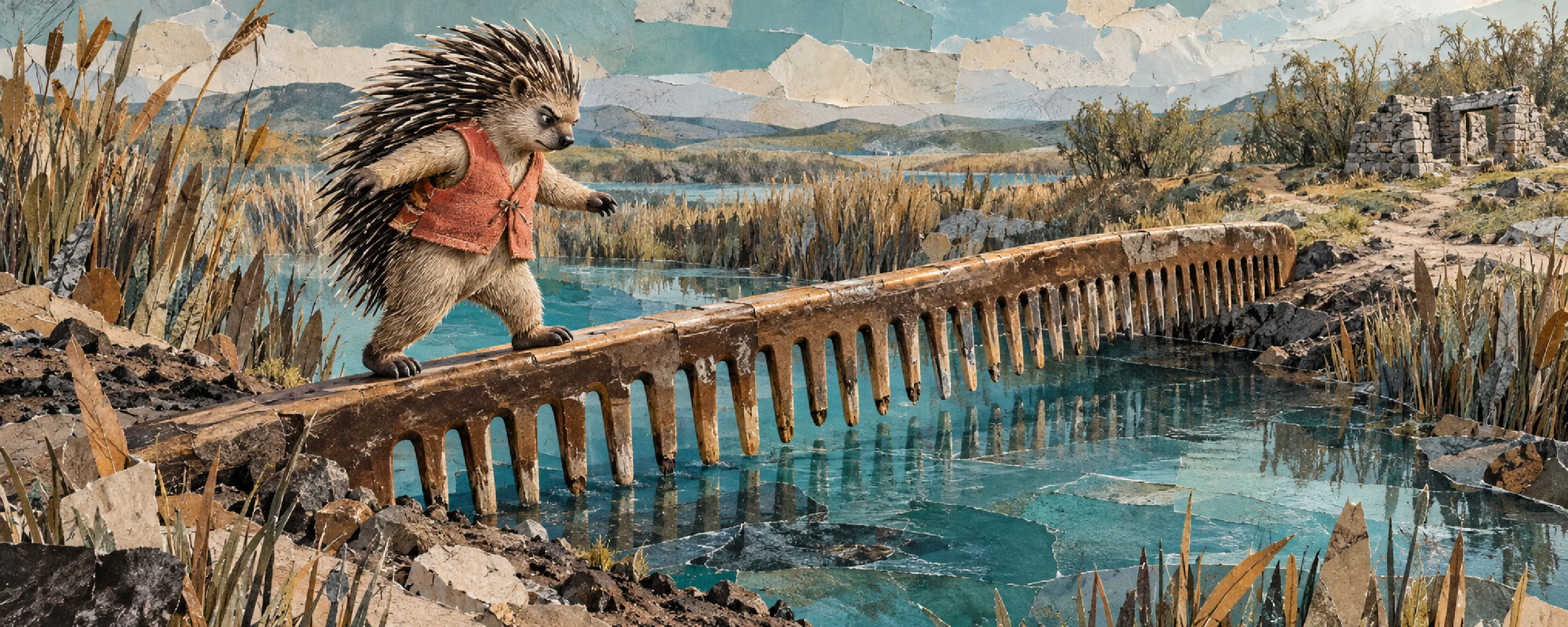
Porcupine Traveler Crossing a Giant Comb
A porcupine traveler carefully crosses the spine of a giant comb spanning a reed marsh. Photographic fragments, torn paper and pencil traces build a surreal panorama where a small expression belongs to a much larger journey.
Remix this referencePorcupine Traveler Crossing a Giant Comb
- Form language
- Build a surreal collage from broad cut silhouettes and selectively detailed fragments, allowing differences in source scale to remain visible.
- Contour
- Alternate crisp scissor cuts with fibrous torn edges; use selective pencil contours to reconnect interrupted forms.
- Mark-making
- Add loose graphite hatching and occasional rubbed transfers over photographic scraps; let pressure and mark spacing vary naturally.
- Surface rendering
- Keep photographic tonal detail beside matte paper blocks and thin gouache veils, with visible overlaps rather than seamless blending.
Priority
Make the mixed-media joins and unexpected scale relationships visibly integral to the surreal image.
What to avoid & what to check
Exact prompt for this example
MODULE OWNERSHIP
subject: Subject count, type, stable proportions and landmarks, resting face geometry, hair shape, physical materials, garment construction and permanent marks. No emotion, movement, color assignment or rendering recipe.
expression: Facial soft-tissue displacement and pupil direction, muscle coordination, regional intensity, asymmetry and onset/peak/release. No head/body pose, stable appearance, skin color or rendering.
gesture: Head/neck/body/limb orientation, joint movement, support, contact and pose-caused occlusion using existing anatomy. No eye/pupil movement, emotion, identity, props inventory or camera.
props: Prop count, type, construction, physical material and scale relative to the subject. Holding/contact belongs to gesture, position to composition, color to palette.
scene: Environment elements, terrain, backdrop/floor presence and structural detail. No canvas positions, camera, lighting, assigned colors or render texture.
camera: Projection, focal-length impression, camera elevation/yaw/roll, viewing distance and crop. No actor pose, world placement, lighting or canvas aspect ratio.
composition: Normalized 0-100% canvas positions, scale in frame, depth/overlap, focal hierarchy and margins. No joint pose, camera projection, rendering, subject/prop inventory or emotion.
palette: Color anchors, hue/saturation/value ranges, colors assigned to parts and approximate color coverage. No illumination direction, shading algorithm, physical material or layout.
lighting: Light-source direction/softness/intensity, ambient illumination, physical shadow direction/length and highlight position. Absence of directional illumination is allowed. No shading technique, palette or material changes.
style: Reusable form abstraction, contour weight/taper/edge quality, medium and mark scale/density/direction, surface rendering and tonal transition technique. No fixed subject proportions, anatomy, identity, expression, pose, palette, light-source direction, camera or layout.
output: Image count, aspect ratio, size, file/alpha requirements and global lettering/logo/watermark restrictions. No background scenery, crop, style, identity or pose.

SUBJECT
inventory: A is one original adult anthropomorphic porcupine traveler.
geometry: A has a compact upright build, broad feet, a blunt muzzle and a swept fan of long quills extending from crown to back.
resting-face: Small round eyes sit beneath short brow ridges; a broad nose and short mouth occupy the rounded muzzle.
appearance: Short fur surrounds smooth keratin quills; a sleeveless wool vest has a wrap front and a simple tied fastening.

PRIORITY


AVOID


CHECK


EXPRESSION — ACTOR A
brows: Brows draw slightly inward, with the nearer brow a little lower.
lids: Upper lids lower mildly while lower lids remain lightly engaged.
cheeks: Cheeks stay mostly relaxed with a small tightening beside the muzzle.
nose: Nostrils remain at rest without wrinkling.
mouth: Lips press gently together, slightly firmer at the nearer corner.
jaw: The jaw settles closed without clenching.
gaze: Pupils aim down and right toward the next foothold.
coordination: The focused upper face leads; the quieter mouth keeps the effort contained.
timing: Catch the onset of concentration before the expression fully tightens.

PRIORITY


AVOID


CHECK


GESTURE
head: A tips the head slightly forward, leaving the muzzle visible in three-quarter view.
torso: The torso inclines into the crossing with a small countertwist through the shoulders.
limbs: One foot advances along the narrow spine; the rear knee stays soft and both arms open unevenly for balance.
contact: The rear sole bears weight on the comb spine as the leading toes begin their next contact.

PRIORITY


AVOID


CHECK


PROPS
inventory: One enormous pocket comb is long enough to bridge the marsh channel.
construction: The comb is carved horn with a thick continuous spine, rounded teeth and an occasional worn tooth tip.

PRIORITY


AVOID


CHECK


SCENE
inventory: A reed marsh contains a winding channel, muddy banks, willow scrub and a small roofless stone shelter.
structure: The channel separates a trampled departure bank from a firmer bank with a path continuing through the scrub.

PRIORITY


AVOID


CHECK


CAMERA
projection: Use a broad environmental perspective with a moderate wide-lens impression and restrained distortion.
viewpoint: Observe from slightly above the crossing, obliquely enough to see the comb's spine and teeth; keep the horizon level.
crop: Show A in full figure and include both banks with ample surrounding marsh.

PRIORITY


AVOID


CHECK


COMPOSITION
placement: Place A left of the midpoint at about half the image height; the comb travels diagonally toward the distant right bank.
depth: A leads the hierarchy, the comb carries the journey, and the far path and shelter provide a small destination. Keep the willow scrub distant.
spacing: Keep open water beneath the crossing and breathing room around the quill silhouette; vary overlaps among reed masses.

PRIORITY


AVOID


CHECK


PALETTE
colors: Use petrol teal, tobacco brown, parchment beige and dusty coral, with sparse near-black accents.
assignment: A has beige fur, dark quills and a coral vest; the comb is tobacco brown, with teal water and subdued beige banks.
balance: Let subdued marsh colors occupy most of the image while the coral garment supplies the strongest saturation.

PRIORITY


AVOID


CHECK


LIGHTING
sources: Soft daylight comes from the upper right with generous diffuse ambient illumination.
shadows: Broad faint shadows extend leftward, with darker contact shadows beneath the feet.
highlights: Small highlights follow the upper-right edges of the nose, quills and comb spine.

PRIORITY


AVOID


CHECK


STYLE GUIDE
form-language: Build a surreal collage from broad cut silhouettes and selectively detailed fragments, allowing differences in source scale to remain visible.
contour: Alternate crisp scissor cuts with fibrous torn edges; use selective pencil contours to reconnect interrupted forms.
mark-making: Add loose graphite hatching and occasional rubbed transfers over photographic scraps; let pressure and mark spacing vary naturally.
surface-rendering: Keep photographic tonal detail beside matte paper blocks and thin gouache veils, with visible overlaps rather than seamless blending.

PRIORITY
Make the mixed-media joins and unexpected scale relationships visibly integral to the surreal image.

AVOID


CHECK


OUTPUT
format: Deliver one finished image, 5:2 panoramic landscape, 3000 × 1200 pixels, opaque PNG.
restrictions: No lettering, logos or watermarks.

PRIORITY


AVOID


CHECK


FINAL INTEGRATION
expression + gesture + composition + style: Keep the facial acting readable within the environmental journey while collage discontinuities enrich the world around it.
Model information comes from image provenance. The same prompt may produce a different result.