Text to imageArt stylesStyle guide
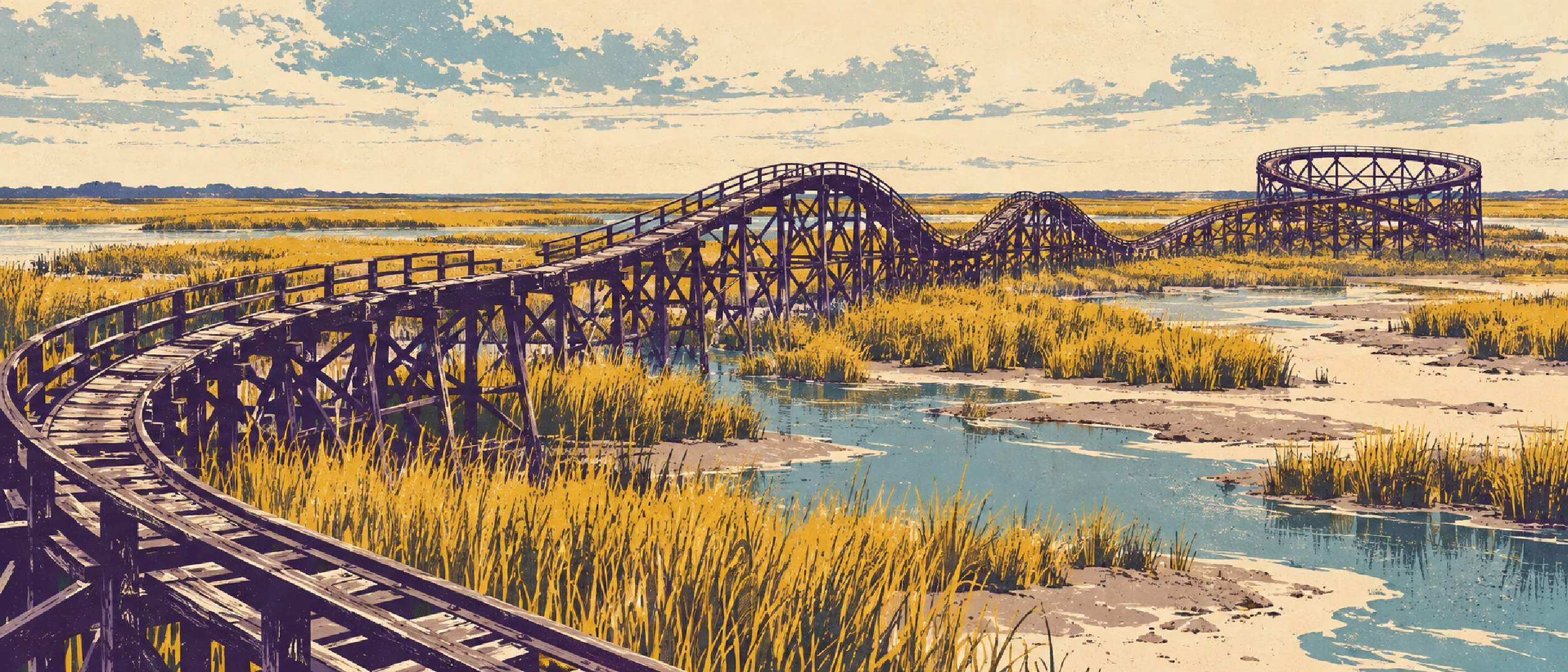
Reeds Beneath the Roller Coaster
A tidal marsh spreads beneath an abandoned wooden roller coaster. Bold screen printing turns the alternating curves of track and masses of reeds into a panoramic visual journey.
Remix this referenceReeds Beneath the Roller Coaster
- Form language
- Reduce forms to decisive interlocking masses; alternate sweeping bands, blunt wedges, and open lattices while allowing small irregularities.
- Contour
- Let stencil-cut silhouettes carry most edges; use selective heavy interior lines with blunt endings and slight chatter at corners.
- Mark-making
- Use broad squeegee-dragged ink passages and sparse raked strokes; vary their pressure and spacing naturally rather than repeating a texture tile.
- Surface rendering
- Build tones with opaque screen-printed layers on absorbent paper; occasional ink overlaps and uneven deposits enrich otherwise firm value steps.
Priority
Make decisive shape rhythms and visibly deposited screen-print ink the defining treatment.
What to avoid & what to check
Exact prompt for this example
MODULE OWNERSHIP
subject: Subject count, type, stable proportions and landmarks, resting face geometry, hair shape, physical materials, garment construction and permanent marks. No emotion, movement, color assignment or rendering recipe.
expression: Facial soft-tissue displacement and pupil direction, muscle coordination, regional intensity, asymmetry and onset/peak/release. No head/body pose, stable appearance, skin color or rendering.
gesture: Head/neck/body/limb orientation, joint movement, support, contact and pose-caused occlusion using existing anatomy. No eye/pupil movement, emotion, identity, props inventory or camera.
props: Prop count, type, construction, physical material and scale relative to the subject. Holding/contact belongs to gesture, position to composition, color to palette.
scene: Environment elements, terrain, backdrop/floor presence and structural detail. No canvas positions, camera, lighting, assigned colors or render texture.
camera: Projection, focal-length impression, camera elevation/yaw/roll, viewing distance and crop. No actor pose, world placement, lighting or canvas aspect ratio.
composition: Normalized 0-100% canvas positions, scale in frame, depth/overlap, focal hierarchy and margins. No joint pose, camera projection, rendering, subject/prop inventory or emotion.
palette: Color anchors, hue/saturation/value ranges, colors assigned to parts and approximate color coverage. No illumination direction, shading algorithm, physical material or layout.
lighting: Light-source direction/softness/intensity, ambient illumination, physical shadow direction/length and highlight position. Absence of directional illumination is allowed. No shading technique, palette or material changes.
style: Reusable form abstraction, contour weight/taper/edge quality, medium and mark scale/density/direction, surface rendering and tonal transition technique. No fixed subject proportions, anatomy, identity, expression, pose, palette, light-source direction, camera or layout.
output: Image count, aspect ratio, size, file/alpha requirements and global lettering/logo/watermark restrictions. No background scenery, crop, style, identity or pose.

SUBJECT
inventory: One abandoned wooden roller coaster, without cars or people.
geometry: A continuous narrow track forms a broad return bend, low rolling humps, and an open helix on cross-braced trestles.
resting-face: No faces are present.
appearance: Weathered timber beams carry paired iron rails; occasional missing boards interrupt the maintenance walkway.

PRIORITY


AVOID


CHECK


PROPS
inventory: No separate props.
construction: No prop construction applies.

PRIORITY


AVOID


CHECK


SCENE
inventory: A tidal wetland contains reed beds, exposed mudbanks, shallow pools, and a winding creek beneath an open sky.
structure: The creek branches around reed islands; low earthen embankments enclose the wetland, with no surviving park buildings.

PRIORITY


AVOID


CHECK


CAMERA
projection: Use a moderately wide perspective with gentle recession and little edge distortion.
viewpoint: Look obliquely across the wetland from a low embankment, slightly above the nearest track deck, with a level horizon.
crop: Use a panoramic environmental view; let the nearest rails exit the lower and left edges while retaining the entire distant helix.

PRIORITY


AVOID


CHECK


COMPOSITION
placement: The near bend anchors the lower left; successive humps carry attention across the middle toward the smaller helix at upper right.
depth: Near trestles overlap reed masses; glimpses of creek connect the gaps and open into a quieter distant pool.
spacing: Alternate dense timber passages with broad water openings; preserve generous sky above the low track and breathing room around the helix.

PRIORITY


AVOID


CHECK


PALETTE
colors: Use soot violet, citron yellow, muted cyan, and warm bone, with strong dark-to-light separation.
assignment: Assign soot violet to timber and rails, citron to reeds, muted cyan to water, and warm bone to sky and exposed mud.
balance: Let bone and citron occupy broad fields, violet establish the dark rhythm, and cyan provide restrained intervals.

PRIORITY


AVOID


CHECK


LIGHTING
sources: Broad hazy daylight arrives from upper left with generous ambient fill.
shadows: Short, soft shadows fall toward lower right, with deeper shade directly beneath the track decks.
highlights: Keep highlights broad and subdued on upper-left-facing surfaces; water reflections remain diffuse.

PRIORITY


AVOID


CHECK


STYLE GUIDE
form-language: Reduce forms to decisive interlocking masses; alternate sweeping bands, blunt wedges, and open lattices while allowing small irregularities.
contour: Let stencil-cut silhouettes carry most edges; use selective heavy interior lines with blunt endings and slight chatter at corners.
mark-making: Use broad squeegee-dragged ink passages and sparse raked strokes; vary their pressure and spacing naturally rather than repeating a texture tile.
surface-rendering: Build tones with opaque screen-printed layers on absorbent paper; occasional ink overlaps and uneven deposits enrich otherwise firm value steps.

PRIORITY
Make decisive shape rhythms and visibly deposited screen-print ink the defining treatment.

AVOID


CHECK


OUTPUT
format: Deliver one finished image, 21:9 aspect ratio, 2520 × 1080 pixels, opaque PNG.
restrictions: No lettering, logos, signatures, or watermarks.

PRIORITY


AVOID


CHECK


FINAL INTEGRATION
composition + style: Let the print's alternating solid and open forms reinforce the visual journey without closing the spatial gaps.
Model information comes from image provenance. The same prompt may produce a different result.