Text to imageLandscapeStyle guide
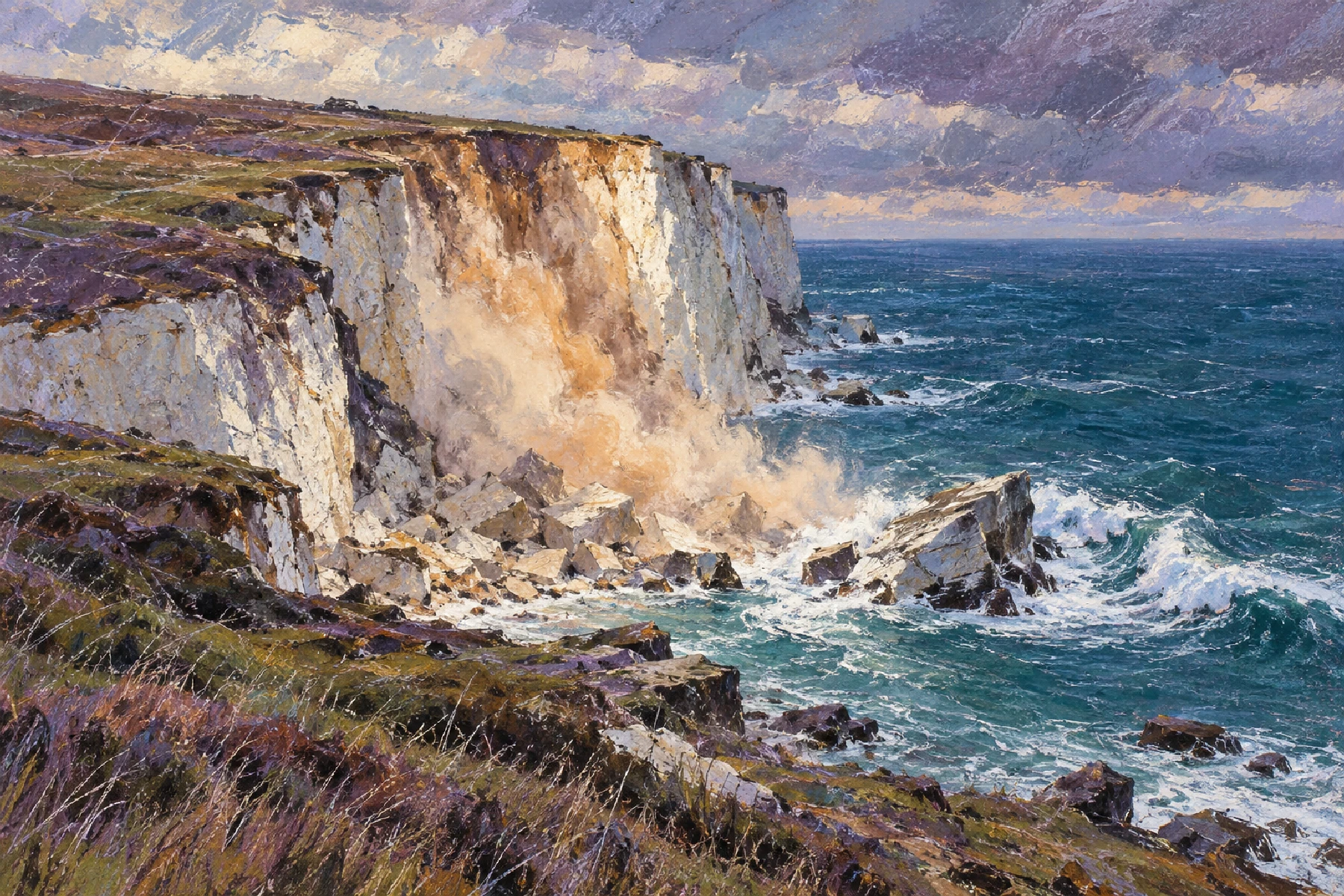
Cliff Fall at the Inlet
Dust from a collapsing chalk cliff overlaps the incoming tide. Rubbed and scratched oil pastel turns a monumental collapse into a dreamlike coastal landscape.
Remix this referenceCliff Fall at the Inlet
- Form language
- Reduce forms to interlocking blunt wedges and swollen veils; allow irregular secondary shapes within this vocabulary.
- Contour
- Use broken, pressure-heavy edges that dissolve into rubbed passages, with occasional sharp scratched interruptions.
- Mark-making
- Drag broad oil-pastel strokes, rub them sideways, then scratch a few wiry tracks through the wax; vary pressure naturally.
- Surface rendering
- Let waxy deposits resist soft smears; expose the ground in scuffed gaps and merge tones through rubbing rather than polished blending.
Priority
Keep rubbed wax and incised scratches visibly distinct throughout the oil-pastel treatment.
What to avoid & what to check
Exact prompt for this example
MODULE OWNERSHIP
subject: Subject count, type, stable proportions and landmarks, resting face geometry, hair shape, physical materials, garment construction and permanent marks. No emotion, movement, color assignment or rendering recipe.
expression: Facial soft-tissue displacement and pupil direction, muscle coordination, regional intensity, asymmetry and onset/peak/release. No head/body pose, stable appearance, skin color or rendering.
gesture: Head/neck/body/limb orientation, joint movement, support, contact and pose-caused occlusion using existing anatomy. No eye/pupil movement, emotion, identity, props inventory or camera.
props: Prop count, type, construction, physical material and scale relative to the subject. Holding/contact belongs to gesture, position to composition, color to palette.
scene: Environment elements, terrain, backdrop/floor presence and structural detail. No canvas positions, camera, lighting, assigned colors or render texture.
camera: Projection, focal-length impression, camera elevation/yaw/roll, viewing distance and crop. No actor pose, world placement, lighting or canvas aspect ratio.
composition: Normalized 0-100% canvas positions, scale in frame, depth/overlap, focal hierarchy and margins. No joint pose, camera projection, rendering, subject/prop inventory or emotion.
palette: Color anchors, hue/saturation/value ranges, colors assigned to parts and approximate color coverage. No illumination direction, shading algorithm, physical material or layout.
lighting: Light-source direction/softness/intensity, ambient illumination, physical shadow direction/length and highlight position. Absence of directional illumination is allowed. No shading technique, palette or material changes.
style: Reusable form abstraction, contour weight/taper/edge quality, medium and mark scale/density/direction, surface rendering and tonal transition technique. No fixed subject proportions, anatomy, identity, expression, pose, palette, light-source direction, camera or layout.
output: Image count, aspect ratio, size, file/alpha requirements and global lettering/logo/watermark restrictions. No background scenery, crop, style, identity or pose.

SUBJECT
inventory: No human or animal character subjects.
geometry: No independently controlled subject geometry applies.
resting-face: No faces are present.
appearance: No character appearance applies.

PRIORITY


AVOID


CHECK


PROPS
inventory: No separate props.
construction: No prop construction applies.

PRIORITY


AVOID


CHECK


SCENE
inventory: A chalk headland, a narrow tidal inlet, fallen slabs, coastal turf, open sea and a low cloud ceiling.
structure: A fresh cliff scar sheds a billowing dust veil; an incoming wave divides around the fallen slabs.

PRIORITY


AVOID


CHECK


CAMERA
projection: Moderate wide-angle perspective with natural recession and little edge distortion.
viewpoint: Look obliquely across the inlet from a low neighboring bluff, with a level roll.
crop: A broad landscape view; crop the nearest turf bank while retaining the cliff crest and distant horizon.

PRIORITY


AVOID


CHECK


COMPOSITION
placement: Place the fresh scar near 35% across and halfway down; let the inlet open toward the right margin.
depth: Overlap the near turf bank, broken slabs and dust veil; the distant sea remains an uninterrupted depth cue.
spacing: Make the scar and dust the first read, the divided wave the second; reserve spacious sea beside the crowded collapse.

PRIORITY


AVOID


CHECK


PALETTE
colors: Chalk ivory, bruised violet, petrol blue and a restrained apricot accent.
assignment: Ivory belongs to cliff and foam, violet to cloud and turf, petrol blue to sea, apricot to dust.
balance: Cool subdued fields dominate; the pale collapse supplies the largest value contrast and the only warm accent.

PRIORITY


AVOID


CHECK


LIGHTING
sources: Broad soft daylight enters from the upper left beneath an overcast sky.
shadows: Short diffuse shadows gather to the right of slabs; the cliff recess stays gently shaded.
highlights: Broad highlights catch the exposed cliff face and the upper edges of breaking water.

PRIORITY


AVOID


CHECK


STYLE GUIDE
form-language: Reduce forms to interlocking blunt wedges and swollen veils; allow irregular secondary shapes within this vocabulary.
contour: Use broken, pressure-heavy edges that dissolve into rubbed passages, with occasional sharp scratched interruptions.
mark-making: Drag broad oil-pastel strokes, rub them sideways, then scratch a few wiry tracks through the wax; vary pressure naturally.
surface-rendering: Let waxy deposits resist soft smears; expose the ground in scuffed gaps and merge tones through rubbing rather than polished blending.

PRIORITY
Keep rubbed wax and incised scratches visibly distinct throughout the oil-pastel treatment.

AVOID


CHECK


OUTPUT
format: One finished image, landscape 3:2, 1800 × 1200 pixels, opaque PNG; no lettering, logos or watermarks.
restrictions: One finished image, landscape 3:2, 1800 × 1200 pixels, opaque PNG; no lettering, logos or watermarks.

PRIORITY


AVOID


CHECK
Model information comes from image provenance. The same prompt may produce a different result.