Text to imageCharacterStyle guide
Mapmaker and the Unfolding Map
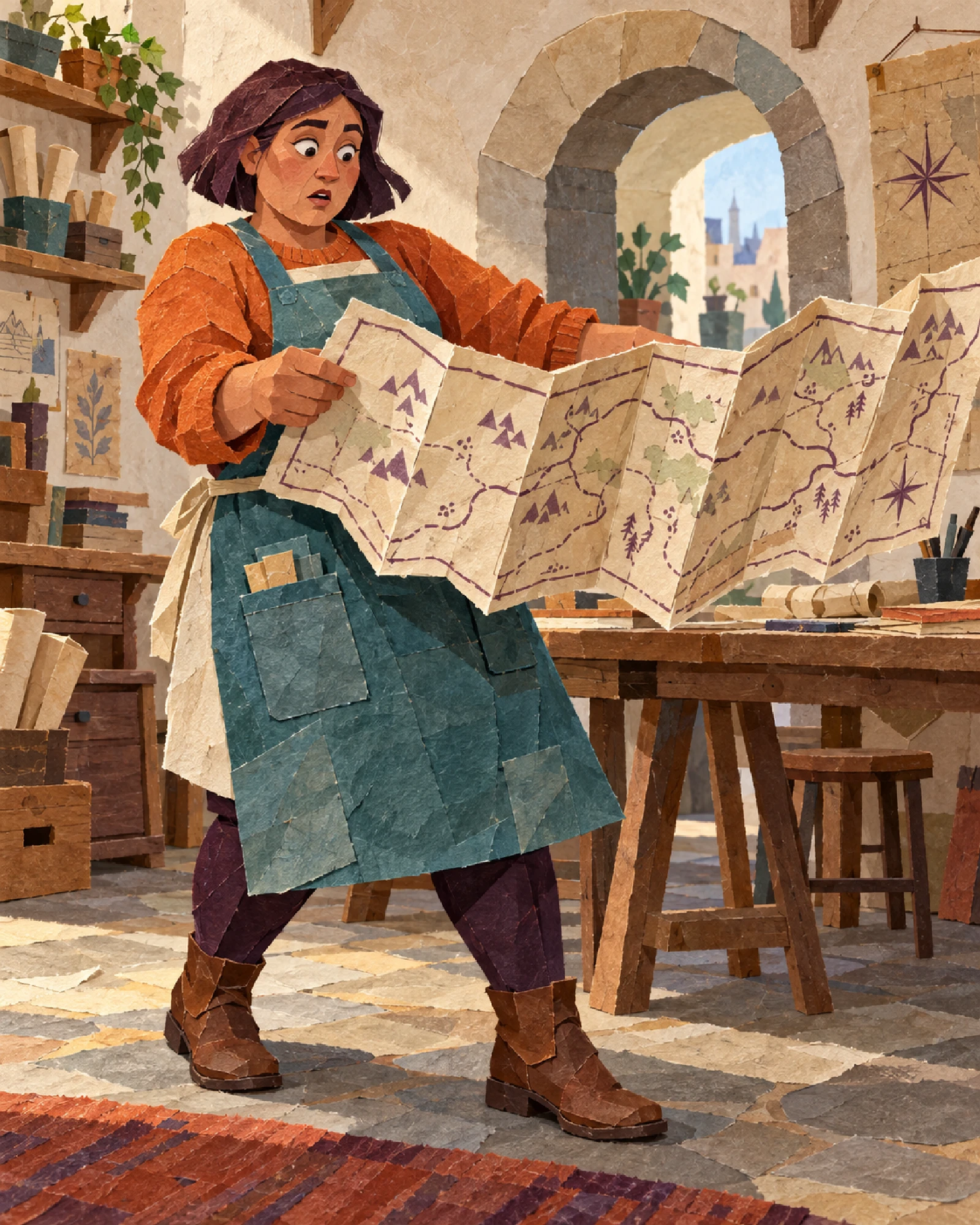
A mapmaker grips both ends and steps back as a folded map suddenly fans open. Overlapping paper shapes and lifted edges give the busy workshop moment a tangible presence.
Remix this referenceMapmaker and the Unfolding Map
- Form language
- Reduce forms to interlocking cut silhouettes and folded planes; alternate broad shapes with small inset fragments rather than outlining every detail.
- Contour
- Let scissor-cut edges make decisive contours, interrupted by occasional hand-torn softness; slight cutting irregularities remain visible.
- Mark-making
- Use sparing broad brushed streaks and rubbed patches within the paper pieces; vary marks naturally and leave some pieces almost untouched.
- Surface rendering
- Build tonal changes with overlapping paper fragments and translucent tissue inserts; retain lifted lips, exposed fibers and gentle pasted wrinkles.
Priority
Make layered cut-paper collage visibly tactile through actual-looking overlaps and lifted edges.
What to avoid & what to check
Exact prompt for this example
MODULE OWNERSHIP
subject: Subject count, type, stable proportions and landmarks, resting face geometry, hair shape, physical materials, garment construction and permanent marks. No emotion, movement, color assignment or rendering recipe.
expression: Facial soft-tissue displacement and pupil direction, muscle coordination, regional intensity, asymmetry and onset/peak/release. No head/body pose, stable appearance, skin color or rendering.
gesture: Head/neck/body/limb orientation, joint movement, support, contact and pose-caused occlusion using existing anatomy. No eye/pupil movement, emotion, identity, props inventory or camera.
props: Prop count, type, construction, physical material and scale relative to the subject. Holding/contact belongs to gesture, position to composition, color to palette.
scene: Environment elements, terrain, backdrop/floor presence and structural detail. No canvas positions, camera, lighting, assigned colors or render texture.
camera: Projection, focal-length impression, camera elevation/yaw/roll, viewing distance and crop. No actor pose, world placement, lighting or canvas aspect ratio.
composition: Normalized 0-100% canvas positions, scale in frame, depth/overlap, focal hierarchy and margins. No joint pose, camera projection, rendering, subject/prop inventory or emotion.
palette: Color anchors, hue/saturation/value ranges, colors assigned to parts and approximate color coverage. No illumination direction, shading algorithm, physical material or layout.
lighting: Light-source direction/softness/intensity, ambient illumination, physical shadow direction/length and highlight position. Absence of directional illumination is allowed. No shading technique, palette or material changes.
style: Reusable form abstraction, contour weight/taper/edge quality, medium and mark scale/density/direction, surface rendering and tonal transition technique. No fixed subject proportions, anatomy, identity, expression, pose, palette, light-source direction, camera or layout.
output: Image count, aspect ratio, size, file/alpha requirements and global lettering/logo/watermark restrictions. No background scenery, crop, style, identity or pose.

SUBJECT
inventory: A is one original adult woman mapmaker; there are no other characters.
geometry: Give her a broad, sturdy build, a rounded rectangular face, a substantial nose and large, practical hands.
resting-face: Her resting landmarks are low, straight brows, broad upper lids, full cheeks and a wide mouth with a shallow upper-lip bow.
appearance: A wedge-shaped bob accompanies a wool pullover, a cotton apron with a broad bib and patch pockets, and leather ankle boots.

PRIORITY


AVOID


CHECK


EXPRESSION — ACTOR A
brows: Both brows lift, with one rising slightly ahead of the other.
lids: Upper lids lift while lower lids remain relaxed; one eye opens slightly wider.
cheeks: Keep the cheeks relaxed, without a smile-driven upward bunching.
nose: Nostrils remain relaxed and the nose bridge stays unwrinkled.
mouth: Lips part into a small uneven opening, with neither corner pulled into a smile.
jaw: The jaw has just begun to drop, leaving a modest mouth opening.
gaze: Pupils look downward toward the nearest unfolding map panel.
coordination: Let brow and lid lift lead the response, with the mouth following more subtly.
timing: Capture the onset of surprise, before the face reaches a fully open reaction.

PRIORITY


AVOID


CHECK


GESTURE
head: Her neck extends slightly forward and her chin lowers toward the unfolding sheet.
torso: Her torso recoils backward with a gentle twist, keeping the shoulders uneven.
limbs: Both arms spread with bent elbows; one knee softens while the other leg steps back to regain balance.
contact: Each hand grips an opposite map edge; the forward boot supports her weight while the folds obscure part of the apron.

PRIORITY


AVOID


CHECK


PROPS
inventory: One foldout route map, large enough when opened to extend beyond A's shoulder width.
construction: Stiff paper forms broad accordion panels with pronounced creases and a simple printed network of branching routes.

PRIORITY


AVOID


CHECK


SCENE
inventory: A small mapmaking workshop contains a trestle worktable, shallow wall shelves, a broad arched doorway and a visible floor.
structure: Use simple plaster walls, open space beneath the tabletop and a thick doorway reveal; incidental workshop details may vary.

PRIORITY


AVOID


CHECK


CAMERA
projection: Use a natural perspective with a normal-lens impression and mild depth compression.
viewpoint: View from slightly above waist height, at a three-quarter yaw, with a level camera roll.
crop: Use a full-figure viewing distance, retaining both boots and the complete spread of the map.

PRIORITY


AVOID


CHECK


COMPOSITION
placement: Place A left of center; let the map spread through the lower middle into the right side, with the face as the first focal point.
depth: The map overlaps A and the worktable; the doorway sits behind them, forming a quieter opening between busy silhouettes.
spacing: Keep open breathing room above the face and around the outer map edge; use uneven gaps between the overlapping folds.

PRIORITY


AVOID


CHECK


PALETTE
colors: Build from warm cream, petrol teal, burnt orange and deep plum, with muted midvalues and selective saturated accents.
assignment: Use orange for the pullover, teal for the apron, cream for the map and walls, plum for hair and routes, and warm brown for skin.
balance: Let cream occupy the largest share, teal and orange carry substantial accents, and plum remain sparing and deep.

PRIORITY


AVOID


CHECK


LIGHTING
sources: A broad, soft source from the upper left provides gentle directional light, supported by generous ambient illumination.
shadows: Cast short shadows down and right beneath lifted edges, with a broader soft grounding shadow beneath the boots.
highlights: Keep highlights subdued, appearing chiefly along upper-left facing fold ridges and facial planes.

PRIORITY


AVOID


CHECK


STYLE GUIDE
form-language: Reduce forms to interlocking cut silhouettes and folded planes; alternate broad shapes with small inset fragments rather than outlining every detail.
contour: Let scissor-cut edges make decisive contours, interrupted by occasional hand-torn softness; slight cutting irregularities remain visible.
mark-making: Use sparing broad brushed streaks and rubbed patches within the paper pieces; vary marks naturally and leave some pieces almost untouched.
surface-rendering: Build tonal changes with overlapping paper fragments and translucent tissue inserts; retain lifted lips, exposed fibers and gentle pasted wrinkles.

PRIORITY
Make layered cut-paper collage visibly tactile through actual-looking overlaps and lifted edges.

AVOID


CHECK


OUTPUT
format: Deliver one finished 4:5 image at 1600 × 2000 pixels as an opaque PNG.
restrictions: Include no lettering, numerals, logos or watermarks.

PRIORITY


AVOID


CHECK


FINAL INTEGRATION
expression + gesture + composition: Coordinate the facial response and bodily reaction so the unfolding event reads immediately within the overlapping arrangement.
style + lighting: Let illumination reveal the collage's dimensional construction while preserving its handmade edge character.
Model information comes from image provenance. The same prompt may produce a different result.