Text to imageLandscapeStyle guide
Rain Beyond the Dry Canyon
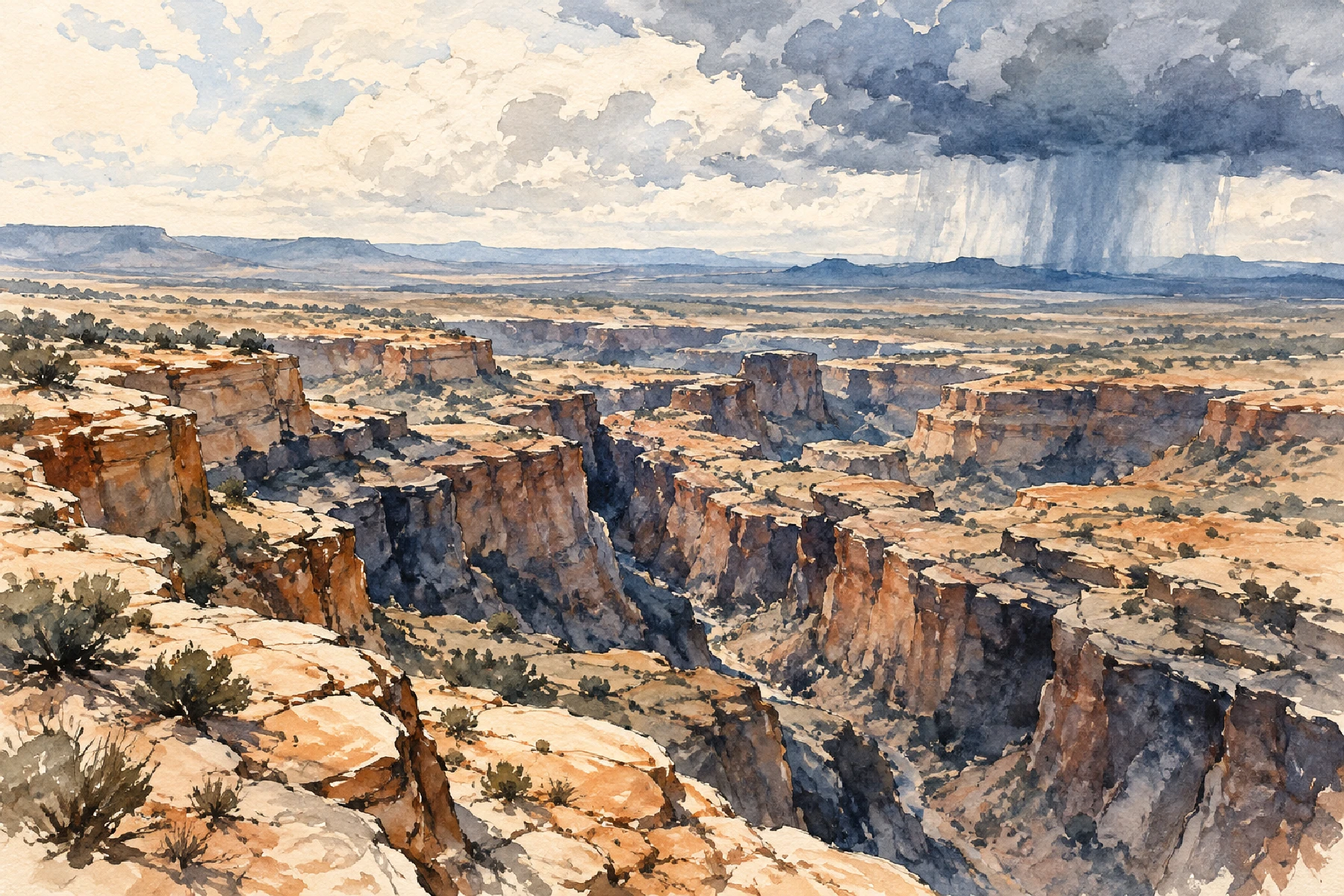
Distant rain curtains hang beyond a branching sandstone canyon. Broken ink strokes, spreading washes and generous untouched paper connect the dry land with the approaching weather.
Remix this referenceRain Beyond the Dry Canyon
- Form language
- Reduce complex forms to interlocking wedges and long interruptions; let minor irregularities vary naturally.
- Contour
- Use pressure-broken brush contours that thicken, taper and disappear instead of enclosing every form.
- Mark-making
- Alternate broad wet sweeps with sparse dry-brush scratches; keep the brush's uneven load visible.
- Surface rendering
- Transparent ink washes bloom into paper, with pooled edges, soft tonal bleeds and untouched paper breaks.
Priority
Preserve the open, gestural character of editorial ink wash.
What to avoid & what to check
Exact prompt for this example
MODULE OWNERSHIP
subject: Subject count, type, stable proportions and landmarks, resting face geometry, hair shape, physical materials, garment construction and permanent marks. No emotion, movement, color assignment or rendering recipe.
expression: Facial soft-tissue displacement and pupil direction, muscle coordination, regional intensity, asymmetry and onset/peak/release. No head/body pose, stable appearance, skin color or rendering.
gesture: Head/neck/body/limb orientation, joint movement, support, contact and pose-caused occlusion using existing anatomy. No eye/pupil movement, emotion, identity, props inventory or camera.
props: Prop count, type, construction, physical material and scale relative to the subject. Holding/contact belongs to gesture, position to composition, color to palette.
scene: Environment elements, terrain, backdrop/floor presence and structural detail. No canvas positions, camera, lighting, assigned colors or render texture.
camera: Projection, focal-length impression, camera elevation/yaw/roll, viewing distance and crop. No actor pose, world placement, lighting or canvas aspect ratio.
composition: Normalized 0-100% canvas positions, scale in frame, depth/overlap, focal hierarchy and margins. No joint pose, camera projection, rendering, subject/prop inventory or emotion.
palette: Color anchors, hue/saturation/value ranges, colors assigned to parts and approximate color coverage. No illumination direction, shading algorithm, physical material or layout.
lighting: Light-source direction/softness/intensity, ambient illumination, physical shadow direction/length and highlight position. Absence of directional illumination is allowed. No shading technique, palette or material changes.
style: Reusable form abstraction, contour weight/taper/edge quality, medium and mark scale/density/direction, surface rendering and tonal transition technique. No fixed subject proportions, anatomy, identity, expression, pose, palette, light-source direction, camera or layout.
output: Image count, aspect ratio, size, file/alpha requirements and global lettering/logo/watermark restrictions. No background scenery, crop, style, identity or pose.

SUBJECT
inventory: One branching sandstone canyon system; no people or animals.
geometry: Broad mesa rims break into tapering ravines with undercut walls and irregular shelves.
resting-face: No facial features apply.
appearance: Exposed sedimentary stone has crumbly ledges and occasional mineral seams.

PRIORITY


AVOID


CHECK


PROPS
inventory: No separate props.
construction: No prop construction applies.

PRIORITY


AVOID


CHECK


SCENE
inventory: A dry plateau with scattered scrub, distant low hills, high cloud and localized rain curtains.
structure: The canyon remains dry while rain connects the distant cloud base to the open plateau.

PRIORITY


AVOID


CHECK


CAMERA
projection: Natural perspective with a moderately wide focal-length impression.
viewpoint: An elevated oblique view looks across the canyon toward the distant plateau, without roll.
crop: A broad landscape view cuts through the nearest rim and retains the distant weather.

PRIORITY


AVOID


CHECK


COMPOSITION
placement: Canyon branches gather below and left of center; the rain occupies a smaller area toward the upper right.
depth: Overlapping rims lead from the foreground toward a narrow distant plateau band.
spacing: The canyon is the first read, followed by the rain; a spacious upper field separates their dense passages.

PRIORITY


AVOID


CHECK


PALETTE
colors: Warm ivory, charcoal indigo, muted rust and pale slate blue; restrained saturation.
assignment: Ivory carries the open sky, indigo the canyon clefts, rust selected rock beds, and slate blue the rain.
balance: Ivory dominates, dark passages stay concentrated, and rust appears as a restrained accent.

PRIORITY


AVOID


CHECK


LIGHTING
sources: Broad, soft daylight enters from the upper left beneath an overcast sky.
shadows: Ledge shadows fall softly down and right; deep clefts receive little ambient light.
highlights: Upward-facing rim surfaces receive the broadest highlights without sharp glints.

PRIORITY


AVOID


CHECK


STYLE GUIDE
form-language: Reduce complex forms to interlocking wedges and long interruptions; let minor irregularities vary naturally.
contour: Use pressure-broken brush contours that thicken, taper and disappear instead of enclosing every form.
mark-making: Alternate broad wet sweeps with sparse dry-brush scratches; keep the brush's uneven load visible.
surface-rendering: Transparent ink washes bloom into paper, with pooled edges, soft tonal bleeds and untouched paper breaks.

PRIORITY
Preserve the open, gestural character of editorial ink wash.

AVOID


CHECK


OUTPUT
format: One finished image, landscape 3:2, 1800 × 1200 pixels, opaque PNG.
restrictions: No lettering, logos or watermarks.

PRIORITY


AVOID


CHECK


FINAL INTEGRATION
composition + style: Let the distribution of marks reinforce the visual intervals established by composition.
Model information comes from image provenance. The same prompt may produce a different result.