Text to imageCharacterStyle guide
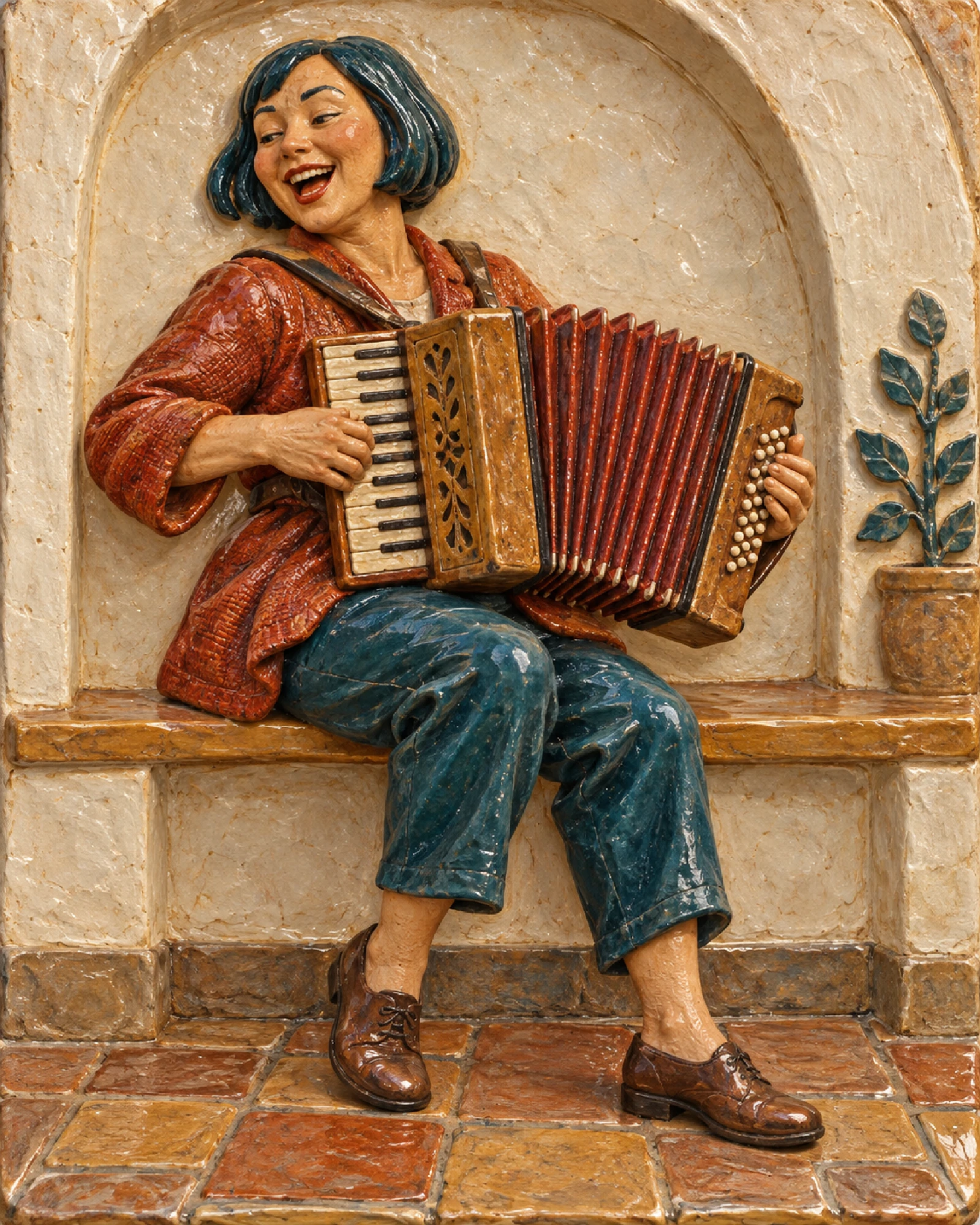
Accordionist Laughing Between Notes
An accordionist bursts into laughter while compressing the bellows. Overlapping arms and instrument folds become a lively ceramic relief with hand-modeled edges and pooled glaze.
Remix this referenceAccordionist Laughing Between Notes
- Form language
- Translate forms into shallow hand-modeled ceramic masses, alternating broad compressed planes with plump raised accents.
- Contour
- Define edges through rounded clay rims and softly pinched boundaries, with small irregularities instead of uniform ink outlines.
- Mark-making
- Use occasional incised strokes and broad brushed-slip traces; allow natural tool pressure and hand variation.
- Surface rendering
- Let translucent glaze pool in hollows and thin over ridges, with softly mottled transitions and exposed clay at selected edges.
Priority
The image must visibly read as modeled glazed ceramic relief.
What to avoid & what to check
Exact prompt for this example
MODULE OWNERSHIP
subject: Subject count, type, stable proportions and landmarks, resting face geometry, hair shape, physical materials, garment construction and permanent marks. No emotion, movement, color assignment or rendering recipe.
expression: Facial soft-tissue displacement and pupil direction, muscle coordination, regional intensity, asymmetry and onset/peak/release. No head/body pose, stable appearance, skin color or rendering.
gesture: Head/neck/body/limb orientation, joint movement, support, contact and pose-caused occlusion using existing anatomy. No eye/pupil movement, emotion, identity, props inventory or camera.
props: Prop count, type, construction, physical material and scale relative to the subject. Holding/contact belongs to gesture, position to composition, color to palette.
scene: Environment elements, terrain, backdrop/floor presence and structural detail. No canvas positions, camera, lighting, assigned colors or render texture.
camera: Projection, focal-length impression, camera elevation/yaw/roll, viewing distance and crop. No actor pose, world placement, lighting or canvas aspect ratio.
composition: Normalized 0-100% canvas positions, scale in frame, depth/overlap, focal hierarchy and margins. No joint pose, camera projection, rendering, subject/prop inventory or emotion.
palette: Color anchors, hue/saturation/value ranges, colors assigned to parts and approximate color coverage. No illumination direction, shading algorithm, physical material or layout.
lighting: Light-source direction/softness/intensity, ambient illumination, physical shadow direction/length and highlight position. Absence of directional illumination is allowed. No shading technique, palette or material changes.
style: Reusable form abstraction, contour weight/taper/edge quality, medium and mark scale/density/direction, surface rendering and tonal transition technique. No fixed subject proportions, anatomy, identity, expression, pose, palette, light-source direction, camera or layout.
output: Image count, aspect ratio, size, file/alpha requirements and global lettering/logo/watermark restrictions. No background scenery, crop, style, identity or pose.

SUBJECT
inventory: A is one original adult woman accordionist; no other characters.
geometry: She has a long oval face, a broad rounded nose, a compact torso and sturdy legs.
resting-face: Her resting features include gently arched brows, wide-set eyes and a broad mouth with a full lower lip.
appearance: A blunt bob frames her jaw; she wears a woven wrap jacket, cropped trousers and plain leather shoes.

PRIORITY


AVOID


CHECK


EXPRESSION — ACTOR A
brows: Both brows lift gently, with the left slightly higher.
lids: Raised lower lids narrow the eyes into soft crescents.
cheeks: Cheeks bunch upward with a stronger lift on the left.
nose: The nostrils widen slightly without a nose wrinkle.
mouth: Lifted corners frame an open laugh with the upper teeth visible.
jaw: The jaw drops freely, leaving the lower lip relaxed.
gaze: Visible pupils angle down toward the accordion.
coordination: The open mouth leads the laugh; the upper face stays softly engaged.
timing: Freeze the full laugh at its apex, just before the mouth begins closing.

PRIORITY


AVOID


CHECK


GESTURE
head: A turns her head slightly left and lets her chin lift away from the instrument.
torso: Her torso twists against the instrument's diagonal while her weight settles over one bent knee.
limbs: Her elbows draw inward to compress the bellows; the other heel rises as the foot pivots.
contact: Both hands remain on the accordion ends; straps support it, and the near forearm partly hides its casing.

PRIORITY


AVOID


CHECK


PROPS
inventory: One accordion spans approximately A's torso width when partly compressed.
construction: Wooden end cases flank cloth-covered folding bellows, with a short keyboard, buttons and leather shoulder straps.

PRIORITY


AVOID


CHECK


SCENE
inventory: A small rehearsal alcove contains a low built-in bench, a shallow arch and a tiled floor.
structure: A plaster wall curves into the arch; broad floor joints and the bench base provide simple architectural divisions.

PRIORITY


AVOID


CHECK


CAMERA
projection: Use shallow perspective with the gentle compression of a short telephoto lens.
viewpoint: View from chest height, slightly to A's right, with no camera roll.
crop: Frame the complete figure and accordion with a little floor and architectural surround.

PRIORITY


AVOID


CHECK


COMPOSITION
placement: A sits left of center in the frame; the accordion extends toward a smaller open interval on the right.
depth: Hands, casing and bellows overlap across the torso; the bench and arch sit behind in shallower layers.
spacing: The face leads, followed by the zigzag bellows; leave breathing room around the head and moving silhouette.

PRIORITY


AVOID


CHECK


PALETTE
colors: Use rust red, honey ochre, deep petrol teal and chalk ivory.
assignment: Rust colors the jacket and bellows; ochre colors skin and wood, teal the hair and trousers, ivory the setting and keys.
balance: A broad ivory field supports concentrated warm colors and smaller dark teal masses.

PRIORITY


AVOID


CHECK


LIGHTING
sources: A broad upper-left source grazes the relief, supported by gentle frontal ambient light.
shadows: Short soft shadows fall down and right beneath raised forms and become deeper at overlaps.
highlights: Small soft-edged glints gather on raised cheeks, rounded rims and the bellows crests.

PRIORITY


AVOID


CHECK


STYLE GUIDE
form-language: Translate forms into shallow hand-modeled ceramic masses, alternating broad compressed planes with plump raised accents.
contour: Define edges through rounded clay rims and softly pinched boundaries, with small irregularities instead of uniform ink outlines.
mark-making: Use occasional incised strokes and broad brushed-slip traces; allow natural tool pressure and hand variation.
surface-rendering: Let translucent glaze pool in hollows and thin over ridges, with softly mottled transitions and exposed clay at selected edges.

PRIORITY
The image must visibly read as modeled glazed ceramic relief.

AVOID


CHECK


OUTPUT
format: Deliver one finished image, portrait 4:5, 1600 × 2000 pixels, opaque PNG; no lettering, logos or watermarks.
restrictions: Deliver one finished image, portrait 4:5, 1600 × 2000 pixels, opaque PNG; no lettering, logos or watermarks.

PRIORITY


AVOID


CHECK


FINAL INTEGRATION
expression + gesture: The facial performance and instrumental action should feel like one uninterrupted moment.
composition + style + lighting: Layer separation and relief illumination cooperate to keep the overlapping narrative readable.
Model information comes from image provenance. The same prompt may produce a different result.