Text to imageCharacterStyle guide
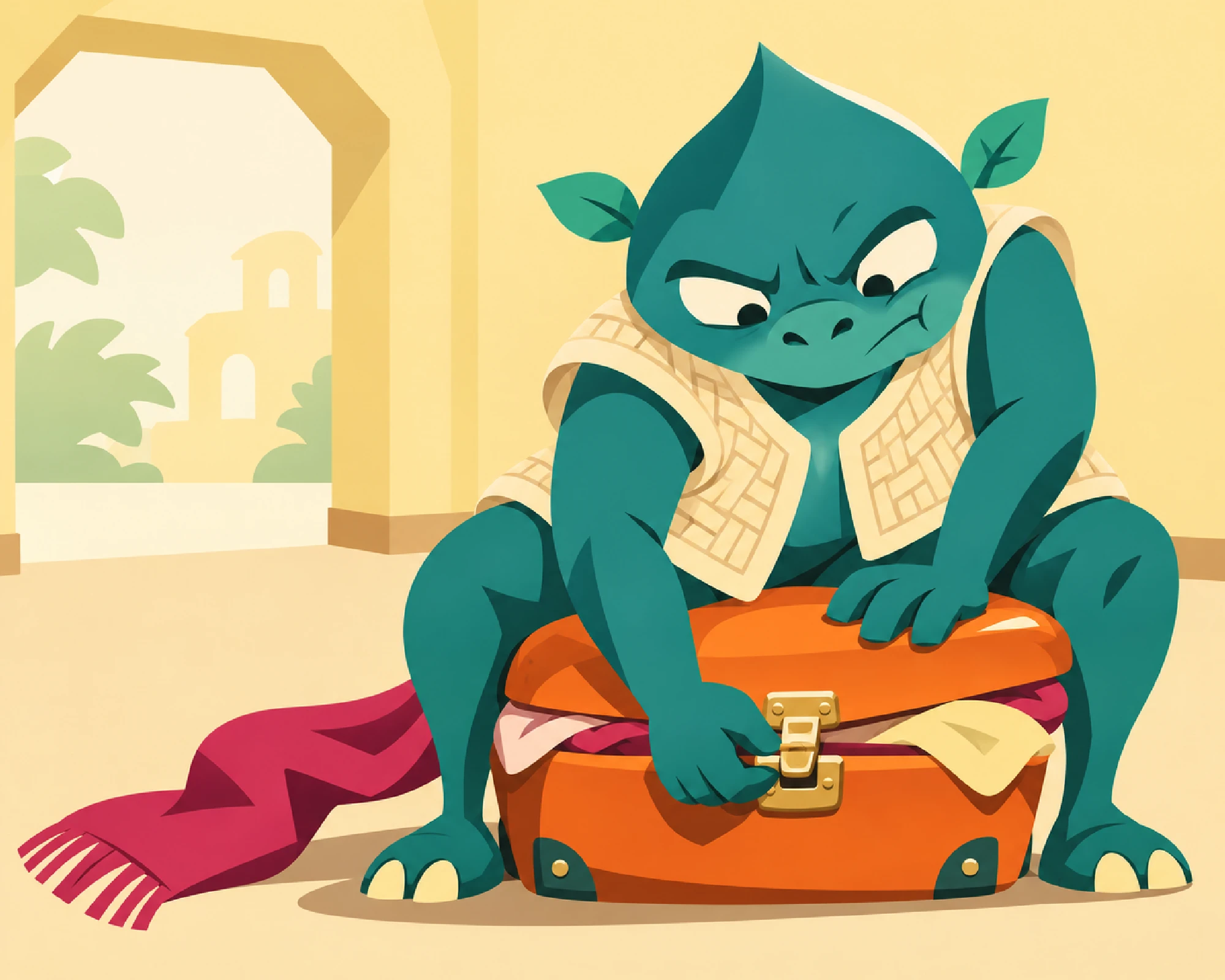
A Spade-Headed Traveler Closing a Suitcase
A spade-headed traveler squats on an overfilled suitcase, trying to align its clasp. A protruding scarf and overlapping limbs make a crisp, playfully asymmetric vector scene.
Remix this referenceA Spade-Headed Traveler Closing a Suitcase
- Form language
- Reduce forms to interlocking convex curves and blunt wedges; use playful asymmetry and allow minor shape variation.
- Contour
- Use crisp unoutlined silhouettes, with short tapered internal strokes only where a boundary needs clarification.
- Mark-making
- Make sparse vector slashes and curved notches as deliberate graphic marks; vary their lengths without roughening every edge.
- Surface rendering
- Use flat vector fields with a few hard-edged inset tone shapes; transitions stay abrupt and surfaces remain graphic.
Priority
Maintain crisp vector abstraction with playful asymmetry.
What to avoid & what to check
Exact prompt for this example
MODULE OWNERSHIP
subject: Subject count, type, stable proportions and landmarks, resting face geometry, hair shape, physical materials, garment construction and permanent marks. No emotion, movement, color assignment or rendering recipe.
expression: Facial soft-tissue displacement and pupil direction, muscle coordination, regional intensity, asymmetry and onset/peak/release. No head/body pose, stable appearance, skin color or rendering.
gesture: Head/neck/body/limb orientation, joint movement, support, contact and pose-caused occlusion using existing anatomy. No eye/pupil movement, emotion, identity, props inventory or camera.
props: Prop count, type, construction, physical material and scale relative to the subject. Holding/contact belongs to gesture, position to composition, color to palette.
scene: Environment elements, terrain, backdrop/floor presence and structural detail. No canvas positions, camera, lighting, assigned colors or render texture.
camera: Projection, focal-length impression, camera elevation/yaw/roll, viewing distance and crop. No actor pose, world placement, lighting or canvas aspect ratio.
composition: Normalized 0-100% canvas positions, scale in frame, depth/overlap, focal hierarchy and margins. No joint pose, camera projection, rendering, subject/prop inventory or emotion.
palette: Color anchors, hue/saturation/value ranges, colors assigned to parts and approximate color coverage. No illumination direction, shading algorithm, physical material or layout.
lighting: Light-source direction/softness/intensity, ambient illumination, physical shadow direction/length and highlight position. Absence of directional illumination is allowed. No shading technique, palette or material changes.
style: Reusable form abstraction, contour weight/taper/edge quality, medium and mark scale/density/direction, surface rendering and tonal transition technique. No fixed subject proportions, anatomy, identity, expression, pose, palette, light-source direction, camera or layout.
output: Image count, aspect ratio, size, file/alpha requirements and global lettering/logo/watermark restrictions. No background scenery, crop, style, identity or pose.

SUBJECT
inventory: One original anthropomorphic traveler creature, actor A.
geometry: A spade-shaped head, small leaf ears, broad midsection, narrow shins and wide three-toed feet.
resting-face: Widely spaced oval eyes, shallow brow ridges and a short, broad muzzle with flexible lips.
appearance: Smooth supple hide and a woven sleeveless vest with a split front and broad bound edges.

PRIORITY


AVOID


CHECK


EXPRESSION — ACTOR A
brows: Brow ridges draw inward, one a little lower.
lids: Lower lids tighten beneath attentive, slightly narrowed eyes.
cheeks: One cheek bunches slightly beside the compressed mouth.
nose: The nostrils stay still without wrinkling the muzzle.
mouth: The lower lip tucks inward; one corner presses harder.
jaw: The jaw is firmly closed with restrained tension.
gaze: Both pupils aim down toward the suitcase clasp.
coordination: Mild upper-face tension supports stronger effort around the lips.
timing: Capture the peak of the facial effort.

PRIORITY


AVOID


CHECK


GESTURE
head: The neck bends forward and the head tips toward the hands.
torso: The traveler squats astride the lid, leaning forward to press it down with body weight.
limbs: Feet plant unevenly; one hand draws the clasp together while the other braces the lid.
contact: Thighs bear against the lid; the bracing palm partly hides its rim.

PRIORITY


AVOID


CHECK


PROPS
inventory: One overfilled suitcase about torso width and one long scarf.
construction: The suitcase has a rigid fiberboard shell, rounded lid and metal clasp; the scarf is soft woven cloth.

PRIORITY


AVOID


CHECK


SCENE
inventory: A modest departure alcove with a floor and a wide open passage.
structure: The passage has chamfered upper corners; a low skirting strip joins wall and floor.

PRIORITY


AVOID


CHECK


CAMERA
projection: Shallow perspective with a normal-lens impression.
viewpoint: A slightly elevated front three-quarter view, without roll.
crop: A medium-wide full-body view includes the entire suitcase and both feet.

PRIORITY


AVOID


CHECK


COMPOSITION
placement: The traveler and suitcase occupy the right half; the scarf extends toward the open left.
depth: The clasp and hands lead into the face; overlapping limbs, lid and scarf make one interlocked cluster.
spacing: Leave an irregular wedge of floor on the left and a narrow breathing gap around the head.

PRIORITY


AVOID


CHECK


PALETTE
colors: Deep teal, tangerine, raspberry, pale lemon and warm cream.
assignment: Teal hide, cream vest, tangerine suitcase, raspberry scarf and pale-lemon architecture.
balance: Use pale surroundings with a compact group of saturated accents and a few deep-value details.

PRIORITY


AVOID


CHECK


LIGHTING
sources: Broad soft illumination arrives from the upper right with ample ambient light.
shadows: A short soft shadow falls leftward beneath the traveler and suitcase.
highlights: Small highlights touch the upper head edge and the clasp.

PRIORITY


AVOID


CHECK


STYLE GUIDE
form-language: Reduce forms to interlocking convex curves and blunt wedges; use playful asymmetry and allow minor shape variation.
contour: Use crisp unoutlined silhouettes, with short tapered internal strokes only where a boundary needs clarification.
mark-making: Make sparse vector slashes and curved notches as deliberate graphic marks; vary their lengths without roughening every edge.
surface-rendering: Use flat vector fields with a few hard-edged inset tone shapes; transitions stay abrupt and surfaces remain graphic.

PRIORITY
Maintain crisp vector abstraction with playful asymmetry.

AVOID


CHECK


OUTPUT
format: One finished image, 5:4 aspect ratio, 2000 × 1600 pixels, opaque PNG; no lettering, logos or watermarks.
restrictions: One finished image, 5:4 aspect ratio, 2000 × 1600 pixels, opaque PNG; no lettering, logos or watermarks.

PRIORITY


AVOID


CHECK


FINAL INTEGRATION
gesture + composition + style: Preserve the contact logic as the overlapping shapes are simplified.
expression + gesture: The facial effort peaks just before the clasp closes.
Model information comes from image provenance. The same prompt may produce a different result.