Text to imageIllustrationStyle guide
A Climber Crossing the Cave Fissure
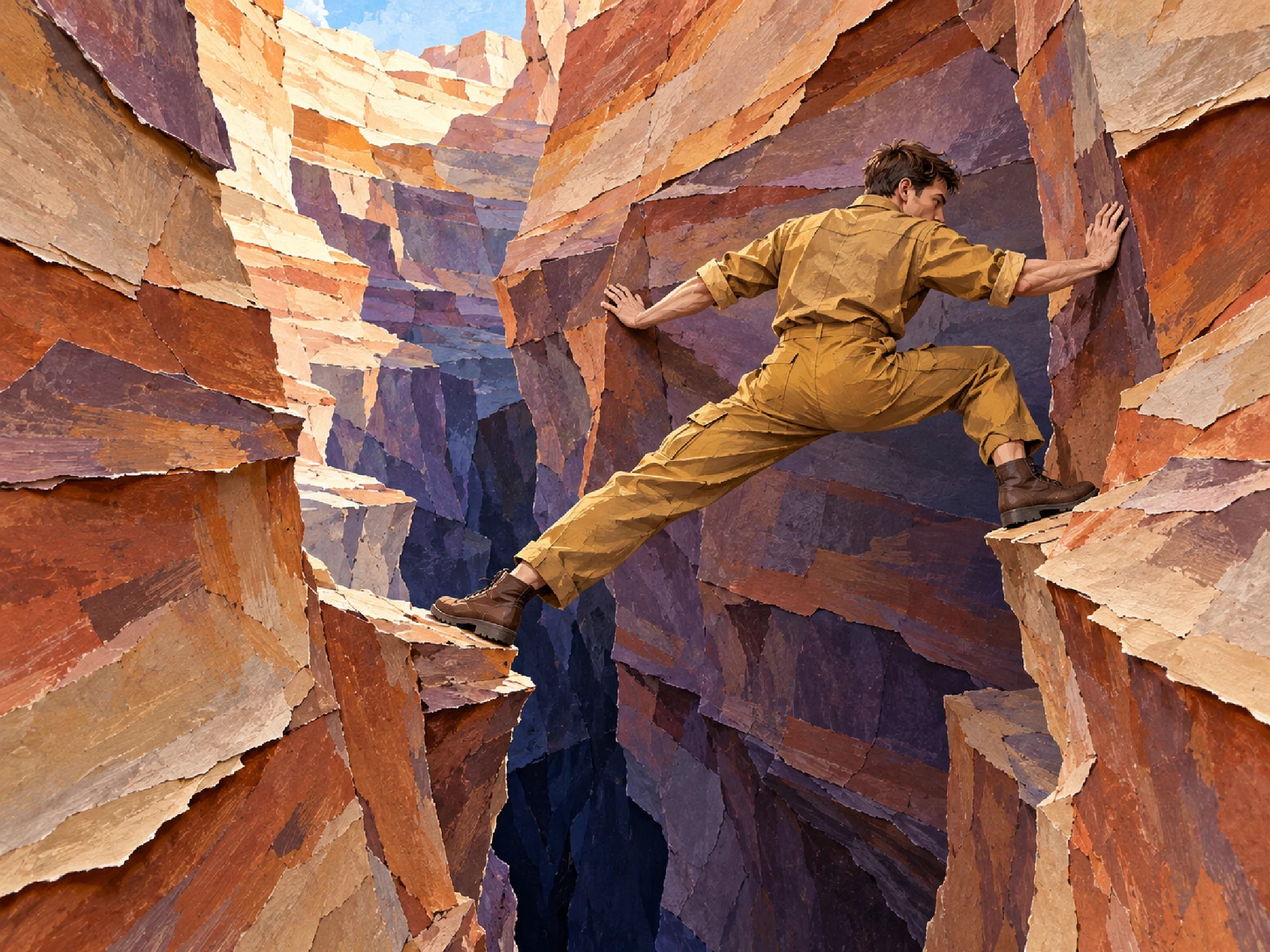
A climber braces against opposing cave walls to cross a deep fissure. Raised cut-paper edges and painted traces turn immense rock layers into a tactile setting for a brief, precarious passage.
Remix this referenceA Climber Crossing the Cave Fissure
- Form language
- Build interlocking cut-paper masses with selectively folded lips; simplify details into generous irregular shapes, allowing natural variation.
- Contour
- Scissor-cut boundaries define contours, mixing long confident cuts with occasional torn fibers and slight edge wavering.
- Mark-making
- Paint paper before assembly with loose opaque brush swipes and intermittent dry skips; vary their width and rhythm naturally.
- Surface rendering
- Expose paper thickness and slight curling; use thin scumbled passages within pieces and abrupt tonal steps between layers.
Priority
The image must visibly read as assembled, painted cut paper with tactile overlaps.
What to avoid & what to check
Exact prompt for this example
MODULE OWNERSHIP
subject: Subject count, type, stable proportions and landmarks, resting face geometry, hair shape, physical materials, garment construction and permanent marks. No emotion, movement, color assignment or rendering recipe.
expression: Facial soft-tissue displacement and pupil direction, muscle coordination, regional intensity, asymmetry and onset/peak/release. No head/body pose, stable appearance, skin color or rendering.
gesture: Head/neck/body/limb orientation, joint movement, support, contact and pose-caused occlusion using existing anatomy. No eye/pupil movement, emotion, identity, props inventory or camera.
props: Prop count, type, construction, physical material and scale relative to the subject. Holding/contact belongs to gesture, position to composition, color to palette.
scene: Environment elements, terrain, backdrop/floor presence and structural detail. No canvas positions, camera, lighting, assigned colors or render texture.
camera: Projection, focal-length impression, camera elevation/yaw/roll, viewing distance and crop. No actor pose, world placement, lighting or canvas aspect ratio.
composition: Normalized 0-100% canvas positions, scale in frame, depth/overlap, focal hierarchy and margins. No joint pose, camera projection, rendering, subject/prop inventory or emotion.
palette: Color anchors, hue/saturation/value ranges, colors assigned to parts and approximate color coverage. No illumination direction, shading algorithm, physical material or layout.
lighting: Light-source direction/softness/intensity, ambient illumination, physical shadow direction/length and highlight position. Absence of directional illumination is allowed. No shading technique, palette or material changes.
style: Reusable form abstraction, contour weight/taper/edge quality, medium and mark scale/density/direction, surface rendering and tonal transition technique. No fixed subject proportions, anatomy, identity, expression, pose, palette, light-source direction, camera or layout.
output: Image count, aspect ratio, size, file/alpha requirements and global lettering/logo/watermark restrictions. No background scenery, crop, style, identity or pose.

SUBJECT
inventory: One adult human climber, actor A; no other figures or animals.
geometry: A has an ordinary adult build and broad palms, with proportions recognizable through practical clothing.
resting-face: A has a straight nasal bridge, a rounded chin and a gently sloping brow ridge.
appearance: Short blunt-cut hair, cotton coveralls with rolled sleeves, and supple leather ankle boots.

PRIORITY


AVOID


CHECK


EXPRESSION — ACTOR A
brows: The visible brow draws slightly inward and down.
lids: The visible eye narrows mildly, with a gently raised lower lid.
cheeks: The visible cheek stays firm without a smile lift.
nose: The visible nostril remains relaxed without flaring.
mouth: Lips meet in a lightly pressed line; neither corner lifts.
jaw: The jaw firms slightly without a pronounced clench.
gaze: The visible pupil aims toward the next foothold across the gap.
coordination: Brow and eyelid tension lead the restrained mouth; far-side features remain unprescribed.
timing: Hold the apex of sustained concentration, with no sudden facial reaction.

PRIORITY


AVOID


CHECK


GESTURE
head: A lowers the chin slightly and turns toward the next foothold, exposing the near-side facial profile.
torso: The torso bridges the gap in a stretched diagonal, twisting slightly toward the next foothold.
limbs: Both arms spread outward; one knee bends beneath the body while the opposite leg reaches across the fissure.
contact: Each palm presses a different wall; the boots brace on separate narrow ledges on opposite sides.

PRIORITY


AVOID


CHECK


PROPS
inventory: No separate props.
construction: No prop construction applies.

PRIORITY


AVOID


CHECK


SCENE
inventory: A sandstone slot cavern contains opposing walls, broken foothold shelves, a deep fissure and an overhead opening.
structure: Broad sedimentary bands buckle around the fissure; occasional fractured lips interrupt the sweeping walls.

PRIORITY


AVOID


CHECK


CAMERA
projection: Moderate wide-angle perspective gives clear near-to-far expansion with restrained edge distortion.
viewpoint: Use a rear three-quarter view from just below shoulder height, looking slightly upward with no roll.
crop: Show A's whole body within an environmental view; crop the surrounding cavern walls at the image edges.

PRIORITY


AVOID


CHECK


COMPOSITION
placement: Set A right of center at about a third of the frame height; the crossing is the primary focus.
depth: Overlapping foreground edges lead past A into recessed bands, leaving the deepest opening unobstructed.
spacing: Sweep the fissure from the lower left toward A; retain gaps around the silhouette and a broad leftward expanse.

PRIORITY


AVOID
Do not add decorative borders.

CHECK


PALETTE
colors: Chalk cream, muted terracotta, dusty violet, deep indigo and umber, with a clear ochre accent.
assignment: Cream and terracotta rocks; violet and indigo recesses; ochre coveralls; umber hair and boots; muted warm skin.
balance: Restrained earth hues dominate; A carries the clearest saturation and the fissure the darkest values.

PRIORITY


AVOID


CHECK


LIGHTING
sources: Broad soft daylight enters from overhead left, supported by weak ambient illumination inside the cavern.
shadows: Ledges cast soft shadows downward and right; close overlaps retain narrow contact shadows.
highlights: Broad subdued highlights touch upward-facing edges; little reflected light reaches the deepest fissure.

PRIORITY


AVOID


CHECK


STYLE GUIDE
form-language: Build interlocking cut-paper masses with selectively folded lips; simplify details into generous irregular shapes, allowing natural variation.
contour: Scissor-cut boundaries define contours, mixing long confident cuts with occasional torn fibers and slight edge wavering.
mark-making: Paint paper before assembly with loose opaque brush swipes and intermittent dry skips; vary their width and rhythm naturally.
surface-rendering: Expose paper thickness and slight curling; use thin scumbled passages within pieces and abrupt tonal steps between layers.

PRIORITY
The image must visibly read as assembled, painted cut paper with tactile overlaps.

AVOID


CHECK


OUTPUT
format: Deliver one finished landscape image, 4:3, 2048 × 1536 pixels, as an opaque PNG.
restrictions: No lettering, logos or watermarks.

PRIORITY


AVOID


CHECK


FINAL INTEGRATION
gesture + composition + scene: Coordinate contact and surrounding negative space so the crossing remains immediately legible.
expression + gesture + camera: Keep the visible facial acting readable within the established crossing pose and environmental view.
style + lighting: Let illumination reveal the assembled surfaces while preserving their visible paper construction.
Model information comes from image provenance. The same prompt may produce a different result.