Text to imageCharacterStyle guide
A Creature Stepping Out of Its Shell
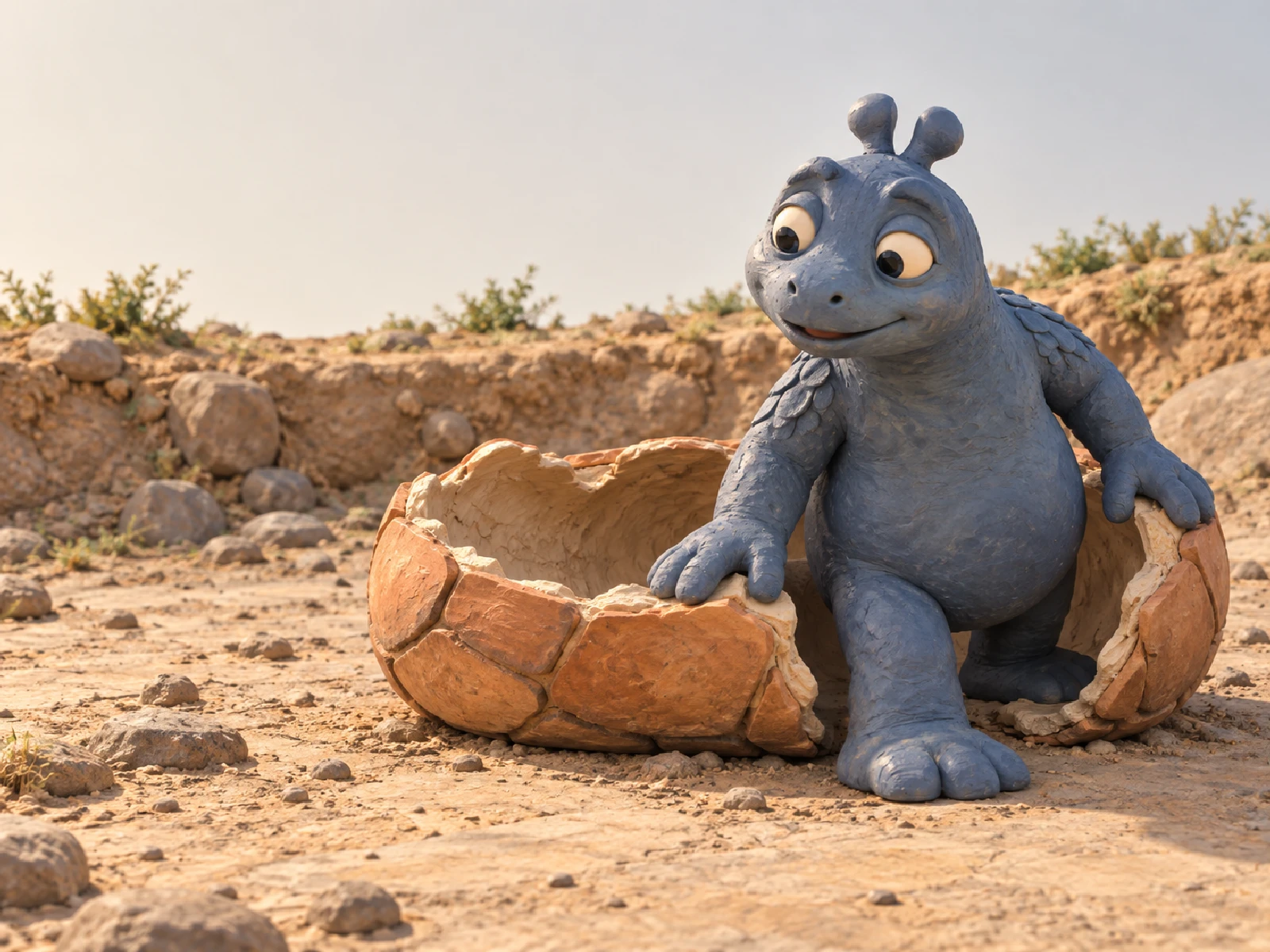
A small, broad-footed creature braces against its split shell and takes its first step outside. Handmade clay gives the spacious earthen setting a tactile presence.
Remix this referenceA Creature Stepping Out of Its Shell
- Form language
- Build a sculptural clay miniature from softly compressed masses; allow slight handmade unevenness within coherent rounded forms.
- Contour
- Use physical silhouette edges rather than drawn outlines, alternating plump rolled edges with occasional pinched breaks.
- Mark-making
- Retain selective thumb depressions, short tool drags, and softened joins; vary their placement naturally instead of stamping a texture.
- Surface rendering
- Render matte clay with broad continuous tonal turns and small rubbed patches; preserve tactile irregularities without polishing them away.
Priority
Make the handbuilt clay volume and worked surface immediately visible.
What to avoid & what to check
Exact prompt for this example
MODULE OWNERSHIP
subject: Subject count, type, stable proportions and landmarks, resting face geometry, hair shape, physical materials, garment construction and permanent marks. No emotion, movement, color assignment or rendering recipe.
expression: Facial soft-tissue displacement and pupil direction, muscle coordination, regional intensity, asymmetry and onset/peak/release. No head/body pose, stable appearance, skin color or rendering.
gesture: Head/neck/body/limb orientation, joint movement, support, contact and pose-caused occlusion using existing anatomy. No eye/pupil movement, emotion, identity, props inventory or camera.
props: Prop count, type, construction, physical material and scale relative to the subject. Holding/contact belongs to gesture, position to composition, color to palette.
scene: Environment elements, terrain, backdrop/floor presence and structural detail. No canvas positions, camera, lighting, assigned colors or render texture.
camera: Projection, focal-length impression, camera elevation/yaw/roll, viewing distance and crop. No actor pose, world placement, lighting or canvas aspect ratio.
composition: Normalized 0-100% canvas positions, scale in frame, depth/overlap, focal hierarchy and margins. No joint pose, camera projection, rendering, subject/prop inventory or emotion.
palette: Color anchors, hue/saturation/value ranges, colors assigned to parts and approximate color coverage. No illumination direction, shading algorithm, physical material or layout.
lighting: Light-source direction/softness/intensity, ambient illumination, physical shadow direction/length and highlight position. Absence of directional illumination is allowed. No shading technique, palette or material changes.
style: Reusable form abstraction, contour weight/taper/edge quality, medium and mark scale/density/direction, surface rendering and tonal transition technique. No fixed subject proportions, anatomy, identity, expression, pose, palette, light-source direction, camera or layout.
output: Image count, aspect ratio, size, file/alpha requirements and global lettering/logo/watermark restrictions. No background scenery, crop, style, identity or pose.

SUBJECT
inventory: One original shell-bearing creature, actor A.
geometry: A pear-shaped trunk, short sturdy legs, broad paddle feet, spoon-shaped hands, and two blunt crown buds.
resting-face: Widely spaced eyes above a blunt muzzle, small nostrils, shallow brow ridges, and a short mouth seam.
appearance: Bare flexible skin with small shoulder scutes; no hair, garments, or permanent markings.

PRIORITY


AVOID


CHECK


EXPRESSION — ACTOR A
brows: Release the inner brow lift into nearly level, relaxed arcs.
lids: Let the upper lids settle slightly; keep the lower lids loose.
cheeks: Lift the cheeks faintly without bunching them beneath the eyes.
nose: Keep the nostrils relaxed with no wrinkle across the muzzle.
mouth: Part the lips narrowly, with one corner slightly higher.
jaw: Release the jaw enough for a small, easy opening.
gaze: Direct both pupils toward the patch of ground beyond the shell.
coordination: Keep the upper face quiet while the mouth carries the gentle release.
timing: Catch the release just after effort, before the mouth closes.

PRIORITY


AVOID


CHECK


GESTURE
head: Extend the neck slightly and lower the chin toward the newly planted foot.
torso: Incline the trunk forward with a small twist away from the shell opening.
limbs: Plant one broad foot outside; leave the other within the opening and bend both supporting arms.
contact: Brace each palm on a different broken rim; let the near rim obscure part of the trailing foot.

PRIORITY


AVOID


CHECK


PROPS
inventory: One discarded shell in two large connected sections, formerly large enough to enclose A's trunk.
construction: A hollow keratin carapace with broad overlapping plates, a thin inner lining, and irregular broken rims.

PRIORITY


AVOID


CHECK


SCENE
inventory: A shallow earthen hollow, a low broken bank, and a few embedded stones.
structure: Continuous ground rises into the bank, with a simple uninterrupted backdrop beyond it.

PRIORITY


AVOID


CHECK


CAMERA
projection: Gentle perspective with a normal-lens impression.
viewpoint: View from the creature's chest height at a three-quarter yaw, without roll.
crop: A full-body environmental view retaining the entire shell and surrounding ground.

PRIORITY


AVOID


CHECK


COMPOSITION
placement: Place A in the right third, with the shell extending toward the lower middle; the face leads attention.
depth: Overlap the lower body with the shell rims; keep the bank as a quieter rear layer.
spacing: Leave a broad open interval across the left half and generous space above the crown.

PRIORITY


AVOID


CHECK


PALETTE
colors: Ink blue, faded apricot, and warm ivory, with restrained saturation.
assignment: Give A ink-blue skin, the shell apricot plates, and the ground and backdrop warm ivory.
balance: Ivory occupies the largest area; blue supplies the strongest dark mass and apricot the warm counterweight.

PRIORITY


AVOID


CHECK


LIGHTING
sources: A broad soft source from upper left, supported by gentle ambient fill.
shadows: Soft shadows fall to the right; deeper contact shadows sit beneath palms, feet, and shell edges.
highlights: Broad subdued highlights follow the upper-left shoulders, muzzle, and shell ridges.

PRIORITY


AVOID


CHECK


STYLE GUIDE
form-language: Build a sculptural clay miniature from softly compressed masses; allow slight handmade unevenness within coherent rounded forms.
contour: Use physical silhouette edges rather than drawn outlines, alternating plump rolled edges with occasional pinched breaks.
mark-making: Retain selective thumb depressions, short tool drags, and softened joins; vary their placement naturally instead of stamping a texture.
surface-rendering: Render matte clay with broad continuous tonal turns and small rubbed patches; preserve tactile irregularities without polishing them away.

PRIORITY
Make the handbuilt clay volume and worked surface immediately visible.

AVOID


CHECK


OUTPUT
format: Deliver one image, 4:3 aspect ratio, 1600 × 1200 pixels, opaque PNG.
restrictions: No lettering, logos, or watermarks.

PRIORITY


AVOID


CHECK
Model information comes from image provenance. The same prompt may produce a different result.