Text to imageArt stylesStyle guide
One Crescent Moon · Gold-Thread Couching
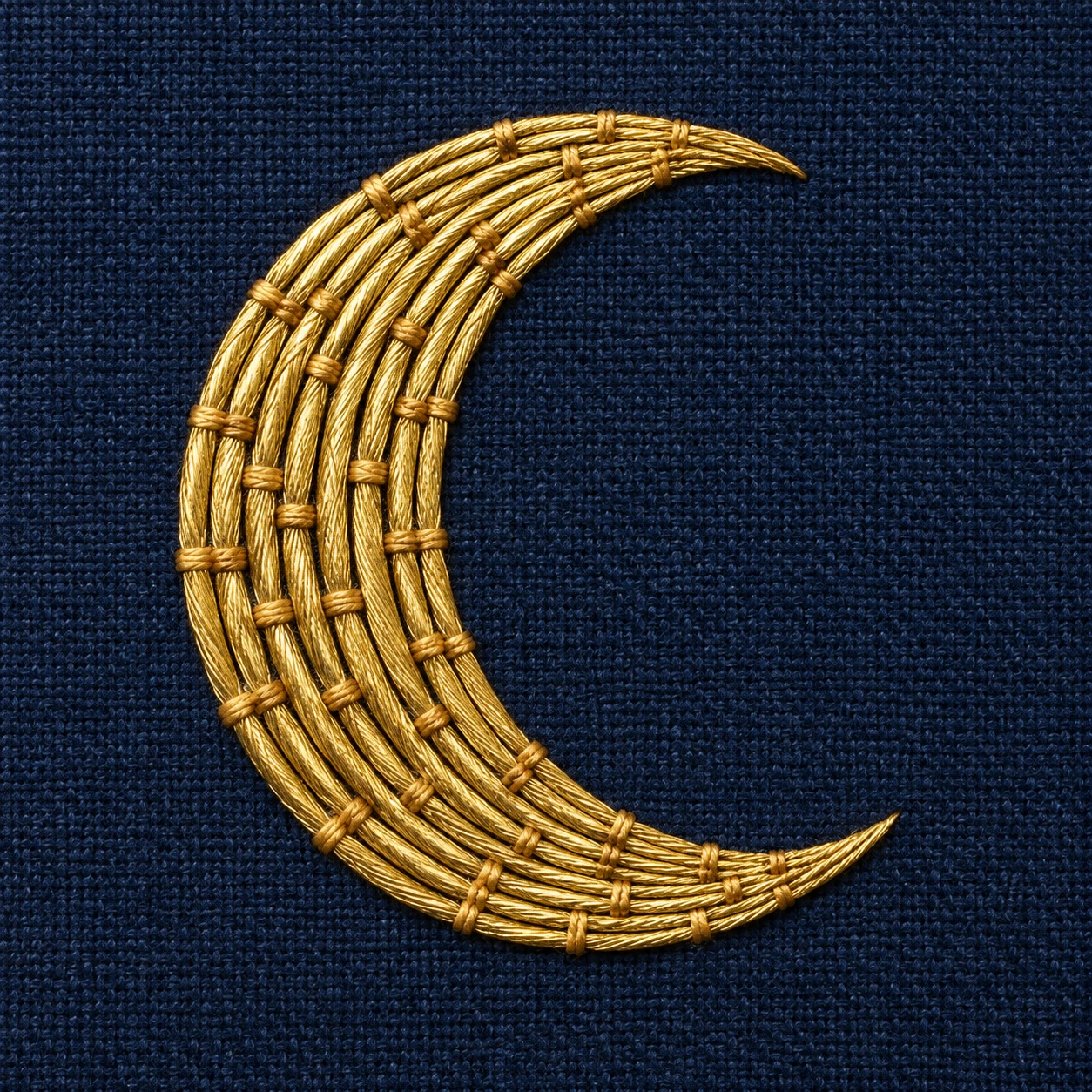
An embroidery reference showing a crescent built from curved gold threads secured by small transverse stitches.
One Crescent Moon · Gold-Thread Couching
- Shape & line
- Build the crescent from closely spaced gold strands laid along nested curves between the upper and lower tips; shorten the inner strands as the shape narrows so both tips taper cleanly without a separate drawn outline.
- Color & light
- Set warm gold against deep navy fabric and light it from the image-upper-left; place narrow bright glints on the upper-left edges of the raised strands and soft dark seams along their lower-right contact edges.
- Texture & material
- Show the gold threads resting visibly above the woven cloth, held down by small ochre stitches crossing the strands at intervals; stagger these ties between neighboring rows and let each tie slightly interrupt the metallic glint.
- Composition
- Keep the crescent as the single focal shape in a flat, square textile study; leave the open area on image-right clear and use a close enough framing to distinguish the long curved gold strands from the short crosswise securing stitches.
Priority
Make the laid gold strands and their transverse securing stitches immediately distinguishable.
What to avoid & what to check
Avoid a smooth metallic plate or dense satin stitches that conceal the couching structure.
Check that curved gold strands remain visible beneath short crossing ties and taper into both crescent tips.
Exact prompt for this example
SUBJECT
One embroidered crescent moon on deep navy woven fabric, with its convex outer edge on image-left and its open concave edge facing image-right. Parallel gold threads fill the crescent and converge toward its two pointed tips.

COMPOSITION
Use a straight-on close view of the fabric with the entire crescent centered and generous plain margins. Keep both tips, the inner curve, and several securing stitches clearly readable.

STYLE GUIDE
1. Shape & line
Build the crescent from closely spaced gold strands laid along nested curves between the upper and lower tips; shorten the inner strands as the shape narrows so both tips taper cleanly without a separate drawn outline.

2. Color & light
Set warm gold against deep navy fabric and light it from the image-upper-left; place narrow bright glints on the upper-left edges of the raised strands and soft dark seams along their lower-right contact edges.

3. Texture & material
Show the gold threads resting visibly above the woven cloth, held down by small ochre stitches crossing the strands at intervals; stagger these ties between neighboring rows and let each tie slightly interrupt the metallic glint.

4. Composition
Keep the crescent as the single focal shape in a flat, square textile study; leave the open area on image-right clear and use a close enough framing to distinguish the long curved gold strands from the short crosswise securing stitches.

PRIORITY
Preserve the requested identity, count, action, composition and output settings. Apply the style rules within those constraints; a style reference must not replace the subject or layout. Within the style: Make the laid gold strands and their transverse securing stitches immediately distinguishable.

AVOID
Avoid a smooth metallic plate or dense satin stitches that conceal the couching structure.

OUTPUT
One square image, with no lettering, labels, border, or watermark.

SELF-CHECK
Check that curved gold strands remain visible beneath short crossing ties and taper into both crescent tips.
Model information comes from image provenance. The same prompt may produce a different result.