Text to imageCafe & brandStyle guide
Hands Cutting the Soap
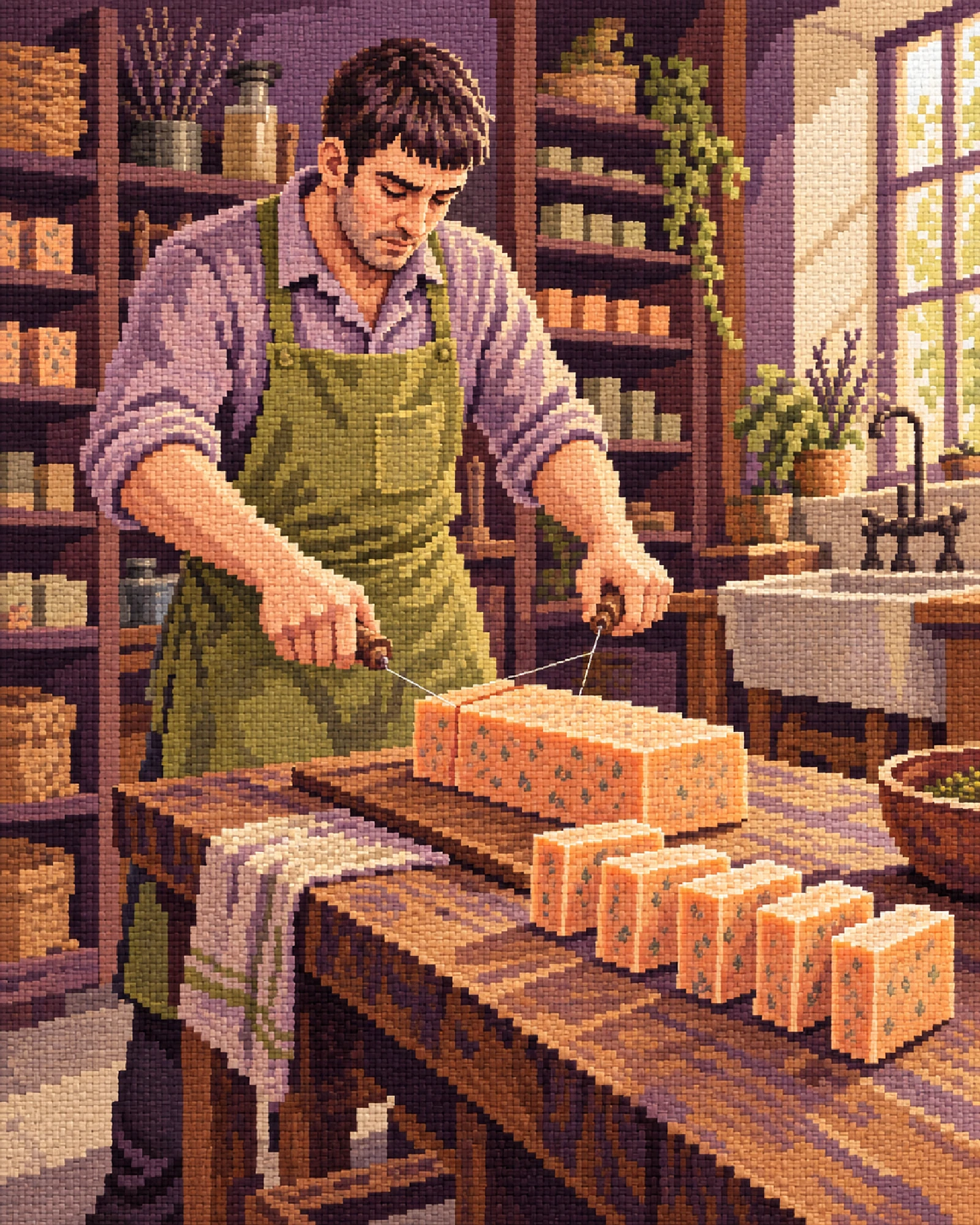
A soapmaker draws a cutting wire through a long soap loaf amid layered curing shelves. Stepped woven pixels and crossing yarn marks create a finished brand illustration for an original small-batch soap workshop.
Remix this referenceHands Cutting the Soap
- Form language
- Reduce forms into chunky interlocking pixel clusters; use stepped curves and broad planes while allowing small cluster variations.
- Contour
- Keep deliberate low-resolution stair edges, occasionally broken by a short yarn end; avoid smoothing those boundaries into continuous curves.
- Mark-making
- Build pixel units from visible crossing warp and weft strokes; vary thread lengths and let occasional skipped crossings interrupt the rhythm.
- Surface rendering
- Group tones into stepped woven patches, mixing adjacent yarn colors at their boundaries; retain soft fiber irregularity without blurring pixel structure.
Priority
Woven construction and deliberate pixel edges must both remain visible in the finished illustration.
What to avoid & what to check
Exact prompt for this example
MODULE OWNERSHIP
subject: Subject count, type, stable proportions and landmarks, resting face geometry, hair shape, physical materials, garment construction and permanent marks. No emotion, movement, color assignment or rendering recipe.
expression: Facial soft-tissue displacement and pupil direction, muscle coordination, regional intensity, asymmetry and onset/peak/release. No head/body pose, stable appearance, skin color or rendering.
gesture: Head/neck/body/limb orientation, joint movement, support, contact and pose-caused occlusion using existing anatomy. No eye/pupil movement, emotion, identity, props inventory or camera.
props: Prop count, type, construction, physical material and scale relative to the subject. Holding/contact belongs to gesture, position to composition, color to palette.
scene: Environment elements, terrain, backdrop/floor presence and structural detail. No canvas positions, camera, lighting, assigned colors or render texture.
camera: Projection, focal-length impression, camera elevation/yaw/roll, viewing distance and crop. No actor pose, world placement, lighting or canvas aspect ratio.
composition: Normalized 0-100% canvas positions, scale in frame, depth/overlap, focal hierarchy and margins. No joint pose, camera projection, rendering, subject/prop inventory or emotion.
palette: Color anchors, hue/saturation/value ranges, colors assigned to parts and approximate color coverage. No illumination direction, shading algorithm, physical material or layout.
lighting: Light-source direction/softness/intensity, ambient illumination, physical shadow direction/length and highlight position. Absence of directional illumination is allowed. No shading technique, palette or material changes.
style: Reusable form abstraction, contour weight/taper/edge quality, medium and mark scale/density/direction, surface rendering and tonal transition technique. No fixed subject proportions, anatomy, identity, expression, pose, palette, light-source direction, camera or layout.
output: Image count, aspect ratio, size, file/alpha requirements and global lettering/logo/watermark restrictions. No background scenery, crop, style, identity or pose.

SUBJECT
inventory: One original adult soapmaker, actor A, wearing a practical work shirt and bib apron.
geometry: A sturdy figure with broad hands, a long oval face and a compact jaw; the apron has a broad bib and straight skirt.
resting-face: Straight brows, hooded eyes, a broad nose tip and a full lower lip establish the resting facial landmarks.
appearance: A short blunt fringe and close-cut hair accompany a cotton shirt with rolled cuffs and a heavy canvas apron with a patch pocket.

PRIORITY


AVOID


CHECK


EXPRESSION — ACTOR A
brows: Inner brows draw slightly inward with a shallow central crease.
lids: Upper lids lower slightly; lower lids hold a small amount of tension.
cheeks: Cheeks remain quiet, with a faint tightening beside the mouth.
nose: Nostrils remain relaxed without a nose wrinkle.
mouth: Lips meet gently, with one corner pressed slightly more firmly.
jaw: The jaw is lightly set without visible clenching.
gaze: Both pupils track the wire's entry into the soap.
coordination: The stronger brow and lid action pairs with a restrained mouth.
timing: Hold the apex of concentration during the resistant middle of the cut.

PRIORITY


AVOID


CHECK


GESTURE
head: A inclines the head toward the work, with the neck extending naturally from the forward-leaning torso.
torso: A leans over the bench with shoulders slightly uneven and weight settled through a staggered standing stance.
limbs: Elbows spread outward as both forearms pull downward; one hand leads slightly to give the cut a clear diagonal action.
contact: Each hand grips one cutter handle; the taut wire presses into the supported loaf.

PRIORITY


AVOID


CHECK


PROPS
inventory: One two-handled wire cutter, one long soap loaf and five finished soap bars.
construction: Wooden palm-length handles join a thin steel wire; the soft cast-soap loaf is forearm-length with a partly opened cut.

PRIORITY


AVOID


CHECK


SCENE
inventory: A compact soap workshop with a substantial workbench, open curing shelves, a deep utility sink and a tall window.
structure: Shelf bays and a deep window recess give the room nested openings; exposed bench legs connect it to a plain continuous floor.

PRIORITY


AVOID


CHECK


CAMERA
projection: Use moderate perspective with a natural normal-lens impression and readable room depth.
viewpoint: View from slightly above bench height, obliquely across its long edge, with no camera roll.
crop: Include the maker from head to upper shins and enough surrounding room for legible shelf openings; crop through some shelving edges.

PRIORITY


AVOID


CHECK


COMPOSITION
placement: Place A slightly left of center, with the hands and cut near 55% image height; the bench spans the lower field.
depth: The hand–wire–soap junction leads, the face follows, and overlapping shelf bays carry attention into the workshop. The bench hides A's lower legs.
spacing: Leave an open interval between the forearms; foreground shelving and a quieter window recess frame the action asymmetrically.

PRIORITY


AVOID


CHECK


PALETTE
colors: Build from deep aubergine, dusty lilac, apricot, muted chartreuse and a small amount of warm ivory.
assignment: Aubergine defines shelves and hair, lilac skin and shirt, chartreuse the apron, apricot soap and ivory the window recess.
balance: Dark surrounding masses occupy much of the image; the warmer soap and pale hands create a compact contrasting passage.

PRIORITY


AVOID


CHECK


LIGHTING
sources: Soft window light enters from the right, with low ambient fill preserving visibility inside the shelving.
shadows: Broad shadows extend left across the bench; shelf recesses remain deeper, with compact contact shadows under the soap.
highlights: Gentle highlights gather on right-facing knuckles, the soap's upper edge and the window-side cheek.

PRIORITY


AVOID


CHECK


STYLE GUIDE
form-language: Reduce forms into chunky interlocking pixel clusters; use stepped curves and broad planes while allowing small cluster variations.
contour: Keep deliberate low-resolution stair edges, occasionally broken by a short yarn end; avoid smoothing those boundaries into continuous curves.
mark-making: Build pixel units from visible crossing warp and weft strokes; vary thread lengths and let occasional skipped crossings interrupt the rhythm.
surface-rendering: Group tones into stepped woven patches, mixing adjacent yarn colors at their boundaries; retain soft fiber irregularity without blurring pixel structure.

PRIORITY
Woven construction and deliberate pixel edges must both remain visible in the finished illustration.

AVOID


CHECK


OUTPUT
format: One finished image, 4:5 aspect ratio, 1600 × 2000 pixels, opaque PNG.
restrictions: Deliver one finished image at 4:5, 1600 × 2000 pixels, as an opaque PNG; no lettering, logos or watermarks.

PRIORITY


AVOID


CHECK
Model information comes from image provenance. The same prompt may produce a different result.