Text to imageIllustrationStyle guide
Orchard in the Catalog Drawer
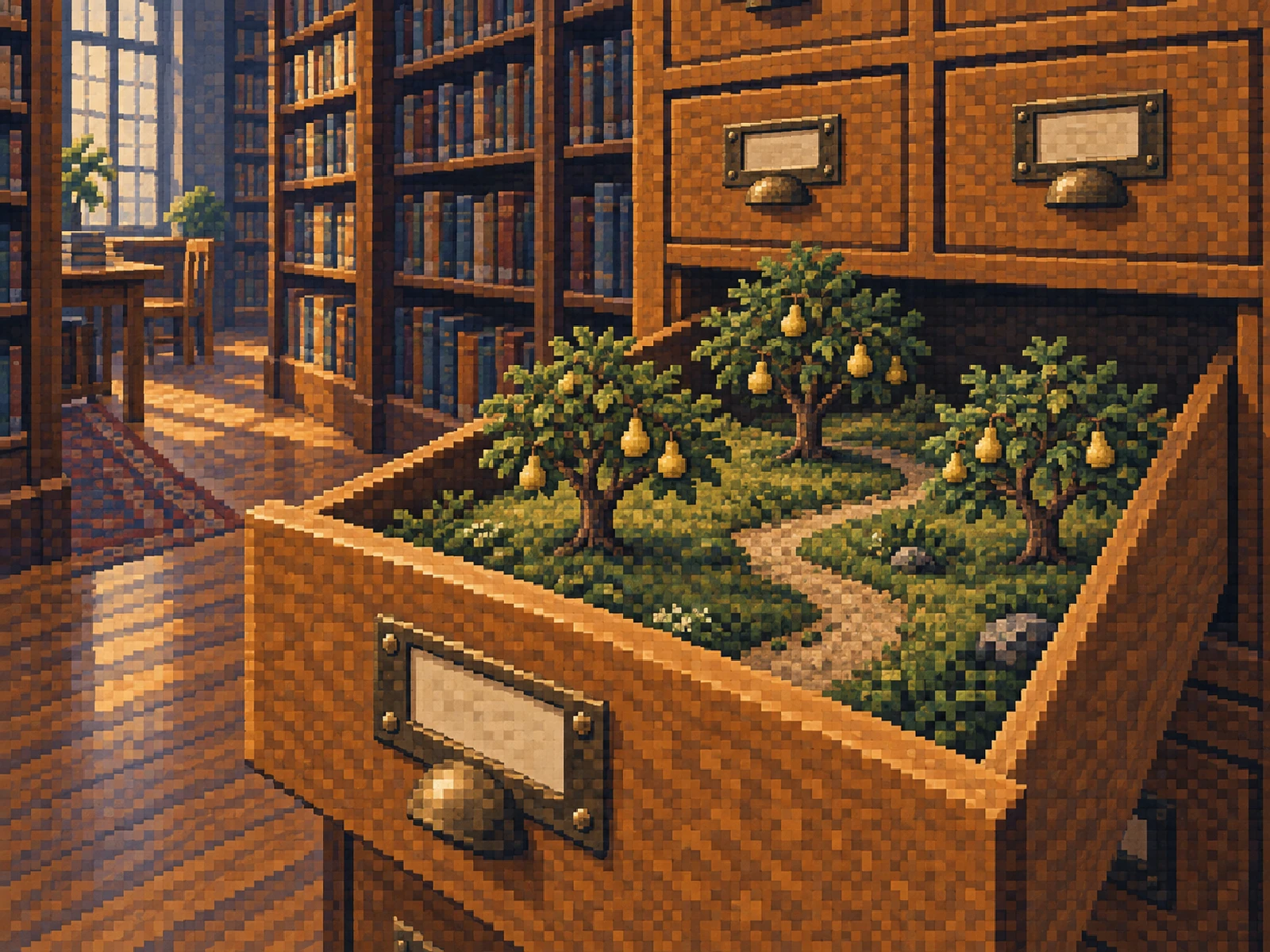
An open library catalog drawer reveals a miniature pear orchard. Interwoven pixel shapes and deliberate stepped edges reveal a small world hidden inside a familiar room.
Remix this referenceOrchard in the Catalog Drawer
- Form language
- Reduce forms to interlocking pixel clusters with a consistent coarse unit; vary cluster silhouettes so organic and built forms remain distinct.
- Contour
- Build deliberate staircase edges from uneven runs of square pixels; use occasional broken boundaries instead of continuous outlining.
- Mark-making
- Alternate short horizontal and vertical pixel bars in loose over-and-under rhythms, with natural interruptions that suggest a woven image.
- Surface rendering
- Turn tones through interwoven pixel bands and sparse dither bridges; preserve broad resting patches so the weave does not become uniform noise.
Priority
The woven pixel construction and deliberately low-resolution edges must remain visibly legible.
What to avoid & what to check
Exact prompt for this example
MODULE OWNERSHIP
subject: Subject count, type, stable proportions and landmarks, resting face geometry, hair shape, physical materials, garment construction and permanent marks. No emotion, movement, color assignment or rendering recipe.
expression: Facial soft-tissue displacement and pupil direction, muscle coordination, regional intensity, asymmetry and onset/peak/release. No head/body pose, stable appearance, skin color or rendering.
gesture: Head/neck/body/limb orientation, joint movement, support, contact and pose-caused occlusion using existing anatomy. No eye/pupil movement, emotion, identity, props inventory or camera.
props: Prop count, type, construction, physical material and scale relative to the subject. Holding/contact belongs to gesture, position to composition, color to palette.
scene: Environment elements, terrain, backdrop/floor presence and structural detail. No canvas positions, camera, lighting, assigned colors or render texture.
camera: Projection, focal-length impression, camera elevation/yaw/roll, viewing distance and crop. No actor pose, world placement, lighting or canvas aspect ratio.
composition: Normalized 0-100% canvas positions, scale in frame, depth/overlap, focal hierarchy and margins. No joint pose, camera projection, rendering, subject/prop inventory or emotion.
palette: Color anchors, hue/saturation/value ranges, colors assigned to parts and approximate color coverage. No illumination direction, shading algorithm, physical material or layout.
lighting: Light-source direction/softness/intensity, ambient illumination, physical shadow direction/length and highlight position. Absence of directional illumination is allowed. No shading technique, palette or material changes.
style: Reusable form abstraction, contour weight/taper/edge quality, medium and mark scale/density/direction, surface rendering and tonal transition technique. No fixed subject proportions, anatomy, identity, expression, pose, palette, light-source direction, camera or layout.
output: Image count, aspect ratio, size, file/alpha requirements and global lettering/logo/watermark restrictions. No background scenery, crop, style, identity or pose.

SUBJECT
inventory: Three miniature mature pear trees with sparse attached fruit; no people or animals.
geometry: Short branching trunks support broad, irregular crowns; recognizable pear fruit widens beneath a narrow neck.
resting-face: No faces or facial landmarks apply.
appearance: Woody trunks have fissured bark, thin leaf blades and firm fruit skins; branch and leaf details may vary naturally.

PRIORITY


AVOID


CHECK


PROPS
inventory: One ordinary-size library card-catalog cabinet, large relative to the miniature trees.
construction: A timber cabinet has shallow box drawers, inset fronts and small metal label holders with blank inserts.

PRIORITY


AVOID


CHECK


SCENE
inventory: A quiet library contains book-filled shelves, a tall window and a wooden floor; miniature turf and a path form the orchard terrain.
structure: The library has a narrow aisle; the orchard terrain is gently uneven, with a winding path.

PRIORITY


AVOID


CHECK


CAMERA
projection: Use natural perspective with a moderately wide focal-length impression and restrained convergence.
viewpoint: Look diagonally down from slightly above cabinet height, close enough to read the drawer interior; keep the view level.
crop: Include the whole extended drawer and most of the cabinet, with enough surrounding room to establish the library.

PRIORITY


AVOID


CHECK


COMPOSITION
placement: One drawer extends forward into the lower-right half, with the entire orchard, turf and path inside it; the aisle opens toward the upper left.
depth: The cabinet rises behind the drawer; its rim overlaps the orchard ground, with crowns separated against cabinet planes and receding shelves.
spacing: Make the orchard the first read and the ordinary drawer its scale cue; leave breathing room around their contrast.

PRIORITY


AVOID


CHECK


PALETTE
colors: Use deep indigo, muted amber, moss green and pale butter yellow, with mostly subdued saturation.
assignment: Assign amber to the cabinet and floor, indigo to shelves and recesses, green to foliage and turf, and yellow to pears.
balance: Amber and indigo occupy most of the image; green forms a compact accent and pale yellow appears sparingly.

PRIORITY


AVOID


CHECK


LIGHTING
sources: Broad, soft window light enters from the left, with gentle ambient illumination throughout the room.
shadows: Soft shadows extend rightward; the drawer cavity remains dimmer, with short contact shadows beneath the trees.
highlights: Quiet highlights touch left-facing crown surfaces, the upper drawer lip and small portions of the metal holders.

PRIORITY


AVOID


CHECK


STYLE GUIDE
form-language: Reduce forms to interlocking pixel clusters with a consistent coarse unit; vary cluster silhouettes so organic and built forms remain distinct.
contour: Build deliberate staircase edges from uneven runs of square pixels; use occasional broken boundaries instead of continuous outlining.
mark-making: Alternate short horizontal and vertical pixel bars in loose over-and-under rhythms, with natural interruptions that suggest a woven image.
surface-rendering: Turn tones through interwoven pixel bands and sparse dither bridges; preserve broad resting patches so the weave does not become uniform noise.

PRIORITY
The woven pixel construction and deliberately low-resolution edges must remain visibly legible.

AVOID


CHECK


OUTPUT
format: Deliver one finished illustration as an opaque PNG, landscape 4:3, at 1600 × 1200 pixels.
restrictions: No lettering, logos, signatures or watermarks.

PRIORITY


AVOID


CHECK


FINAL INTEGRATION
subject + props + scene + composition: Let the botanical forms and familiar furnishing establish the scale surprise together, while the surrounding room supplies recognition.
style + palette + lighting: Translate the assigned colors and visible illumination into the woven pixel language while retaining clear tonal separation.
Model information comes from image provenance. The same prompt may produce a different result.