Text to imageComicsStyle guide
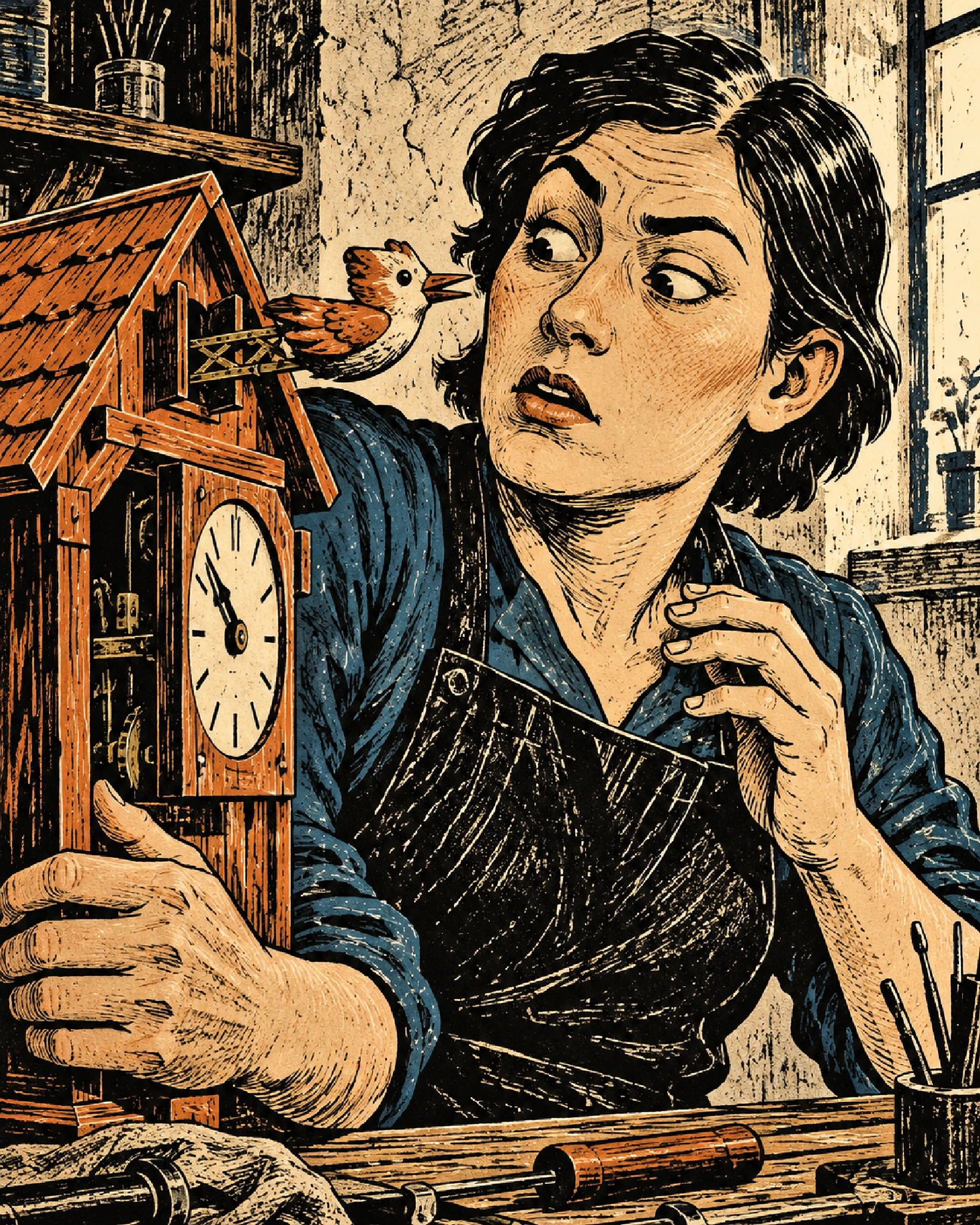
Cuckoo at Her Nose
A clock repairer meets the mechanical cuckoo almost nose to beak. Rough woodcut marks and bold ink masses capture the brief, comic surprise.
Remix this referenceCuckoo at Her Nose
- Form language
- Reduce forms to interlocking angular planes and blunt curves, letting small irregularities disrupt otherwise decisive silhouettes.
- Contour
- Use broad, slightly broken outer contours and thin splintered inner cuts; edges should feel carved rather than smoothly traced.
- Mark-making
- Cluster short gouges into bending rhythms, alternating sparse open passages with forceful hatch bundles; vary cuts naturally.
- Surface rendering
- Build tone from dense ink masses and exposed paper cuts, with uneven ink bite and restrained block misregistration at selected edges.
Priority
Rendering medium: woodcut graphic-novel illustration.
What to avoid & what to check
Exact prompt for this example
MODULE OWNERSHIP
subject: Subject count, type, stable proportions and landmarks, resting face geometry, hair shape, physical materials, garment construction and permanent marks. No emotion, movement, color assignment or rendering recipe.
expression: Facial soft-tissue displacement and pupil direction, muscle coordination, regional intensity, asymmetry and onset/peak/release. No head/body pose, stable appearance, skin color or rendering.
gesture: Head/neck/body/limb orientation, joint movement, support, contact and pose-caused occlusion using existing anatomy. No eye/pupil movement, emotion, identity, props inventory or camera.
props: Prop count, type, construction, physical material and scale relative to the subject. Holding/contact belongs to gesture, position to composition, color to palette.
scene: Environment elements, terrain, backdrop/floor presence and structural detail. No canvas positions, camera, lighting, assigned colors or render texture.
camera: Projection, focal-length impression, camera elevation/yaw/roll, viewing distance and crop. No actor pose, world placement, lighting or canvas aspect ratio.
composition: Normalized 0-100% canvas positions, scale in frame, depth/overlap, focal hierarchy and margins. No joint pose, camera projection, rendering, subject/prop inventory or emotion.
palette: Color anchors, hue/saturation/value ranges, colors assigned to parts and approximate color coverage. No illumination direction, shading algorithm, physical material or layout.
lighting: Light-source direction/softness/intensity, ambient illumination, physical shadow direction/length and highlight position. Absence of directional illumination is allowed. No shading technique, palette or material changes.
style: Reusable form abstraction, contour weight/taper/edge quality, medium and mark scale/density/direction, surface rendering and tonal transition technique. No fixed subject proportions, anatomy, identity, expression, pose, palette, light-source direction, camera or layout.
output: Image count, aspect ratio, size, file/alpha requirements and global lettering/logo/watermark restrictions. No background scenery, crop, style, identity or pose.

SUBJECT
inventory: One adult woman, a clock repairer; actor A.
geometry: A sturdy build with broad hands, a square chin, a long nasal bridge and prominent rounded ears.
resting-face: Straight brows, deep-set almond eyes and a wide mouth with a shallow central dip in the upper lip.
appearance: Short wedge-shaped hair tucked behind the ears; a canvas apron over a collarless woven shirt. Minor folds may vary.

PRIORITY


AVOID


CHECK


EXPRESSION — ACTOR A
brows: The right brow lifts into an arch; the left rises only slightly.
lids: Upper lids lift unevenly, with a little more opening in the nearer eye.
cheeks: Cheeks remain mostly loose, with faint tension beside the mouth.
nose: The nose stays unwrinkled and the nostrils remain relaxed.
mouth: Lips part into a small uneven oval, one corner held slightly higher.
jaw: The jaw releases only a little, keeping the reaction compact.
gaze: Both pupils turn toward the nearby beak with mild inward convergence.
coordination: The quick upper-face opening leads the smaller mouth response.
timing: Catch the first instant of surprise, before it becomes a broad reaction.

PRIORITY


AVOID


CHECK


GESTURE
head: A draws her head back, shortening the neck and tucking the chin slightly.
torso: Her upper torso withdraws from a forward bend, one shoulder trailing behind the other.
limbs: One forearm stays extended; the other hand pauses near her collarbone with loosely spread fingers.
contact: Her extended palm braces the clock case against the bench; the bird and her nose do not touch.

PRIORITY


AVOID


CHECK


PROPS
inventory: One cuckoo clock, its case roughly the size of A's head, with an integrated mechanical bird.
construction: A timber case with an open service panel, a plain dial and a carved bird with a wooden beak on an extendable brass slider.

PRIORITY


AVOID


CHECK


SCENE
inventory: A small repair workshop with a plaster wall, a shallow window recess and a workbench.
structure: The thick window reveal and broad bench board provide just enough architectural context.

PRIORITY


AVOID


CHECK


CAMERA
projection: Natural perspective with a normal-lens impression and little near-field distortion.
viewpoint: Eye-level, three-quarter view from A's left, at intimate conversational distance; no roll.
crop: Close crop through the crown, upper torso and outer clock edge; retain both hands and the complete beak.

PRIORITY


AVOID


CHECK


COMPOSITION
placement: The face dominates the right half; the clock rises from the lower left, its beak almost meeting the nose.
depth: The clock overlaps the apron in the foreground; the face sits behind it and the wall recedes quietly.
spacing: Make the narrow nose-to-beak gap the focal hinge; leave an open wedge above the clock and room around the raised hand.

PRIORITY


AVOID


CHECK


PALETTE
colors: Soot black, warm bone, muted petrol blue and a small burnt-orange accent.
assignment: Bone skin and wall, petrol-blue shirt, black hair and apron, orange clock case with bone dial and bird.
balance: Bone and black occupy broad areas; blue stays subdued and orange supplies the concentrated warm accent.

PRIORITY


AVOID


CHECK


LIGHTING
sources: Broad, moderately strong window light enters from upper right with gentle room ambience.
shadows: Soft-edged shadows fall down-left beneath the chin, clock ledge and supporting hand.
highlights: Broad highlights touch the right temple, nose ridge and upper edge of the clock.

PRIORITY


AVOID


CHECK


STYLE GUIDE
form-language: Reduce forms to interlocking angular planes and blunt curves, letting small irregularities disrupt otherwise decisive silhouettes.
contour: Use broad, slightly broken outer contours and thin splintered inner cuts; edges should feel carved rather than smoothly traced.
mark-making: Cluster short gouges into bending rhythms, alternating sparse open passages with forceful hatch bundles; vary cuts naturally.
surface-rendering: Build tone from dense ink masses and exposed paper cuts, with uneven ink bite and restrained block misregistration at selected edges.

PRIORITY
Rendering medium: woodcut graphic-novel illustration.

AVOID


CHECK


OUTPUT
format: One finished illustration, portrait 4:5, 1600 × 2000 pixels, opaque PNG.
restrictions: No lettering, speech balloons, numerals, logos or watermarks.

PRIORITY


AVOID


CHECK
Model information comes from image provenance. The same prompt may produce a different result.